Key takeaways
- Compare the best camping coffee percolators for camp stoves and open fires, with stainless, enamel, and aluminum picks in 8 to 12 cup sizes.
- Top Pick: COLETTI Bozeman Percolator Coffee Pot (12 Cup)
- Runner-up: Coleman Stainless Steel Coffee Percolator (12 Cup)
- Also consider: Farberware Classic Yosemite Percolator (8 Cup)
Quick answer: The COLETTI Bozeman 12 Cup is the strongest all-around camping percolator here, with an all-stainless brew path, a glass view top, and a 60 fl oz capacity. The Coleman 12 Cup Stainless Steel Percolator is the proven group-camping classic, the Farberware Classic Yosemite covers smaller crews in polished stainless, the GSI Outdoors Enamelware pot brings classic speckled style to the fire, and the Primula Today is the lightest budget pick at just 12 ounces.
As an Amazon Associate, we earn from qualifying purchases.
Table of Contents
- Why Campers Still Brew With a Percolator
- How to Choose
- Quick Comparison
- 1. COLETTI Bozeman Percolator Coffee Pot (12 Cup)
- 2. Coleman Stainless Steel Coffee Percolator (12 Cup)
- 3. Farberware Classic Yosemite Percolator (8 Cup)
- 4. GSI Outdoors Enamelware Percolator Coffee Pot (8 Cup)
- 5. Primula Today Aluminum Stove Top Percolator (9 Cup)
- Fit and Camp Checks
- FAQ
- Conclusion
- Product and ASIN Reference
Why Campers Still Brew With a Percolator
A percolator brews coffee by cycling heated water up a hollow stem and over a basket of grounds, again and again, until the liquid in the pot reaches the strength you want. There is no cord, no pump, and no paper filter requirement, which is exactly why the design keeps its place in camp kitchens. A percolator works anywhere you can make heat: a two-burner camp stove, a grill grate, a bed of coals at the edge of a fire, or a kitchen burner at home during a power outage.
The clear knob on the lid is the control panel. As the water cycles, the liquid bubbling up into the knob darkens, and that color tells you when to pull the pot off the heat. A gentle, steady perk builds flavor without boiling the coffee into bitterness, so most percolator technique comes down to heat management rather than settings.
One sizing habit matters before anything else in this guide. Percolator makers measure a cup as 5 fl oz, the same convention used on most drip coffee makers. A 12-cup pot therefore brews 60 fl oz, which fills about five generous 12 oz camp mugs. Keep that conversion in mind and the capacities below will match what actually lands in your mug.
How to Choose
Start with capacity. Solo campers and couples are well served by an 8 or 9 cup pot, while groups of four or more coffee drinkers should look at the 12 cup models, remembering that the cup count is measured in 5 oz pours. A pot that is too large wastes fuel and water on small trips, and a pot that is too small leaves the last person in line waiting for a second brew cycle.
Material decides how the pot ages. Stainless steel resists corrosion, shrugs off soot, and does not hold flavors from one brew to the next, which is why three of the five picks here use it. Enameled steel brings the classic speckled camp look over a heavy-gauge steel core, but the enamel can chip if the pot takes a hard knock on rock or concrete. Aluminum is the lightest and heats quickly, though it needs hand washing and a little more care to keep its finish.
Check the knob and the handle next. A glass view top lets you judge brew strength by color, while a resin cap trades a little clarity for resistance to breaking. Handles vary just as much: silicone-wrapped and wooden handles stay more comfortable over a flame than bare steel, and any handle should sit far enough from the pot body that a gloved hand can grip it while the pot is hot.
Finally, confirm the heat sources the listing supports. Most of these pots are listed for gas stoves and campfires, but induction is the common exception, and at least one pick below is specifically listed as not induction compatible. If your camp stove is a small backpacking burner, also compare the pot’s base diameter with the burner head and pot supports so the pot sits stable when full.
Quick Comparison
| Product | Capacity | Material | Weight | Tier |
|---|---|---|---|---|
| COLETTI Bozeman Percolator Coffee Pot (12 Cup) | 12 cups (60 fl oz) | Stainless steel | 2 lb | Premium |
| Coleman Stainless Steel Coffee Percolator (12 Cup) | 12 cups | Stainless steel | 2.37 lb | Mid-range |
| Farberware Classic Yosemite Percolator (8 Cup) | 8 cups | Stainless steel | 2.25 lb | Mid-range |
| GSI Outdoors Enamelware Percolator Coffee Pot (8 Cup) | 8 cups | Enameled steel | 1.26 lb | Budget |
| Primula Today Aluminum Stove Top Percolator (9 Cup) | 9 cups | Aluminum | 12 oz | Budget |
1. COLETTI Bozeman Percolator Coffee Pot (12 Cup)
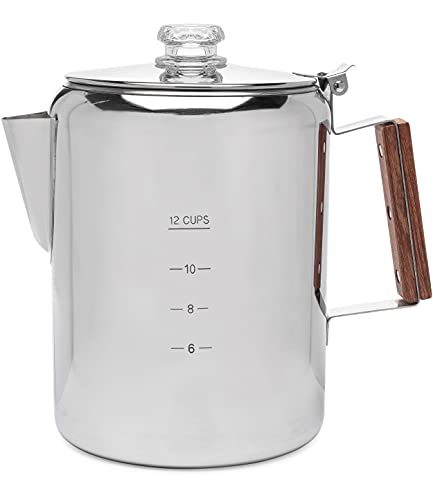
The Bozeman is built around a simple promise in its listing: no aluminum and no plastic in the brew path. The pot, basket, and stem are stainless steel components, the view top is glass, and the only non-metal touches are the wooden parts of the handle. For campers who want to watch the perk and keep every surface the coffee touches made of steel or glass, that construction is the whole argument.
Capacity is 12 cups by the percolator convention, which COLETTI itself translates in the listing to 60 fl oz, or about five 12 oz mugs. That makes the Bozeman a genuine group pot for a family campsite or a hunting camp, while the same listing family also offers smaller sizes for buyers who do not need the full volume. The listing states the pot is dishwasher safe and includes filter discs to help keep fine grounds out of the cup, a useful extra for anyone brewing with a finer grind than a percolator basket prefers.
Two limits belong in the decision. The listing states plainly that this percolator does not work on induction stovetops, so induction households should look at the brand’s separate induction model instead. The steel parts also get hot in use, as the listing warns, so a glove or pot holder is part of pouring. On a camp stove, grill, or campfire, though, the Bozeman’s heavy stainless build and glass top make it the most complete package in this roundup.
Specs
- Brand and model: COLETTI Bozeman Percolator Coffee Pot
- Tier: Premium
- Capacity: 12 cups (60 fl oz)
- Material: Stainless steel with glass view top and wooden handle parts
- Dimensions: 6.78 x 7.2 x 8.26 in
- Weight: 2 lb
- Notable: Dishwasher safe as listed; not for induction stovetops
2. Coleman Stainless Steel Coffee Percolator (12 Cup)

Coleman’s 12-cup percolator is the long-running camp standard, and its listing keeps the formula simple: a stainless steel pot with the base, tube, basket, and basket lid all included, so the box holds everything needed to brew with no separate filter purchase. The steel is described as corrosion resistant and easy to wipe down, a practical pairing for a pot that will live with soot, sap, and damp gear bins.
The side handle is shaped for pouring, and the top carries a replaceable glass knob, which matters on a product meant to last for years of trips: the most fragile part can be swapped rather than retiring the pot. At 2.37 lb it is the heaviest pot in this group, but that weight buys the joint-largest capacity here, a full 12 cups for big groups on a stove or grill.
The trade-offs are plain in the listing data. The pot is not listed as dishwasher safe, so cleanup is a rinse and wipe at the wash basin, and the steel handle calls for a glove when the pot comes straight off a hot grate. For car campers and RV travelers who brew for a crowd and value a simple, complete kit from a brand built around camp gear, those are easy compromises.
Specs
- Brand and model: Coleman Stainless Steel Coffee Percolator, model 2000016403
- Tier: Mid-range
- Capacity: 12 cups
- Material: Stainless steel
- Dimensions: 13 x 7 x 4.63 in (as published in the listing)
- Weight: 2.37 lb
- Notable: Base, tube, basket, and basket lid included; replaceable glass knob
3. Farberware Classic Yosemite Percolator (8 Cup)

The Yosemite is the polished kitchen classic of the group, a mirror-finished stainless pot sized for four to eight cups. Farberware’s listing highlights a non-reactive interior, so water and coffee do not pick up odors or tastes from earlier brews, and a permanent percolator filter basket that removes the need for paper filters entirely. The tight-fitting lid seals in heat while the see-through glass knob shows when percolating begins and ends.
For camp use, the details translate well. The listing rates the pot as gas stovetop compatible, the balanced handle is designed for a confident grip while pouring, and the whole percolator is fully immersible and dishwasher safe apart from the knob and pump tube spring, which makes post-trip cleanup at home simple. At 8 cups it suits a couple or a small family better than a basecamp crowd.
The honest limit is scale and setting. Eight 5 oz cups is about five modest mugs, so large groups will brew twice, and the polished finish shows camp soot more than a brushed or enamel surface. As a dual-duty pot that moves between the home stove and the camp stove without fuss, it earns its place.
Specs
- Brand and model: Farberware Classic Yosemite Percolator, model 50124
- Tier: Mid-range
- Capacity: 8 cups
- Material: Stainless steel, mirror finish
- Dimensions: 9.25 x 6.25 x 8.25 in
- Weight: 2.25 lb
- Notable: Permanent filter basket; dishwasher safe except knob and pump tube spring
4. GSI Outdoors Enamelware Percolator Coffee Pot (8 Cup)

GSI’s enamelware pot is the traditionalist’s pick: heavy-gauge steel under a speckled enamel finish, with a bright stainless steel rim. The product description states the enamel is kiln-hardened twice at one thousand degrees Fahrenheit to stand up to scratches and chipping, and the three-ply construction is there to spread heat evenly across the base. The viewing cap is unbreakable resin rather than glass, so a dropped lid on rocky ground is a smaller worry.
At 1.26 lb, this 8-cup pot is noticeably lighter than the stainless picks of similar capacity, which helps when the coffee kit rides in a tote with the rest of the kitchen. The listing positions it for open fire or gas stove use across campsite, cabin, and RV cooking, and the package includes the percolator and its insert, ready to brew.
Enamel’s known weakness still applies: a hard impact on stone or concrete can chip the finish even with the double kiln hardening, so the pot prefers a padded spot in the gear bin over rattling against cast iron. Buyers who love the classic camp-kitchen look and brew for two to four people will find that an acceptable trade.
Specs
- Brand and model: GSI Outdoors Enamelware Percolator Coffee Pot, model 25254
- Tier: Budget
- Capacity: 8 cups
- Material: Enameled steel with stainless steel rim
- Dimensions: 5.9 x 8 x 9 in
- Weight: 1.26 lb
- Notable: Resin viewing cap; listed for open fire or gas stove
5. Primula Today Aluminum Stove Top Percolator (9 Cup)

The Primula Today is the lightweight budget workhorse. Its aluminum body lists at just 12 ounces, less than half the weight of the enamel GSI and a third of the big stainless pots, and the listing credits the aluminum with spreading heat evenly for a quick, piping hot brew. For backpackers willing to carry a real pot, or car campers keeping the kitchen bin light, that weight gap is the headline.
The kit is complete out of the box: pot, lid, and a basket with a filter screen assembly, topped by a clear knob for watching the brew color, plus a lipped spout and a stay-cool black plastic handle. Primula’s own brewing guidance in the listing is one tablespoon of coffee per 5 ounces of water, a handy starting ratio for first-time percolator users. Capacity sits between the two groups at 9 cups.
Care is the compromise. The listing says the pot is not dishwasher safe, so it is hand wash only, and Primula suggests cleaning periodically with lemon juice and warm water to keep the aluminum bright. A one-year limited warranty is listed. For the lightest, simplest route into percolator coffee at camp, those are small chores.
Specs
- Brand and model: Primula Today Aluminum Stove Top Percolator, model TPA-3609
- Tier: Budget
- Capacity: 9 cups
- Material: Aluminum
- Dimensions: 5.2 x 8.15 x 8.23 in
- Weight: 12 oz
- Notable: Stay-cool plastic handle; hand wash only; one-year limited warranty as listed
Fit and Camp Checks
Before the first trip, run four quick checks. First, set the empty pot on your camp stove and confirm the base sits flat and stable on the pot supports; a full 12-cup pot carries about 60 fl oz of water, and a wobbly grate only gets worse with that load. Second, measure the pot’s height against your stove’s windscreen and your camp kitchen storage bin, since the tallest pots here stand a little over 9 in before the knob.
Third, do a water-only trial run at home. It confirms the stem and basket assemble correctly, shows how the knob looks at a gentle perk versus a hard boil, and lets you practice pulling the pot off the heat by color rather than by timer. Fourth, pack for the handle you chose: steel handles and lids get hot over a fire, so a glove or pot holder belongs in the coffee kit next to the grounds.
Finally, match the pot to your group’s real mug count, not the box number. Five campers with 12 oz mugs will empty a 12-cup percolator in one round, so groups larger than that should plan on a second brew cycle or step up to the biggest pot their stove can hold.
FAQ
How many mugs does a 12-cup percolator really fill?
Percolator cups are measured at 5 fl oz, so a 12-cup pot brews 60 fl oz of coffee. That fills about five 12 oz mugs, or six to seven smaller camp cups. The 8 and 9 cup pots in this guide brew 40 and 45 fl oz by the same measure.
Can these percolators go directly over a campfire?
The stainless and enamel picks here are listed for stove and fire use, and the Primula listing describes campfire brewing as well. Set the pot on a grate rather than in the flames, keep handles turned away from the heat, and expect soot on the exterior that wipes off steel and enamel more easily than polished finishes.
What grind and ratio work best in a percolator?
A coarse grind suits a percolator basket, since fine grounds can slip through the basket holes into the pot. Primula’s listing guidance of one tablespoon of coffee per 5 ounces of water is a sound starting point; add grounds for a stronger pot rather than perking longer, which can turn the brew bitter.
How should a camp percolator be cleaned after a trip?
Follow the listing for your model. The COLETTI and Farberware pots are listed as dishwasher safe, with the Farberware excluding its knob and pump tube spring, while the Coleman and the aluminum Primula call for hand washing. Every pot benefits from a full dry before storage so the basket and stem stay fresh for the next trip.
Conclusion
For most campers, the COLETTI Bozeman is the buy: an all-stainless brew path, a glass view top, and honest 60 fl oz group capacity in a pot built for stoves, grills, and fires. The Coleman 12 Cup remains the dependable crowd classic with every part included, and the Farberware Yosemite is the polished pick for smaller crews that split time between home and camp. The GSI Enamelware pot delivers the classic look at a light 1.26 lb, and the Primula Today keeps things simple and featherweight for budget-minded brewers. Match the capacity to your mug count, pick the material that fits how your gear gets treated, and any of these five will keep the campsite in coffee.