Key takeaways
- Compare the best trekking poles by shaft material, lock type, grip and weight, from a premium cork-grip pick to budget aluminum pairs for camp trails.
- Top Pick: Black Diamond Trail Ergo Cork Trekking Poles
- Runner-up: Foxelli Carbon Fiber Trekking Poles
- Also consider: Hiker Hunger Carbon Fiber Trekking Poles
The best trekking poles for most campers are the Cascade Mountain Tech Aluminum Quick Lock poles, because the 6061 aluminum shafts bend rather than snap under a sideways load, the cork grips carry an extended foam section for short climbs, and a tip kit is in the box. The premium pick is the Black Diamond Trail Ergo Cork, with an angled natural cork grip and the brand’s FlickLock Pro levers. The Foxelli and Hiker Hunger carbon fiber pairs are the light options at a published 7.6 ounces per pole, and the TrailBuddy is the budget 7075 aluminum pair with the longest accessory list at its tier.
Every pick below is described from its published specifications: shaft material, lock type, grip, length range, weight, and what arrives in the box. One boundary applies throughout. A trekking pole is only as trustworthy as its locks and its shaft, so the buying decision that matters is not the color or the strap padding; it is whether the lock holds the length you set under a full body load on a descent, and whether the shaft material matches how hard you are on gear. Set the length so your elbow sits near a right angle, plant the carbide tip before you trust it, and the category does its job.
As an Amazon Associate, we earn from qualifying purchases.
Table of Contents
- How to Choose Trekking Poles
- Quick Comparison
- 1. Black Diamond Trail Ergo Cork Trekking Poles
- 2. Foxelli Carbon Fiber Trekking Poles
- 3. Hiker Hunger Carbon Fiber Trekking Poles
- 4. TrailBuddy Trekking Poles
- 5. Cascade Mountain Tech Aluminum Quick Lock Trekking Poles
- Care, Setup and Safety Tips
- Frequently Asked Questions
- Conclusion
How to Choose Trekking Poles
Start with shaft material, because it decides how a pole fails. Aluminum shafts, used by the Black Diamond, TrailBuddy and Cascade Mountain Tech below, bend under a hard sideways load and can usually be bent back and walked out on. Carbon fiber shafts, used by the Foxelli and Hiker Hunger, are lighter and absorb more vibration, but a carbon shaft that is levered against a rock can snap instead of bending, and a snapped pole is a finished pole. Neither material is better in the abstract: aluminum suits rocky camps, scout groups and anyone who leans on poles hard, while carbon suits long trail days where swing weight is the thing that wears you down.
Next, check the lock, because the lock is the part that actually carries your weight. Every pick below uses an external lever lock, a clamp you flip open, slide the section, and flip shut. Lever locks can be adjusted with gloves on, can be re-tensioned with a small screw when they age, and show you at a glance whether they are closed. Whatever pair you buy, set both poles to your length at home, lean your full weight on each one, and confirm nothing creeps before the first trip. A lock that slips an inch at home will slip a foot on a wet descent.
Then match length range and packed size to your height and your pack. The pairs below extend to between 54 and 55 inches, which covers hikers well past six feet, and collapse to between 24 and 27 inches. The collapsed figure is the one to check against your pack: a 24 inch pole straps neatly to a daypack, while the 27 inch Black Diamond below rides outside a smaller pack or travels in a duffel. If you plan to pitch a tarp or a trekking-pole tent at camp, confirm the shelter’s required pole height falls inside your pair’s adjustment range before you rely on it.
Finally, read the grip and the accessory list. Cork grips, fitted to all five pairs below, mold to the hand over a season and stay grippy with sweaty palms; an extended foam section under the cork lets you choke down on short steep pitches without stopping to shorten the pole. Baskets and rubber tips are the consumables: trekking baskets keep tips out of trail cracks, snow baskets matter only in winter, and rubber tip covers are what you fit for pavement, slickrock and boardwalks, and they are the first part most hikers lose. A pair that ships with spares, as the Foxelli and Hiker Hunger do, saves a second order.
Quick Comparison
| Product | Shaft | Lock | Grip | Max length | Weight | Tier |
|---|---|---|---|---|---|---|
| Black Diamond Trail Ergo Cork | Aluminum | FlickLock Pro lever | Natural cork, angled | 140 cm (55 in) | 18 oz per pair | Premium |
| Foxelli Carbon Fiber | Carbon fiber | Quick flip lock | Cork | 54 in | 7.6 oz per pole | Mid-range |
| Hiker Hunger Carbon Fiber | 3K carbon fiber | Flip lock | Cork with EVA extension | 55 in per listing data | 7.6 oz per pole | Mid-range |
| TrailBuddy | 7075 aluminum | Lever lock | Cork with EVA | 54 in | 9.7 oz per pole | Budget |
| Cascade Mountain Tech Aluminum Quick Lock | 6061 aluminum | Quick lock lever | Cork with EVA extension | 54 in | 10 oz per pole | Budget |
1. Black Diamond Trail Ergo Cork Trekking Poles

The Trail Ergo Cork is the premium pick and the one built for hikers who put real load through their poles. The grip is the headline: natural cork set at a 15 degree corrective angle, so the wrist stays in a neutral position instead of cocking forward at every plant, with an EVA foam extension below it for choking down on climbs and a padded fusion comfort strap. The shafts are three-section aluminum, adjusted by dual FlickLock Pro levers, the brand’s metal lever system, which can be re-tensioned as it wears and operated with gloves on.
Published data puts the pair at 1 pound 2 ounces, with a collapsed length of 27 inches and a full extension of 140 centimeters, about 55 inches, which is the longest reach in this guide and the reason tall hikers and tarp pitchers end up here. The tips are interchangeable carbide Tech Tips, trekking baskets are fitted, and the poles are snow basket compatible for four-season use per the brand’s published description. The honest trade is packed size: at 27 inches collapsed, this pair does not disappear into a small pack, and aluminum will never match the carbon pairs below on swing weight. What you get instead is the strongest lock-and-grip package here and a shaft that bends rather than breaks.
Specs
- Model: BD1121530000ALL1 (per the Amazon product information block)
- Shaft: Aluminum, three-section
- Lock: Dual FlickLock Pro lever locks
- Grip: Natural cork at a 15 degree ergonomic angle, EVA foam extension
- Strap: Padded fusion comfort strap
- Tips: Interchangeable carbide Tech Tips
- Baskets: Trekking baskets fitted; snow basket compatible
- Usable length: Up to 140 cm (55 in) per published data
- Collapsed length: 27 in (69 cm)
- Weight: 1 lb 2 oz (18 oz) per pair per published data
- Warranty: Not stated in the sources checked
2. Foxelli Carbon Fiber Trekking Poles

The Foxelli pair is the light pick that still arrives as a complete kit. The shafts are carbon fiber, the grips are cork, and the length is set by quick flip locks, with a published range from 24 inches folded to 54 inches extended. The brand’s published weight is 7.6 ounces per pole, the joint lightest figure in this guide, and that is the entire argument for the pair: on a long approach to a backcountry camp, a few ounces saved at the end of each arm is the difference between poles that get carried and poles that get left in the car.
What separates the Foxelli from other light carbon pairs is the accessory set. The listing data describes an all-terrain accessory package with spare tips and baskets and a carry case, which covers the small parts every hiker loses first: a rubber tip on slickrock, a basket in a root tangle. The honest limit is the carbon itself. The brand’s own category guidance applies: carbon is stiff and light, and it is the wrong material to lever against a boulder or to catch a falling body sideways. Hike within that limit and this is the pair that disappears in the hand; the model number in the listing data is HOG1.
Specs
- Model: HOG1 (per the Amazon product information block)
- Shaft: Carbon fiber
- Lock: Quick flip locks
- Grip: Cork
- Length: 24 in folded to 54 in extended
- Weight: 7.6 oz per pole per the brand’s published data
- Included: All-terrain accessory set with spare tips and baskets, carry case, per the listing data
- Color shown in listing data: Black
- Warranty: Not stated in the sources checked
3. Hiker Hunger Carbon Fiber Trekking Poles

The Hiker Hunger pair is the second carbon option, built on a 3K carbon fiber shaft with the same published 7.6 ounces per pole as the Foxelli, and it differentiates on the details around the grip. The cork grip is shaped to the hand, an EVA foam extension sits under it for steep pitches, and the straps are neoprene padded to avoid chafing on long days, a small thing that matters at mile fifteen. The tips are tungsten carbide, and the locks are quick-adjust flip locks.
The accessory list is the joint longest here: the listing data for the line includes a carry bag, two mud baskets, two snow baskets, two rubber tips and two rubber feet, so the pair covers mud season, snow season and pavement out of one box. One figure needs care. The Amazon listing data gives an extended length of 55 inches, while some published coverage of the same poles lists 54 inches; either way the pair collapses to 24 inches, the joint shortest packed size in this guide, which is why this is the carbon pair to strap to a small pack. Like the Foxelli, the shafts carry the carbon warning: strong along their length, vulnerable to a sideways snap, and not the pair to lend to a beginner who will fall on them.
Specs
- Model: HHO-CF-TP (part number in the listing data)
- Shaft: 3K carbon fiber
- Lock: Quick-adjust flip locks
- Grip: Cork with EVA foam extension
- Strap: Neoprene padded
- Tips: Tungsten carbide
- Extended length: 55 in per the listing data (some published coverage lists 54 in)
- Collapsed length: 24 in
- Weight: 7.6 oz per pole per the brand’s published data
- Included: Carry bag, 2 mud baskets, 2 snow baskets, 2 rubber tips, 2 rubber feet, per the listing data
- Warranty: Not stated in the listing data reviewed
4. TrailBuddy Trekking Poles

The TrailBuddy is the budget aluminum pair with the strongest shaft alloy in this guide. The shafts are 7075 aircraft-grade aluminum, the stronger of the two common pole alloys, and the brand’s own description makes the case plainly: aluminum does not perform as carbon does under weight, but it holds up far better under lateral pressure, which is the load a pole actually sees when it wedges between rocks. The handles are cork with EVA, the tips are tungsten carbide, and the locks are lever locks that a gloved hand can work.
The published length range runs from 24.5 inches collapsed to 54 inches extended, and the brand’s published weight is 9.7 ounces per pole, which matches the 1.21 pound pair weight in the listing data. A nylon carry bag is included, and the brand’s published set contents add mud baskets, snow baskets and rubber tips. One caution from the listing data reviewed for this guide: recent crawls of this model’s Amazon page showed no featured offer in the summary area while other sellers were present, so confirm a live offer from a seller you trust before ordering. For a first pair, a scout troop, or a camper who will lend poles out, this is the combination of alloy, accessories and simplicity to beat.
Specs
- Model: 1A (part number in the listing data)
- Shaft: 7075 aircraft-grade aluminum
- Lock: Lever locks
- Grip: Cork with EVA
- Tips: Tungsten carbide
- Length: 24.5 in collapsed to 54 in extended
- Weight: 9.7 oz per pole per the brand’s published description (1.21 lb per pair in the listing data)
- Included: Nylon carry bag; mud baskets, snow baskets and rubber tips per the brand’s published set contents
- Warranty: 1 year limited warranty per the brand’s published description
5. Cascade Mountain Tech Aluminum Quick Lock Trekking Poles
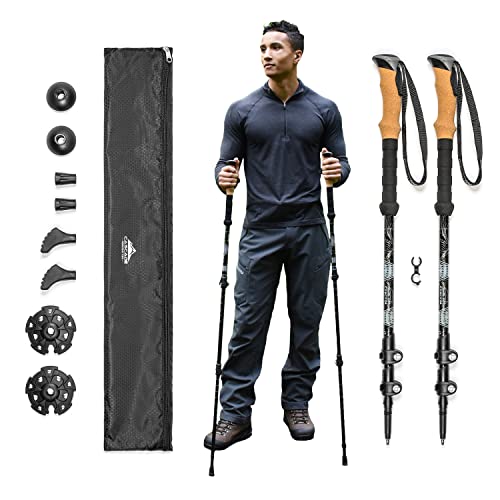
The Cascade Mountain Tech pair is the all-round recommendation, and it earns that spot on the grip and the shaft alloy working together. The shafts are 6061 aircraft-grade aluminum with quick lock levers, and the cork grip carries an extended EVA down grip, the feature usually reserved for pricier poles: on a short steep pitch you slide your hand down the foam instead of stopping to work the locks, and on the descent you come back up to the cork. The tip is tungsten carbide, and a tip kit is included in the box, so the rubber covers and baskets that wear out first are covered from day one.
The listing data gives an extended length of 54 inches and a published weight of about 10 ounces per pole, the heaviest per-pole figure here by a small margin, which is the honest price of the aluminum build and the extended grip. In return you get the shaft that survives being stepped on at camp, sat on in a trunk, and levered out of a crack, and a brand that sells replacement sections and tips as spare parts across its line. The model in the listing data is the cork-grip version, TP-AL-QL-CORK-LB-3. For car campers and newer hikers who want one pair that handles trails, tarp pitches and camp chores without a fragile shaft to nurse, this is the pair to buy first.
Specs
- Model: TP-AL-QL-CORK-LB-3 (per the Amazon product information block)
- Shaft: 6061 aircraft-grade aluminum
- Lock: Quick lock levers
- Grip: Cork with extended EVA down grip
- Tip: Tungsten carbide; tip kit included
- Extended length: 54 in per the listing data
- Collapsed length: Not stated in the sources checked
- Weight: About 10 oz per pole per published listing coverage
- Warranty: Not stated in the sources checked
Care, Setup and Safety Tips
Set the length before the trip, not at the trailhead. Stand in your hiking shoes, hold the grip with the tip on the ground, and adjust until your elbow sits near a right angle; then set the second pole to the same marks. Shorten both poles by an inch or two for long climbs and lengthen them for descents, and re-check the lever tension after the first mile, because a new lock that was set gently at home can creep under real load. Before any trip where a fall would matter, plant each pole and lean your full weight on it. A lock that slips on the porch is a free lesson; the same slip on a scree slope is not.
Treat the shafts according to their material. Aluminum poles that bend in a fall can often be straightened enough to walk out on, and a bent section is a replacement part, not a ruined trip. Carbon poles need an inspection habit instead: run a hand down each shaft after any fall or rock strike, and retire a pole with a visible crack, a soft spot, or frayed fibers, because carbon gives little warning before it lets go. Keep carbide tips covered with the rubber feet on pavement, slickrock and wooden boardwalks, where bare carbide skates and scars the surface, and swap baskets to match the ground: small trekking baskets for summer trails, wide snow baskets before winter camps.
On recalls: none of the five models in this guide is subject to a CPSC recall. The recent fall-hazard recall in the wider mountain gear category covered C.A.M.P. brand ice axes, a different product type from a different maker, recalled because a handle screw could loosen; it does not touch any pole here. That is exactly why the check should match the full model name rather than the product category. Search the exact model against the CPSC database before you buy, and remember that a trekking pole is a balance aid, not a climbing tool: it is not rated to arrest a fall, hold a rope load, or substitute for an ice axe on steep snow.
Frequently Asked Questions
How long should trekking poles be for my height?
Set them so your elbow bends at roughly a right angle with the tip planted beside your foot. As a starting point, hikers around five feet tall usually land near 100 centimeters, hikers near six feet near 120 centimeters, and tall hikers should confirm a pair reaches 54 inches or more, which every pair in this guide does. If you pitch a tarp or a trekking-pole shelter at camp, check the shelter’s required pole height against the pair’s range before the trip, and remember that a longer maximum also matters on descents, where most hikers run their poles an inch or two longer than the flat-ground setting.
Are carbon fiber or aluminum trekking poles better for camping?
It depends on how the poles will be treated. Carbon fiber, in the Foxelli and Hiker Hunger pairs here, is lighter at a published 7.6 ounces per pole and absorbs more trail vibration, which suits long hiking days between camps. Aluminum, in the Black Diamond, TrailBuddy and Cascade Mountain Tech pairs, is heavier per pole but bends instead of snapping under a sideways load, and it tolerates camp life better: being stepped on, tossed in a trunk, or used to prop a tarp in wind. For a dedicated backpacking pair, carbon earns its weight saving; for a general camp pair that gets lent out and knocked around, aluminum is the safer buy.
Can I pitch a tarp or tent with trekking poles?
Yes, if the shelter is designed for it and the pole reaches the required height. Many tarps and some ultralight tents pitch on two adjustable poles set tip-up or handle-up, and the pairs here extend to between 54 and 55 inches, which covers most tarp ridge heights and many trekking-pole tents. Two things to confirm first: the shelter’s specified pole length must fall inside your pair’s adjustment range with the lock fully engaged, not at its last notch, and a carbon shaft should not be the pole you tension a ridgeline against in high wind, because the load is sideways. Aluminum pairs like the TrailBuddy and Cascade Mountain Tech are the better shelter poles.
How do I stop trekking pole locks from slipping?
Start by closing the lever fully; a half-closed lever is the most common cause. If a pole still creeps, open the lever and turn its tension screw a quarter turn at a time, closing and load-testing between adjustments, until the section holds a full body lean without moving. Clean grit out of the clamp and off the shaft sections, because sand in the joint defeats the clamp, and dry the sections before collapsing the poles for storage so the locks are not stored under tension against damp metal. If a lock still slips after tensioning and cleaning, the clamp is worn and the section should be serviced or replaced before the pole is trusted on a descent.
Conclusion
Match the pole to the load and the camp. The Black Diamond Trail Ergo Cork is the premium answer for hikers who lean hard on their poles, with the angled cork grip, FlickLock Pro levers and the longest extension here. The Foxelli and Hiker Hunger carbon pairs tie on published weight at 7.6 ounces per pole; take the Foxelli for its accessory kit, or the Hiker Hunger for the padded straps, the 24 inch packed size and the longest included-parts list. The TrailBuddy is the budget pair with the strongest shaft alloy, and the Cascade Mountain Tech Aluminum Quick Lock is the all-round buy, with the extended foam grip and tip kit that make it the easiest first pair to live with. Whichever you choose, set the length at home, load-test both locks, and check the exact model against the CPSC database before the first trip.