Key takeaways
- Compare the best pickleball balls for outdoor courts, from the Franklin X-40 and Dura Fast 40 to the Selkirk Pro S1, with holes, weights, and pack sizes.
- Top Pick: Franklin Sports X-40 Outdoor Pickleballs, 12 Pack
- Runner-up: Dura Fast 40 Pickleballs, 6 Pack
- Also consider: Selkirk Pro S1 Pickleball Balls, 12 Pack
The best pickleball balls are outdoor balls built to a single regulation pattern: a hard plastic shell of about 2.9 in across, weighing a little under an ounce, pierced by roughly 40 small holes that keep the flight straight in wind and the bounce honest on rough asphalt and acrylic. Within that shared pattern, the five balls below split by temperament. Some are hard and fast, built for tournament pace. Some are softer and slower, built for long rallies and cold mornings. One carries a no-crack warranty, and one is weighted a touch heavier so an exposed court plays fair. All five are approved by USA Pickleball for sanctioned outdoor play, so any of them can go from a driveway game to a tournament draw without a rulebook argument.
Short on time? The Franklin X-40 is the default pick, the official ball of the US Open Pickleball Championships and the ball most outdoor groups already play. The Dura Fast 40 is the fast tournament pick, harder and quicker off the paddle than anything else here. The Selkirk Pro S1 is the durability pick, with a patented 38-hole pattern and a one-year no-crack warranty. The Onix Pure 2 is the wind pick, weighted heavier and seam-welded against splitting, and the Onix Fuse G2 is the soft pick, the gentlest ball of the five and the one that stays playable longest into cold weather. One scope note before the picks: every ball below is an outdoor ball. Indoor balls are a different product, softer with 26 larger holes, and the buying guide explains the split before the reviews so a first-time buyer orders the right box.
As an Amazon Associate, we earn from qualifying purchases.
Table of Contents
- How to Choose a Pickleball Ball
- Quick Comparison
- 1. Franklin Sports X-40 Outdoor Pickleballs, 12 Pack
- 2. Dura Fast 40 Pickleballs, 6 Pack
- 3. Selkirk Pro S1 Pickleball Balls, 12 Pack
- 4. Onix Pure 2 Outdoor Pickleball Balls, 6 Pack
- 5. Onix Fuse G2 Outdoor Pickleball Balls, 6 Pack
- Care, Storage, and When to Retire a Ball
- FAQ
- Conclusion
How to Choose a Pickleball Ball
Start with the court: outdoor balls and indoor balls are different products
Outdoor balls use a hard shell and about 40 small holes. The hard shell survives abrasive asphalt and acrylic, and the small holes give the wind less to grab, so the ball holds its line on an exposed court. Indoor balls use a softer shell and 26 larger holes, which suits smooth gym and wood floors: the ball grips the polished surface, bounces lower and slower, and makes less noise. The two are not interchangeable in any useful sense. An indoor ball outdoors feels mushy, wears fast, and blows around; an outdoor ball indoors skids on a gym floor and bounces too lively for the smaller space. Every pick in this roundup is an outdoor ball, so if your group plays in a recreation center gym, treat this guide as the outdoor half of the decision and shop the 26-hole indoor pattern separately.
Construction: one-piece molded or two-piece welded
Most outdoor balls are made one of two ways. A one-piece ball is rotationally molded as a single shell and then drilled, so there is no seam anywhere in the structure; the Franklin X-40, the Dura Fast 40, and the Selkirk Pro S1 are all built this way. A two-piece ball is molded as two hemispheres and joined with a welded seam, the method behind the Onix Pure 2 and Fuse G2. Neither method is automatically better. One-piece balls have no seam to split, but a hard one-piece shell can crack outright in cold weather. A welded seam is a visible line around the ball, yet a well-made weld flexes instead of fracturing, and Onix publishes its seam welding as the reason its balls resist splitting. Read construction together with hardness: the harder the ball, the more the failure mode matters.
Holes: count, size, and pattern
Hole count is the quickest spec to compare. The mainstream outdoor pattern is 40 holes, shared by the X-40, the Dura Fast 40, and the two Onix balls in retailer data. The Dura varies the pattern by drilling two hole sizes, larger and smaller holes mixed around the shell, which the maker credits for its true, straight flight. The Selkirk Pro S1 breaks from the pattern entirely with 38 holes in a patented aerodynamic layout, trading the standard count for a flight the maker says stays consistent shot after shot. Smaller holes generally mean a faster, harder-feeling ball that wind pushes around less; that is why outdoor balls use many small holes while indoor balls use fewer, larger ones. What matters most is consistency: holes drilled or molded evenly keep the ball from wobbling in flight, and every ball here comes from a maker that publishes its pattern rather than leaving it vague.
Hardness and speed
Balls that meet the same size and weight rules still play at different speeds. The Dura Fast 40 is the hardest and fastest ball in this roundup, and it comes off the paddle hot, rewards drives and counters, and gives the soft game less margin. The X-40 sits a step below it, firm but more forgiving, which is one reason it became the default recreational ball as well as a tournament ball. The Selkirk and the Pure 2 occupy the middle, and the Fuse G2 is the softest and slowest of the five, with a livelier bounce and a longer rally built in. Speed is a preference, not a ranking: hard hitters and tournament players usually want the fast end, newer players and touch players usually rally better at the soft end, and a group that mixes both should standardize on one ball so nobody adjusts mid-session.
Durability and temperature
Outdoor balls die in three ways: they crack, they go soft, or they go out of round. Cracking is a cold-weather failure. Hard plastic turns brittle as temperatures fall, and the hardest balls suffer first; Onix’s own listing guidance for the Dura Fast 40 puts expected life at only a handful of games in harsh conditions, which is honest arithmetic for a ball built for speed over lifespan. Going soft is a heat and mileage failure, as the shell work-hardens and the bounce drops. Going out of round shows up as a wobble in flight and a sideways hop on the bounce. The softer Onix balls and the warranty-backed Selkirk are the answers at the durability end: the Fuse G2 uses a softer material that the maker says does not feel as hard in temperatures below 50 degrees, and Selkirk backs the Pro S1 with a one-year no-crack warranty, the strongest durability promise in this roundup.
Approval, color, and pack size
For sanctioned play, the ball must sit on the USA Pickleball approved list, and all five picks do. Approval also guarantees the basics everywhere else: a regulation ball measures between 2.874 and 2.972 in across and weighs between 0.78 and 0.935 oz, so an approved ball from any maker here is the same size and near the same weight as the ball your opponents bring. Color is a visibility choice: optic yellow is the default on most outdoor courts, neon green reads well against some surfaces and in flat light, and a few lines add brighter colors for low sun. Pack size is a wear-rate calculation. Balls are consumables, so frequent players buy 12-packs and clubs buy bulk; a 3-pack or 6-pack suits a first try of a new model, and the listings below note the pack each pick is known for.
Quick Comparison
| Product | Construction | Holes | Weight | Pack | Best for | Tier |
|---|---|---|---|---|---|---|
| Franklin Sports X-40, 12 Pack | One-piece molded | 40 | 26 g | 12 | The default outdoor ball | Mid-range |
| Dura Fast 40, 6 Pack | One-piece molded | 40 in two sizes | 0.92 oz | 6 | Fast tournament pace | Premium |
| Selkirk Pro S1, 12 Pack | One-piece molded | 38 | 0.93 oz | 12 | Durability, no-crack warranty | Premium |
| Onix Pure 2 Outdoor, 6 Pack | Two-piece welded | Smaller precision-drilled | 27.2 g | 6 | Windy courts, true flight | Mid-range |
| Onix Fuse G2, 6 Pack | Two-piece welded | Smaller precision-drilled | About 26 g | 6 | Soft feel, cold weather | Budget |
1. Franklin Sports X-40 Outdoor Pickleballs, 12 Pack

The Franklin X-40 is the ball the rest of this roundup gets measured against. It is a one-piece outdoor ball in polyethylene, rotationally molded as a single shell and finished with 40 machine-drilled holes, at the regulation 26 g weight and 74 mm diameter. Franklin publishes it as the official ball of the US Open Pickleball Championships, and it sits on the USA Pickleball approved list for outdoor tournament play. That combination, official status plus a mid-range tier, is why the X-40 became the ball most clubs stock and most open-play groups pull out of the bag: whatever court you walk onto, this is the flight and bounce the regulars expect.
The playing character follows from the build. A one-piece shell has no seam, so there is no weld line to split, and the machine-drilled holes keep the pattern even enough that the ball flies without the wobble that gives away a cheap ball. The X-40 is firm, a clear step harder than the Onix pair below, but it stops short of the Dura Fast 40’s edge, so drives come off lively while dinks and resets stay manageable for intermediate players. In wind it behaves the way a 40-hole ball should, holding a line without the float of a softer ball, and the optic yellow color is the most visible default on the blue and green acrylic most outdoor courts wear.
The 12-pack listed here is the working size for a regular player: enough balls to run two courts, absorb the odd crack or lost ball, and still have fresh stock for a weekend tournament. The same ball also sells in 3-packs for a first try and in bulk counts for clubs, all under the same model, so a group can standardize without hunting variants. One honest limit belongs in the open: the X-40 is a hard ball, and hard balls crack in cold weather and soften with heavy mileage, so winter players should read the care section and consider keeping the softer Fuse G2 as the cold-morning ball alongside it.
Specs
- Brand: Franklin Sports
- Model: X-40, model number 52828X
- Construction: One-piece, rotationally molded polyethylene
- Holes: 40, machine-drilled
- Weight: 26 g (0.92 oz)
- Diameter: 74 mm (2.91 in)
- Color: Optic Yellow on this pack; other colors in the line
- Pack size: 12 (the line also sells 3, 36, and 100 counts)
- Approval: USA Pickleball approved for outdoor tournament play; official ball of the US Open Pickleball Championships
- Tier: Mid-range
Where it fits best: Almost everyone who plays outdoors. The X-40 is the safe first purchase, the club standard, and the ball to buy when your group has not agreed on a ball yet, because it is the one most players already know.
Watch-outs: Firm feel is not for everyone, and players who want long, soft rallies will prefer the Fuse G2. Like every hard ball here, it can crack in cold weather, so rotate stock and keep spares in the bag through winter.
2. Dura Fast 40 Pickleballs, 6 Pack
The Dura Fast 40 is the connoisseur’s outdoor ball, the one built for pace above everything else. It is rotationally molded as a single piece, like the X-40, but the shell is harder and the hole pattern is more elaborate: 40 holes drilled in two sizes, larger and smaller mixed around the ball, a layout the maker credits with the true, straight, fast flight the name promises. Dura publishes the ball as approved and sanctioned for tournament play under the USA Pickleball rules, and its history as an official ball at the US Open Pickleball Championships and the national championships is the reason so many competitive players treat it as the reference fast ball.
On court, the difference from the X-40 is immediate. The Dura comes off the paddle hotter, holds its speed deeper into the flight, and bounces lower and quicker, which compresses reaction time at the kitchen line and rewards players who drive and counter with intent. Spin grips well on the hard shell, and the ball stays honest in wind. This is the ball to practice with if your tournament draw uses it, because adjusting to its pace mid-event is a genuine handicap, and it is the ball strong recreational groups choose when the X-40 starts to feel slow.
The trade is durability, and the maker is unusually candid about it: published listing guidance for the Dura Fast 40 puts expected life at roughly 3 to 10 games in harsh conditions. Heat, cold, and hard hitting all shorten that further, and the hard shell is the most cold-brittle in this roundup. Treat the Dura as a performance consumable. Buy the 6-pack for match play, keep the balls out of a hot trunk between sessions, and do not expect a box to last a season of daily drilling. Players who accept that bargain get the fastest legal ball in the guide; players who do not should take the X-40 or the Pro S1 and give up a little speed for a lot of life.
Specs
- Brand: Dura (Onix)
- Model: PB111-0001
- Construction: One-piece, rotationally molded
- Holes: 40, drilled in two sizes
- Weight: 0.92 oz (26 g)
- Colors: Yellow on this pack; Neon in the line
- Pack size: 6 (the line also sells other counts, including dozens and bulk)
- Approval: USA Pickleball approved and sanctioned for tournament play
- Ball life: Maker guidance of roughly 3 to 10 games in harsh conditions
- Tier: Premium
Where it fits best: Competitive players and tournament regulars who want the fastest, hardest ball in the roundup and who already budget for balls as a consumable. It is also the right practice ball when your events play the Dura.
Watch-outs: The shortest working life of the five, by the maker’s own published guidance, and the most vulnerable to cold-weather cracking. Newer players often find it unforgiving: the low, quick bounce punishes late swings.
3. Selkirk Pro S1 Pickleball Balls, 12 Pack

The Selkirk Pro S1 is the engineer’s answer to the outdoor ball problem, and it starts by breaking the pattern the other four follow. Instead of 40 holes, Selkirk drills 38 in a patented aerodynamic arrangement, arguing that the layout holds flight and bounce consistent for longer as the ball wears. The shell is a one-piece polyethylene build the maker describes as crack-resistant, and Selkirk puts money behind the claim: the Pro S1 carries a one-year no-crack warranty, the only warranty of its kind in this roundup and the strongest durability signal any ball maker here publishes.
That warranty reframes the purchase. Every other ball in this guide is bought as a pure consumable, replaced when it cracks, softens, or wobbles, with no recourse when a ball dies young. A no-crack warranty does not stop a ball from going soft or out of round, and it does not cover ordinary wear, but it removes the most sudden and most common cold-weather failure from the owner’s risk for a full year. For players in northern states whose season runs into frosty mornings, and for clubs that stock balls by the dozen, that guarantee is a rational reason to pay the premium tier.
In play, the Pro S1 sits in the middle of this roundup’s speed range: firmer and quicker than the Onix pair, a touch more controlled than the Dura, and close enough to the X-40 that a group can switch without a long adjustment. The published weight of 0.93 oz puts it at the top of the regulation band, which helps it hold a line outdoors, and the 38-hole pattern gives it a flight character regulars describe as steady rather than lively. The 12-pack is the natural size, and the line adds 4-packs for a trial and bulk counts for facilities. One sourcing note applies: Selkirk also lists a newer S2 Pro ball in its range, so match the Pro S1 name and the 38-hole description when ordering to land on the ball reviewed here.
Specs
- Brand: Selkirk Sport
- Model: Pro S1, model number 10054
- Construction: One-piece polyethylene, crack-resistant design
- Holes: 38, patented aerodynamic pattern
- Weight: 0.93 oz
- Diameter: 2.8 in, per the listing data
- Warranty: 1-year no-crack warranty
- Pack size: 12 (the line also sells 4 and 100 counts)
- Approval: USA Pickleball approved for tournament play
- Tier: Premium
Where it fits best: Players and clubs who burn through balls and want the cost of cracking carried by the maker for a year. It is also the natural premium upgrade for X-40 players who like the firm game but not the replacement rate.
Watch-outs: The warranty covers cracking, not softness or shape, so a ball can still age out of true flight with no claim attached. The 38-hole flight feels slightly different from the 40-hole standard, and purists standardizing for a Dura or X-40 event should practice with the event ball.
4. Onix Pure 2 Outdoor Pickleball Balls, 6 Pack
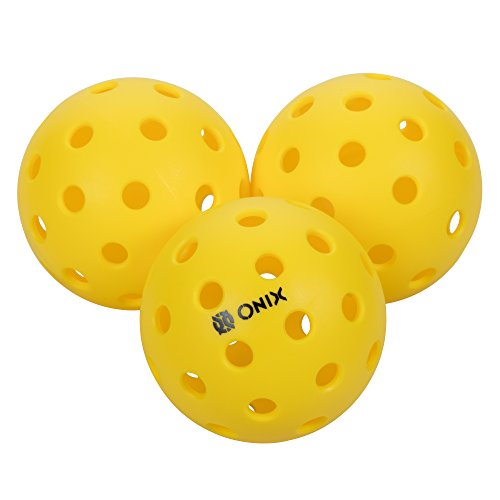
The Onix Pure 2 is the wind ball of the roundup. Where the one-piece balls chase speed, the Pure 2 is built as two halves joined by a welded seam, with smaller precision-drilled holes and deliberate extra weight: listing data puts it at 27.2 g, above the X-40 and Dura, and Onix builds its case for the ball on exactly that mass. A heavier ball with smaller holes deflects less in a crosswind, so the Pure 2 holds the line you hit on exposed courts where a lighter ball drifts a foot wide by the time it crosses the net. Onix names the package True Flight and Authentic Bounce technology, and the approved list carries the ball for outdoor tournament play.
The welded seam is the second half of the design. Splitting at the seam is the classic failure of two-piece balls, and Onix publishes its seam welding as engineered specifically to resist it, with the Pure 2’s controlled, robotic production keeping the two halves symmetrical so the ball rolls and bounces true. In play the result is a ball a half-step softer and slower than the X-40, with a truer, calmer flight: rallies run a little longer, the bounce reads consistently, and the ball feels composed on rough, gritty asphalt that makes harder balls skitter. Recreational groups that play on open park courts, where wind is a daily opponent, tend to settle on this ball and stop experimenting.
Two buying notes belong in the open. First, the long-running Amazon listing for Onix outdoor balls presents the Pure 2 and the Dura Fast 40 as options under one roof, so confirm that the option in the cart is the Pure 2 in the yellow 6-pack before paying; the two balls play very differently and a careless click swaps a wind ball for the fastest ball in this guide. Second, the extra weight that steadies the Pure 2 outdoors makes it the heaviest-feeling ball here at the net, and players who prize a feather touch on dinks may prefer the Fuse G2. Within its brief, though, the Pure 2 is the most considered design in the roundup: every published choice, mass, holes, seam, points at the same problem of outdoor conditions.
Specs
- Brand: Onix
- Model: Pure 2 Outdoor
- Construction: Two-piece, seam welded
- Holes: Smaller, precision-drilled (the maker does not headline a count)
- Weight: 27.2 g, per the listing data; weighted for wind stability
- Color: Yellow
- Pack size: 6 (the line also sells a 100 count)
- Approval: USA Pickleball approved for outdoor tournament play
- Tier: Mid-range
Where it fits best: Open, windy courts and rough park asphalt, and recreational groups that value a true, calm flight over raw pace. It is the ball most likely to end a group’s ball arguments on an exposed court.
Watch-outs: Check the listing option carefully, since the same listing sells the very different Dura Fast 40. The heavier feel is a feature in wind and a preference question at the net, and the welded seam, however well made, is still the part to inspect as the ball ages.
5. Onix Fuse G2 Outdoor Pickleball Balls, 6 Pack

The Onix Fuse G2 is the soft option, built for players who find the tournament balls harsh. It is a two-piece ball with the same Onix emphasis on seam welding as the Pure 2, published as three times as durable as the original Fuse, with smaller precision-drilled holes and precise weighting meant to keep the flight balanced and the bounce authentic. The listing names it the official ball of the APP and PPA tours, and it sits on the USA Pickleball approved list for outdoor play, so the soft feel does not cost it tournament legality. What it costs is speed: the Fuse G2 is the slowest ball in this roundup, and that is the point.
A softer ball changes the game in ways recreational players feel immediately. The bounce is a touch higher and the ball stays on the paddle a fraction longer, which lengthens rallies, forgives late contact, and makes the soft game at the kitchen line easier to learn. Onix also builds the cold-weather case for this ball: the maker says its softer material does not feel as hard in temperatures below 50 degrees, which addresses the season when hard balls turn brittle and crack. Between the softer shell and the welded seam, the Fuse G2 is the ball in this guide most likely to survive a winter of regular play, and its budget tier makes a 6-pack an easy experiment for a group that has only ever played the X-40.
The limits are the mirror of the strengths. Advanced players who drive hard will find the Fuse G2 slow off the paddle and lively off the bounce, and a group preparing for an event that plays the Dura or the X-40 should not train exclusively on it. One listing note also applies: this ball sells on Amazon under more than one listing and in 3, 6, and 100 counts across neon green and yellow, so match the Fuse G2 name, the neon green color, and the 6-pack count when ordering, and glance at the live offer on the listing you choose. Matched correctly, it is the friendliest ball here: the one new players rally with longest and cold-climate players reach for first.
Specs
- Brand: Onix
- Model: Fuse G2, model code KZ41006N-G2 for this pack
- Construction: Two-piece, seam welded; published as three times as durable as the original Fuse
- Holes: Smaller, precision-drilled (the maker does not publish a count)
- Weight: About 26 g, per retailer spec data for the line
- Colors: Neon Green on this pack; Yellow in the line
- Pack size: 6 (the line also sells 3 and 100 counts)
- Approval: USA Pickleball approved for outdoor tournament play; official ball of the APP and PPA tours, per the listing
- Tier: Budget
Where it fits best: Newer players, touch players, and anyone whose season runs into cold weather. It is also the budget way into an approved ball from a major maker, and the natural second ball for an X-40 household to keep for winter and for guests.
Watch-outs: The slowest ball here, and competitive players will call it soft within a game. It sells under several listings and pack counts, so verify the model, color, and count at checkout rather than assuming the first result is this 6-pack.
Care, Storage, and When to Retire a Ball
Pickleballs are consumables, but how they are stored decides whether a pack dies in weeks or lasts a season. Heat is the quiet killer: a bag of balls left in a hot trunk or a sunny garage softens faster, loses bounce unevenly, and ages well ahead of its court time. Store balls indoors at room temperature, out of direct sun, and bring only the session’s worth to the court. Cold is the loud killer. Hard balls turn brittle below about 40 degrees, and the first hard drive of a frosty morning is when cracks happen; on cold days, keep the balls in an inside pocket or an insulated bag until play starts, warm them in your hands, and reach for the softest ball you own, which in this roundup is the Fuse G2.
Rotate stock so the same three balls do not absorb every session. A simple habit works: new balls start at the back of the bag, played balls move forward, and every ball gets inspected when it comes out. The inspection takes seconds. Roll the ball on a flat surface and watch for a wobble, squeeze it gently and look for cracks around the holes and along any seam, and bounce it beside a fresh ball; a ball that bounces noticeably lower or veers has aged out. Retire cracked balls immediately, because a cracked edge plays unpredictably and can cut a hand reaching into the bag, and retire out-of-round balls as soon as the wobble shows, since they teach bad timing.
Finally, keep the set matched. A rally only plays true when both sides use the same ball, so standardize your group on one model, keep a spare pack of that same model sealed for tournaments and guests, and do not mix a soft ball and a hard ball in the same rotation. Balls that are merely dirty wash clean with water and a cloth; skip solvents and dishwashers, which attack the plastic and shorten the life you are trying to extend.
FAQ
What is the difference between indoor and outdoor pickleball balls?
Outdoor balls have a hard shell and about 40 small holes, built to survive rough courts and hold a line in wind. Indoor balls are softer, with 26 larger holes, built for smooth gym floors where they bounce lower and slower. The five balls in this guide are all outdoor balls. An indoor ball used outside wears fast and blows around, and an outdoor ball used inside skids on polished floors, so buy for the court you actually play on.
How long does an outdoor pickleball ball last?
It depends on the ball, the weather, and how hard your group hits. The maker of the Dura Fast 40 publishes expected life at roughly 3 to 10 games in harsh conditions for that fast, hard ball. Softer balls such as the Fuse G2 generally last longer, and the Selkirk Pro S1 carries a one-year no-crack warranty. Any ball is done when it cracks, wobbles in flight, or bounces unevenly, whatever the calendar says.
Does USA Pickleball approval matter if I never play tournaments?
Approval matters less as a permission slip and more as a guarantee of the basics: an approved ball is regulation size, within the legal weight band, and built to published bounce and hardness standards, so it plays like the ball every other group uses. All five picks here are approved. For pure backyard play an unapproved ball can still be fun, but approved balls cost little more and remove the guesswork.
Why do outdoor balls crack in cold weather, and how do I stop it?
The plastic in a hard outdoor ball turns brittle as temperatures fall, and a hard-hit ball can split instead of flexing. Warm balls before play, store them indoors rather than in a cold garage or trunk, avoid leaving them in a freezing car between sessions, and switch to a softer ball such as the Fuse G2 on the coldest days. The Selkirk Pro S1’s no-crack warranty is the other answer, since it moves the cost of a cold-weather crack to the maker for a year.
Conclusion
Every ball in this roundup is regulation size, approved for sanctioned outdoor play, and built by a maker that publishes its construction, so the choice is about temperament rather than quality. The Franklin X-40 is the default: the official US Open ball, firm and familiar, in a 12-pack at a mid-range tier. The Dura Fast 40 is the speed pick, the hardest and fastest ball here, bought with open eyes about its short published lifespan. The Selkirk Pro S1 is the durability pick, trading the standard hole count for a patented 38-hole pattern and a one-year no-crack warranty. The Onix Pure 2 is the wind pick, heavier and seam-welded for exposed courts, and the Onix Fuse G2 is the soft pick, the gentlest and most cold-tolerant ball of the five at a budget tier. Pick the ball that matches your court and your season, buy it in the pack size your wear rate demands, and your group can stop arguing about the ball and get back to arguing about line calls.