Key takeaways
- Compare the best molkky sets, from the official Finnish birch set in its wooden crate to numbered block toss games with scoreboards and exact-50 scoring.
- Top Pick: Quick Comparison
- Runner-up: Quick Comparison
- Also consider: ApudArmis Wooden Tossing Game Set
The best molkky sets are the ones that keep the Finnish game intact: twelve wooden pins numbered 1 through 12, one heavier throwing pin, and a scoring system that turns arithmetic into the contest. Molkky, spelled Mölkky in Finnish and pronounced roughly MURL-kee, was created in Finland in 1996 and built on the older Karelian skittle tradition. Players stand behind a throwing line and toss the throwing pin underhand at the pin formation. Knock down exactly one pin and you score the number printed on it. Knock down two or more and you score only the count of pins that fell. The first player to reach exactly 50 points wins, and the word exactly does the work: overshoot 50 and your score drops back to 25, and miss every pin on three turns in a row and you are out of the game. It is a throwing game where the endgame is a maths problem, and that is why it has spread from Finnish summer cottages to backyards everywhere else.
Short on time? The Tactic Games set is the official pick, the game as its Finnish maker publishes it, in FSC-certified Baltic birch with a wooden crate for a case. The Yard Games Scatter is the crafted pick, with the numbers burned into the wood so they cannot wear away. The GoSports Skittle Scatter is the household pick, the same game from the mainstream yard-games shelf with a dry-erase scoreboard and a tote in the box. The ApudArmis set is the straightforward pick, a numbered block toss set with scoreboard and carrying case. And the SpeedArmis set is the value pick, rubber wood blocks with a scoreboard and a zippered case. One naming note before the picks: because Molkky is a protected trademark held by Tactic, most other makers sell the identical game under names like Scatter, Skittle Scatter, or numbered block toss, and this guide treats those sets as what they are, the same game in a different box.
As an Amazon Associate, we earn from qualifying purchases.
Table of Contents
- How to Choose Molkky Sets
- Quick Comparison
- 1. Molkky by Tactic Games US
- 2. Yard Games Scatter Number Block Tossing Game
- 3. GoSports Skittle Scatter Numbered Block Toss Game
- 4. ApudArmis Wooden Tossing Game Set
- 5. SpeedArmis Wooden Throwing Game
- Care, Storage, and Safety Checks
- FAQ
- Conclusion
How to Choose Molkky Sets
The game is the scoring, so start there
Every set in this guide plays the same published game, and the game is worth understanding before the wood, because the scoring is what the equipment has to serve. The twelve pins stand in a set formation a throwing distance from the line, low numbers and high numbers placed where the formation makes them hard or easy to isolate. A throw that fells one pin pays that pin’s face value, so a skilled player late in a game hunts the single pin carrying the exact number needed. A throw that fells several pins pays only the number of pins, never their sum, which means a wild smash into the formation is worth less than a surgical single. Fallen pins are stood back up where they fell, so the formation spreads and changes shape as the game goes on, and the target a player faces in the last rounds is the debris of everyone else’s throws. The bust rule, over 50 and back to 25, and the three-miss elimination rule complete a game that stays live to the final throw. A set that publishes these rules in full, bust and elimination included, is selling the real game. A set whose rules quietly simplify the scoring is selling a lesser one, and the rules sheet is the first page to read on any listing.
Official molkky, or the scatter naming
Molkky is a trademark, not a generic name, and that single fact explains the whole shape of this category. Tactic Games, the Finnish company that has owned the game since 2016 and manufactures it in Pori, Finland, is the only maker that can sell a set under the Molkky name, and its set is the reference the others are measured against: regulation piece sizes, Finnish birch, and the official rules. Everyone else sells the same game under a descriptive name, Scatter, Skittle Scatter, numbered block toss, or wooden throwing game, and those sets are legitimate products playing the identical game with the identical scoring. The practical consequence for a buyer is that the name on the box tells you who made it, not what game is inside. Judge the unofficial sets on their wood, their numbering, and their case, exactly as you would judge the official one, and judge the official one on the same terms rather than on the trademark alone. This guide does that: one official set, four scatter-named sets, ranked by specification rather than by name.
Wood decides how long the numbers survive
A molkky set is thirteen pieces of wood that spend their lives being struck by the heaviest piece in the box, so the wood is the durability specification. The official set is Baltic birch, the dense, fine-grained wood the game was designed in, FSC-certified in Tactic’s published specification. The scatter sets use the hardwoods and rubber wood common to the yard-games shelf, and the honest differences are density and finish: a denser pin takes seasons of impacts without mushrooming at the striking face, and a smooth, sanded finish keeps splinters out of the game and lets a fallen pin slide rather than dig in. What to read on a listing is the species line and the sanding line. A maker who names the wood and describes the finish is publishing a specification; a listing that says only wooden pieces is asking you to guess. Weight follows the same logic. Regulation pieces are sized so the throwing pin carries real momentum, roughly twice the length of a scoring pin, and a set whose throwing pin feels like a toy will scatter nothing. The published regulation dimensions put the scoring pins at about 5.9 in tall and the throwing pin at about 8.9 in long, and sets that publish their pin dimensions near those figures are playing the real game.
How the numbers are marked is a real specification
Every pin carries its number on the angled top face, and the marking method decides whether the set is still readable in its third summer. The strongest method is burning: numbers heat burned into the wood sit below the surface and cannot rub, fade, or peel. Laser etching and laser engraving cut the same idea shallower, still far more durable than ink. Printed or painted numbers sit on the surface, and the surface is exactly where the throwing pin lands, throw after throw. This is not a cosmetic point. The entire endgame of molkky is reading the field: which pin carries the 7 you need, which cluster sums to a safe count. A set whose high numbers have worn faint turns the strategy into guesswork. When a listing states its marking method, burned or etched, treat it as the headline specification it is. When it says nothing, assume print and set expectations accordingly.
The scoreboard and the case are not accessories
Molkky scoring is cumulative, bust-adjusted, and tracked across every player, so the game needs a written score in a way that a race-to-a-target game does not. Sets answer this three ways: a dry-erase scoreboard in the box, a paper score pad, or nothing, leaving the group to a phone or to memory and argument. The dry-erase board is the grown-up answer, reusable, visible to the whole group, and hard to dispute after a bust drops someone to 25. The case matters for the same structural reason. Thirteen loose pieces of wood are exactly the kind of thing that loses one pin to a garage corner, and a molkky set missing its 12 pin is a broken game, because the scoring assumes the full set of numbers. A wooden crate, a durable carrying case, a tote, or a zippered bag is therefore part of the game, not packaging. Read the included-components line for both items, board and case, before you read anything else on the page.
Players, ages, and surfaces
The published game is for two or more players, and it scales unusually well: turns are individual, teams form by simple addition, and a group of eight plays the same game as a pair, just with longer waits between throws. The official set is rated for ages 6 and up, and the throwing is underhand by rule, which is what makes the game work across ages; a child who can lob the pin can compete, because the scoring rewards placement over power. Surfaces are the one real limit. The game wants grass, dirt, gravel, or sand, ground where pins stand upright and fall cleanly. Hard pavement is playable but unkind: pins bounce, slide, and chip at the edges, and the throwing pin takes the worst of it. Long grass is the opposite problem, swallowing fallen pins and hiding the numbers. A mown lawn, a beach, or a campsite pitch is the game’s home ground, and every set in this guide is built for exactly those surfaces.
Quick Comparison
| Product | Naming | Numbering | Case | Best for | Tier |
|---|---|---|---|---|---|
| Molkky by Tactic Games US | Official Molkky | Printed on regulation birch pins | Wooden crate with rope handles | The game as its Finnish maker publishes it | Premium |
| Yard Games Scatter | Scatter | Heat burned-in | Durable carrying case | Numbers that cannot wear away | Premium |
| GoSports Skittle Scatter | Skittle Scatter | Laser-etched | Tote bag, dry-erase scoreboard included | The complete household set | Mid-range |
| ApudArmis Wooden Tossing Game Set | Numbered block toss | Numbered blocks, per listing | Carrying case, scoreboard included | A straightforward set for lawn and beach | Mid-range |
| SpeedArmis Wooden Throwing Game | Numbered block toss | Numbered blocks, per listing | Nylon zipper case, scoreboard included | The value route into the game | Budget |

1. Molkky by Tactic Games US
This is the original, and its claim on that word is legal as well as historical. Tactic Games owns the Molkky trademark, manufactures the set in Pori, Finland, and publishes the game in its regulation form: twelve numbered skittles and one throwing pin in FSC-certified Baltic birch, sized and weighted to the tournament standard the maker’s United States arm describes as regulation. The birch is the specification that matters most. It is the wood the game was designed around in 1996, dense enough that the pins take direct hits season after season, and finished so the set arrives as furniture-grade wood rather than craft-store dowel. The whole set packs into a wooden crate with rope handles, which is both the storage answer and the transport answer: the crate is the case, and the game lives in it between summers.
The play is the full official game with nothing simplified away. Tactic publishes the complete rule set, the set formation, the face-value single, the count for multiples, the bust back to 25, and the three-miss elimination, and the maker’s scoring app exists for groups who would rather keep the count on a phone than on paper. Because the pieces are regulation size, this is also the set that matches the game as it is played in organised competition, where the World Championship is held in Finland each year. A household that learns the game on this set has learned the game itself, not one retailer’s simplification of it.
Two honest notes belong with this pick. First, the version note: Tactic sells the game in more than one package, including a cardboard case version and themed editions, and the identifier in this guide’s table is the United States listing for the standard set, model 41061, the birch set in the wooden crate. Match the crate and the model line on the live listing before ordering, because the themed and cardboard versions are different products at different builds. Second, the numbering note: the official set’s numbers are printed on the pin tops rather than burned or etched, the one specification where two of the scatter sets below arguably out-build the original. Birch is hard enough that the print holds up well in practice, but a buyer whose first priority is numbers that can never fade should read the next pick before deciding. Neither note dents the pick’s logic. For a buyer who wants the game from the maker that owns it, in the wood it was designed in, this is the set the others are compared to.
Specs
- Brand: Tactic Games US, by Tactic Games of Pori, Finland
- Type: Official molkky set, Finnish throwing game
- Model: 41061, per the maker’s United States listing
- Material: FSC-certified Baltic birch wood, made in Finland, per maker copy
- Pins: Twelve numbered skittles plus one throwing pin, regulation size and weight, per maker copy
- Regulation dimensions: Scoring pins about 5.9 in tall, throwing pin about 8.9 in long, per published regulation descriptions
- Carry: Wooden crate with rope handles, per maker copy
- Players: Two or more, per maker copy
- Ages: 6 and up, per maker copy
- Scoring: First to exactly 50 points; overshooting drops the score to 25; three consecutive misses eliminate a player, per the official rules
- Tier: Premium
Where it fits best: Players who want the official game from the Finnish maker that owns it, in regulation birch, and groups who may one day play the game beyond the backyard.
Watch-outs: Tactic sells cardboard-case and themed versions under the same game name, so confirm the wooden crate build and the model line on the live listing. The numbers are printed rather than burned in, the one place a rival below out-specifies the original.
2. Yard Games Scatter Number Block Tossing Game
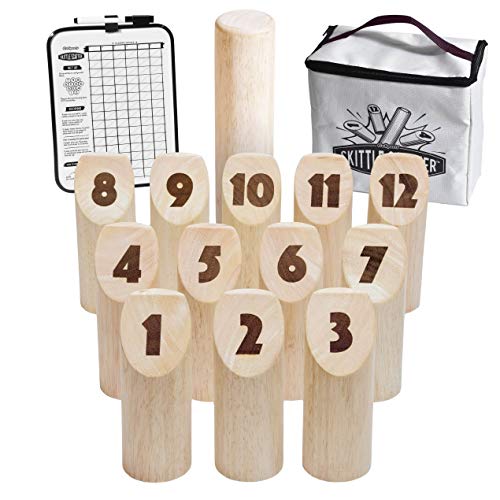
The Yard Games Scatter is the set built around the specification this guide keeps returning to: the numbers are heat burned into the wood. Yard Games, the Minnesota maker whose whole catalogue is wooden yard games, sells the molkky game under the Scatter name, and its headline difference from every printed set is that the number on each pin is branded into the angled top face. A burned number has no surface layer to lose. It survives the throwing pin’s impacts, the sun, and the damp grass at the bottom of the case, and it is still legible in the set’s fifth summer, which is exactly when the endgame arithmetic starts to matter to a group that has learned the game properly.
The rest of the set follows the same durability brief. The pieces are the standard thirteen, twelve numbered pins and the throwing stick the maker calls the Scatter, and the set packs into a durable carrying case rather than a tote, the sturdier answer for a game that travels to campsites and beaches. The published game is the complete one: pins set in formation about ten feet from the throwing line in friendly play, singles paying face value, multiples paying the count, exactly 50 to win, and the bust rule resetting an overshoot to 25. Yard Games publishes those rules plainly, which matters, because a scatter set is only the real game if its rule sheet says so.
The honest limit is the mirror of the official set’s. This is an unofficial set, however well built, and a buyer who cares about the trademark, the Finnish manufacture, or tournament-regulation provenance should buy the Tactic set above. The Scatter also asks its buyer to trust a smaller specification sheet: the listing leads with the burned numbers and the case rather than with wood species and pin dimensions, so a buyer who wants every figure in print before ordering will find less of it here. What is published, though, is the figure that decides the set’s working life. For a group that plays often and plays outdoors, numbers that cannot wear off are the specification that outlasts every other line on the page.
Specs
- Brand: Yard Games
- Type: Number block tossing game, Scatter format of the molkky game
- Pins: Twelve numbered pins plus one throwing stick, per the listing title
- Numbering: Heat burned-in numbers, per the listing title
- Carry: Durable carrying case, per the listing title
- Players: Two or more, per maker copy
- Scoring: First to exactly 50 points; overshooting resets the score to 25, per the published rules of the format
- Included components: Twelve numbered pins, throwing stick, carrying case, per the listing title
- Tier: Premium
Where it fits best: Frequent players who have watched printed numbers fade on other wooden games, and groups who want the set that stays readable for years in a hard case.
Watch-outs: An unofficial scatter set, so buyers set on the official Finnish product should choose the Tactic set. The published specification sheet is shorter than the official set’s, leading with the burned numbers and case rather than full dimensions.
3. GoSports Skittle Scatter Numbered Block Toss Game
The Skittle Scatter is the molkky game in its most bought form, and its defining specification is completeness: twelve numbered skittles, one throwing baton, a dry-erase scoreboard, and a portable carrying case, which is the whole game, scoring included, in one tote. GoSports, the backyard games line of P and P Imports, builds the set in hand-sanded knot-free hardwood with the numbers laser-etched into the pins, a marking method that sits between print and branding on the durability scale and well ahead of either on a mainstream set. The maker’s rules copy states the game plainly: toss the baton at the cluster of numbered pins to reach exactly 50 points without going over. That is the real game, bust rule and all, published by the same company whose cornhole and ladder toss sets are already in half the garages in the country.
The scoreboard deserves its own sentence, because GoSports is the pick here that treats scoring as part of the product. Molkky’s running totals, with their busts and resets, are the one piece of bookkeeping a casual group reliably loses, and a dry-erase board in the box settles it: visible to everyone, corrected in a second, and reusable for as long as the set lasts. The case dimensions published for the set, 14.5 x 7.5 x 11 in, describe a genuinely portable package, closer to a tote than to the Tactic crate, and the whole thing is built to be thrown in a car rather than shelved.
Two notes belong here. First, the age note: published specification data for this set lists recommended ages of 12 and up, a more conservative line than the official set’s 6 and up, though the game itself is the same underhand toss and younger players join in under the usual supervision in most households. Second, the provenance note, the mirror of the Yard Games pick: this is a mainstream manufacturer’s scatter set, hardwood rather than Finnish birch, and a buyer shopping for the official article or for burned-in numbers should look at the two premium picks. For everyone setting up a first molkky game from an empty box, with the score kept properly from the first afternoon, this is the straightforward pick.
Specs
- Brand: GoSports, by P and P Imports LLC
- Type: Numbered block toss game, Skittle Scatter format of the molkky game
- Material: Hand-sanded knot-free hardwood, per maker copy
- Numbering: Laser-etched, per maker copy
- Included components: Twelve numbered skittles, one throwing baton, one dry-erase scoreboard, one carrying case, per maker copy
- Case dimensions: 14.5 x 7.5 x 11 in, per published specification data for the set
- Players: Two or more, per maker copy
- Scoring: First to exactly 50 points without going over, per maker copy
- Tier: Mid-range
Where it fits best: Households and casual groups who want the complete game, scoreboard included, from a mainstream yard-games maker, in a tote that lives in the car.
Watch-outs: Published specification data lists ages 12 and up, a conservative line for a game younger children commonly play supervised. Hardwood rather than birch, and etched rather than burned numbers, so the two premium picks out-build it on those lines.
4. ApudArmis Wooden Tossing Game Set

The ApudArmis set is the molkky game sold straight, under the plainest name in the category: a wooden tossing game set of numbered blocks, with a scoreboard and a carrying case, for the lawn, the backyard, and the beach. ApudArmis is a volume maker of wooden outdoor games, stacking towers and tossing sets among them, and this set follows the house pattern of completeness over provenance: twelve numbered blocks, a throwing dowel, a scoreboard for the running totals, and a case to keep the thirteen pieces together, which is the full working kit of the game with nothing essential left to improvise.
What this pick offers a buyer is the game itself at the category’s working end, in the format the beach and the campsite actually reward. The set is built to travel, the case is part of the product rather than an upgrade, and the scoreboard answers the same bookkeeping problem the GoSports set answers, the running total with its busts and resets that a group will not reliably hold in memory. The play is the published format, singles at face value and multiples at the count, first to exactly 50, and the surfaces named in the set’s own title, lawn and beach, are the surfaces the game is meant for.
The limits are the ones the whole value end of this category shares, and they belong in the open. The listing leads with the component list rather than with wood species, pin dimensions, or a marking method, so the specification sheet a buyer can verify before ordering is thinner than the sheets above it in this guide; the numbers’ marking method in particular is not stated in the listing data reviewed, and a buyer for whom burned or etched numbers are the priority should choose the Yard Games or GoSports set. The brand also sells a same-name family of wooden games, including a stacking tower, so the title check matters: the identifier in this guide’s table is the tossing game with the scoreboard and case, not the tower. For a group that wants the game complete and portable and is content to let the component list be the specification, this set covers the ground.
Specs
- Brand: ApudArmis
- Type: Numbered block toss game, molkky format
- Included components: Twelve numbered blocks, one throwing dowel, scoreboard, carrying case, per the listing title
- Play surfaces: Outdoor lawn, backyard, and beach, per the listing title
- Players: Two or more, per the format’s published rules
- Scoring: First to exactly 50 points; overshooting drops the score to 25, per the format’s published rules
- Numbering method: Not stated in the listing data reviewed
- Tier: Mid-range
Where it fits best: Groups who want the complete game, scoreboard and case included, for the lawn and the beach, without paying the premium end of the category.
Watch-outs: The maker sells several wooden games under similar names, including a stacking tower, so match the tossing game title and the scoreboard-and-case component line on the live listing. The numbering method and wood species are not stated in the listing data reviewed.
5. SpeedArmis Wooden Throwing Game
The SpeedArmis set is the value route into the game, and it is a more honest product than its position suggests, because its listing publishes real figures: twelve numbered blocks at 6 x 2 in, a throwing block at 10 x 2 in, rubber wood construction, a scoreboard, and a nylon zipper carrying case, at a published set weight of 3.5 lb. Those pin dimensions sit close to the regulation pattern, a shade under the official length on the throwing pin, and the rubber wood is a sensible species for the category, dense and shock-absorbent in the way a pin that gets struck for a living needs to be. The pieces are sanded with rounded edges per the maker’s copy, and the zippered case is the right kind of case for the value end: light, closable, and hard to spill.
The play is the full format. SpeedArmis publishes the game as a twelve-block toss to exactly 50, indoors at a tailgate or outdoors on the lawn, and the scoreboard in the box handles the running totals. Taken together, this is the set for a buyer who wants to learn whether their group likes molkky before paying for birch and branding, or who wants a second set that lives at the lake house or in the camping kit where a crate would be overkill. A complete, correctly sized, correctly scored game at the category’s entry point is a legitimate product, and this is that product.
The watch-outs are version discipline and marking method. SpeedArmis sells this game in more than one version, including an updated build with a shaved-top pin design under its own separate listing, and the identifier in this guide’s table is the standard set described above, model CAS-Skittle; a buyer who wants the updated pin shape should confirm they are on the other listing, and a buyer who wants this set should confirm the reverse. The numbering method is not the headline of this listing the way burning is for the Yard Games set, so a buyer whose group will play weekly for years should weigh the premium picks’ marking methods against this set’s completeness and size. For a first set, a spare set, or a travelling set, the trade runs the other way.
Specs
- Brand: SpeedArmis
- Type: Wooden throwing game, twelve numbered block toss format of the molkky game
- Model: CAS-Skittle, per the Amazon Canada product-information block
- Material: Rubber wood, per the Amazon Canada product-information block
- Numbered blocks: Twelve, 6 x 2 in each, per the Amazon Canada product-information block
- Throwing block: 10 x 2 in, per the Amazon Canada product-information block
- Included components: Twelve numbered blocks, throwing block, scoreboard, nylon zipper carrying case, per maker copy
- Weight: 3.5 lb, per retailer specification data for the set
- UPC: 616366289562, per the Amazon Canada product-information block
- Tier: Budget
Where it fits best: First-time buyers learning the game, and households who want a complete, light, zippered-case set for the campsite, the beach, or a second home.
Watch-outs: A separate updated version with a shaved-top pin design sells under its own listing, so match the model line and the standard title before ordering. The numbering method is not stated as burned or etched in the listing data reviewed.
Care, Storage, and Safety Checks
Care for a molkky set is moisture discipline and little else. Wooden pins that come in wet and stay wet will swell, split at the striking face, and grow mould in the case, so the routine is to wipe the pieces down after play, let them dry in the open air before they go back into the crate or bag, and store the set indoors or in a dry shed rather than in a damp garage corner. Inspect the pins at the start of each season. The throwing pin takes the most punishment and shows it first: a pin with a deep split or a mushroomed end changes how the throw flies and should be retired or sanded smooth, because a rough striking face is where splinters come from. Check the numbers while you are at it. A printed number that has faded can be re-inked with a wood marker in a minute, and doing it in spring beats squinting at the 11 pin during an endgame in August.
Storage discipline in this category is completeness discipline. The game is thirteen pieces and the scoring assumes all twelve numbers, so a set that loses one pin to the bottom of a gear closet is not a slightly smaller game, it is a broken one. Every pick above ships a crate, case, tote, or zippered bag, and the set that goes back into its container complete, every time, is the set that survives. When a piece does wear out, replace it from the same maker and the same version where you can, because pin sizes vary slightly across this category and a borrowed pin of a different weight quietly changes the game it joins.
A note on safety and recalls, for completeness: no United States recall covers molkky sets, scatter sets, or wooden skittle throwing games as a product class, and none covers any of the five picks here. The safety checks that matter are the playing checks. The throw is underhand by rule, and the rule is worth enforcing, because an overhand throw of a solid wooden pin is a different and worse game. Keep the lane and the pin formation clear of spectators and younger children while a throw is live, play on grass or sand rather than pavement where a bouncing pin travels further, and supervise younger players, whose job includes standing behind the throwing line until the pin has landed. None of the five picks is a lawn dart set, a croquet set, or a metal-tipped throwing game, and none carries the sharp-point or lead-paint history that has drawn recalls elsewhere in the yard-games aisle; the checks above are the whole of it.
FAQ
What is molkky, and how is it scored?
Molkky is a Finnish throwing game from 1996, built on the older Karelian skittle tradition. Twelve wooden pins numbered 1 through 12 stand in a formation, and players take turns throwing a heavier wooden pin at them underhand. Knock down one pin and you score the number on it; knock down two or more and you score only the count of pins that fell. Fallen pins are stood back up where they landed, so the formation spreads as the game goes on. The first player to reach exactly 50 points wins; go over 50 and your score drops back to 25, and miss every pin on three turns in a row and you are eliminated.
What is the difference between molkky sets and scatter sets?
The game inside the box is the same, and the difference is the name on it. Molkky is a protected trademark held by Tactic Games, the Finnish company that manufactures the official set in birch in Finland, so only Tactic can sell the game under the Molkky name. Other makers sell the identical game, same twelve numbered pins, same throwing pin, same exact-50 scoring, under descriptive names like Scatter, Skittle Scatter, or numbered block toss. Judge those sets on their wood, their numbering method, and their case rather than on the missing trademark, and judge the official set on the same terms.
How much space does a molkky game need, and where can it be played?
Less than most yard games. Friendly play sets the pin formation about 10 to 12 feet from the throwing line, and published rules put the line at roughly 3 to 4 metres, so a lawn about 20 feet long hosts the full game with room for the formation to spread. The surface matters more than the size: grass, dirt, gravel, and sand all work, because the pins stand upright and fall cleanly. Hard pavement is playable but unkind, since pins bounce, slide, and chip, and very long grass hides fallen pins and their numbers. A mown lawn, a beach, or a campsite pitch is the game’s home ground.
How long do wooden molkky pins last, and how should they be cared for?
Seasons, with basic care, and the failure order is predictable: the throwing pin wears first, then the numbers on printed sets, then the striking faces of the scoring pins. Wipe the pieces after play, dry them before they go back in the crate or case, and store the set somewhere dry. Sand a rough striking face smooth before it splinters, and re-ink a faded printed number rather than guessing at it mid-game. Sets with burned-in or laser-etched numbers, two of the picks in this guide among them, skip the fading problem entirely, which is why the marking method is worth weighing at purchase.
Conclusion
Molkky sets divide by who made them and how they are finished, not by the game, because the game, twelve numbered pins and a race to exactly 50, is identical in every box here. The Tactic set is the official answer, the game in FSC-certified Finnish birch from the maker that owns it, crate included. The Yard Games Scatter is the craftsman answer, numbers burned into the wood so the endgame stays readable for years. The GoSports Skittle Scatter is the household answer, the complete game with a dry-erase scoreboard and a tote from the mainstream yard-games shelf. The ApudArmis set is the straightforward answer, the full component list in a case for the lawn and the beach. And the SpeedArmis set is the value answer, correctly sized rubber wood blocks with a scoreboard and a zippered case. Match the identifier, read the included-components line, dry the pins before they go away, and any of the five will be scattering pins for seasons.