Key takeaways
- Compare the best slackline kits for backyard balance, from the original Gibbon ClassicLine to 60 ft training kits with overhead lines and tree protection.
- Top Pick: Gibbon ClassicLine Slackline Kit with TreeWear, 49 ft
- Runner-up: ZenMonkey Slackline Kit with Overhead Training Line, 60 ft
- Also consider: Trailblaze Complete Slackline Kit, 60 ft
The best slackline kits all do the same deceptively simple thing: they stretch a flat band of webbing between two trees and turn it into a walking line that bounces, sways, and rolls under your feet. A slackline is not a tightrope. The line is tensioned firmly but never drum-tight, and that deliberate give is the game, because every step has to be balanced rather than merely placed. The modern backyard version descends from the climbing camps of Yosemite, where climbers walked parking-lot chains and then webbing between trees, and its retail form keeps that simplicity intact. There is no court to mark, no net to hang, and no score to keep. There is a line, two anchors, and a wobble that is either settling down or putting you on the grass.
Short on time? The Gibbon ClassicLine with TreeWear is the classic pick, the original two-inch ratchet line from the maker that popularized backyard slacklining, with tree pads in the box. The ZenMonkey kit is the complete training pick, a 60 ft line with an overhead training line, an arm trainer, and the longest tree protectors in this guide. The Trailblaze Complete Kit is the family pick, a 60 ft main line with a full-length training line and wide tree pads. The flybold kit is the hardware pick, built around a twin gear ratchet with a five-ton break load. And the VEVOR kit is the budget pick, a full 60 ft set with a training line at the entry end of the category. One format note before the picks: this guide covers slackline kits only, the two-piece ratchet lines you walk on. It does not cover ninja obstacle lines, which hang obstacles from a line for climbing across, or ziplines, which are steel cable riding lines. Those are different products with different hardware, and they are covered in their own guides.
As an Amazon Associate, we earn from qualifying purchases.
Table of Contents
- How to Choose Slackline Kits
- Quick Comparison
- 1. Gibbon ClassicLine Slackline Kit with TreeWear, 49 ft
- 2. ZenMonkey Slackline Kit with Overhead Training Line, 60 ft
- 3. Trailblaze Complete Slackline Kit, 60 ft
- 4. flybold Slackline Kit with Training Line, 57 ft
- 5. VEVOR Slackline Kit with Training Line, 60 ft
- Care, Storage, and Safety Checks
- FAQ
- Conclusion
How to Choose Slackline Kits
Width is the first specification: two inches to learn, one inch to specialize
Every kit in this guide is built on flat polyester webbing, and the webbing’s width is the decision everything else hangs on. The two-inch line is the beginner standard and the format of four of the five picks here. A two-inch band gives the foot a platform, spreads the walker’s weight across more material, and moves slower and more predictably when it sways, which is why schools, camps, and families start there. The one-inch line is the older climbing format and the specialist’s tool: narrower, livelier, and noticeably harder to stand on, suited to experienced walkers and to the long, low-tension setups called longlines. Neither width is better in the abstract. They are different difficulty settings woven into the product. A buyer shopping for a first line, a family line, or a line guests will try at a cookout should read the width line first and stay with two inches. A listing that does not state its width is asking you to guess at the one specification that decides how the first week on the line feels.
The headline length is a system number, not a walking number
Slackline kits are sold by total webbing, and total webbing is not the span you walk. A standard kit has two pieces: the main line, with a sewn loop at one end, and a shorter ratchet strap that carries the tensioning ratchet. The advertised length adds both pieces together, and the wraps around the two anchor trees come out of the same total. The Gibbon pick below is the honest example: it is sold as a 49 ft kit, and its own specification sheet breaks that into a 41 ft line and an 8 ft ratchet strap, before any webbing goes around a trunk. This is not a trick, it is how the whole category is measured, but it means the number to compare is the main-line length and the tree spacing you actually have. Most backyard setups string the line across ten to twenty feet of the available webbing and coil the rest, which is why a 49 to 60 ft kit covers nearly any yard. Buy length for the anchors you have, not for the biggest number on the box, and remember that a longer line set up over a longer span bounces more and sits higher off its lowest point, which is a harder line to learn on, not an easier one.
The ratchet is the safety-critical part of the kit
A slackline kit has very few parts, and the ratchet does the hardest work in it. The ratchet is the winch that pulls the webbing to tension and locks it there, and it is the component that stores the energy the whole system runs on. Three specification lines matter. The first is the safety lock: the better ratchets, including the Gibbon pick’s, carry a locking mechanism that keeps the handle from releasing under load, and a ratchet without one is a downgrade no saving justifies. The second is the gear drive: most kits use a single-gear ratchet, while the flybold pick below uses a twin gear ratchet, which pulls with more mechanical advantage and tensions a long line with less handle effort. The third is the ratchet cover, sometimes called a ratchet pad or protection sleeve, a padded wrap that keeps the steel ratchet off the tree and off the walker’s hands and feet. Read the included-components line for it. A kit that ships a ratchet cover and a ratchet with a safety lock has specified its most dangerous part properly. A kit that says only ratchet has told you the minimum.
Training lines and arm trainers shorten the first week
The hardest part of slacklining is the first hour, when standing up at all is the achievement, and the category has developed a standard answer: a second, overhead line. A training line is a separate length of webbing rigged above the main line at about arm height, tensioned by its own small ratchet, and held like a handrail while the walker learns. An arm trainer is a shorter loop or strap used the same way, giving the hands something to steady against without a full second line. Three of the five picks below include an overhead training line, and four include an arm trainer. These are not accessories in the decorative sense. They change who the kit works for. A solo adult learning alone has no spotter, and the overhead line is the spotter. Children learning on a family line use it constantly. A confident walker who already balances well may never rig it, and for that buyer the Gibbon pick’s simpler box is no loss. Decide by who will actually stand on the line in the first month. Beginners and families should treat the training line as a requirement. Returning walkers can treat it as optional.
Tree protection is part of the product, not an accessory
A tensioned line concentrates real force on a small band of bark, and bare webbing under load will strip that bark and can girdle and kill a tree. Tree protection is the category’s answer: felt or fabric pads that wrap the trunk under the webbing, spreading the load and keeping the strap off the bark. Every pick in this guide includes tree protectors, and their specifications differ in ways worth reading. Length is the main line: the ZenMonkey pick’s pads run 60 in, the longest here, wrapping large trunks fully, while the Gibbon pads run 3.3 ft each and join with hook-and-loop closures for bigger trees. Built-in guide loops, found on the ZenMonkey and Trailblaze pads, hold the webbing in place on the pad while you tension, which is a genuine setup convenience rather than a decoration. Width matters too: a wider pad spreads force over more bark. Beyond the trees themselves, protection is also permission. Parks, schools, and neighbors tolerate slacklines that leave trunks unmarked. A kit without pads in the box is not finished, and a buyer whose chosen kit lacks them should add a pair before the first setup, not after the first scar.
Breaking load is not working load, and both are printed for a reason
Slackline listings carry two different strength numbers, and reading the wrong one is the category’s most common specification error. The breaking load is the force at which the webbing or system fails in a test, and it is high by design: the Gibbon webbing is rated at 40 kN, about 9,000 lb, and the flybold line carries a five-ton break load per its maker’s copy. The working load, sometimes printed as a load capacity, is the walker’s weight the kit is meant to carry in use, and it is far lower: the Trailblaze kit specifies a 300 lb capacity. The gap between the two numbers is the safety margin, and it exists because a bouncing walker loads a line dynamically, well beyond standing weight, and because webbing ages, abrades, and gets tensioned by fallible humans. The buying rule is simple. Match the kit to the working load for the heaviest walker who will use it, and treat a high breaking load as evidence of margin, not as permission. A listing that prints only a breaking load in tons and no working capacity has given you the impressive number and withheld the useful one.
Quick Comparison
| Product | Format | Main line | Training line | Tree protection | Best for | Tier |
|---|---|---|---|---|---|---|
| Gibbon ClassicLine Slackline Kit with TreeWear, 49 ft | Two-piece ratchet kit | 41 ft, 2 in webbing | Not included | Two felt pads, 3.3 ft each | The original backyard line | Premium |
| ZenMonkey Slackline Kit with Overhead Training Line, 60 ft | Two-piece ratchet kit | 52 ft, 2 in webbing | Overhead line and arm trainer | Two pads, 6 in x 60 in | A complete training setup | Mid-range |
| Trailblaze Complete Slackline Kit, 60 ft | Two-piece ratchet kit | 60 ft | Full-length 60 ft line | Two wide pads, 4.9 ft | Families learning together | Mid-range |
| flybold Slackline Kit with Training Line, 57 ft | Two-piece ratchet kit | 57 ft total system | Overhead line included | Extra-wide protectors | Twin gear ratchet hardware | Mid-range |
| VEVOR Slackline Kit with Training Line, 60 ft | Two-piece ratchet kit | 60 ft | Training line included | Protectors included | A full kit at the entry tier | Budget |
1. Gibbon ClassicLine Slackline Kit with TreeWear, 49 ft
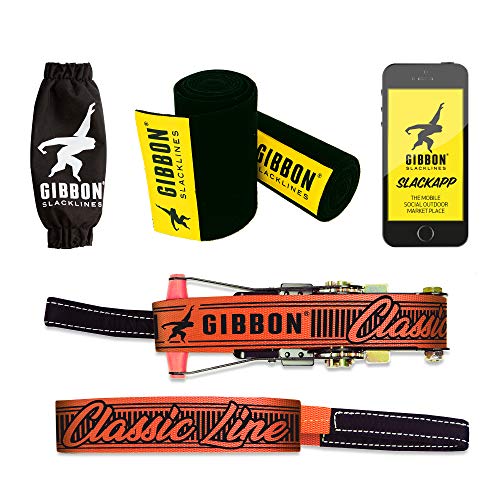
This is the kit that made the category a category. Gibbon built its name on the two-inch ratchet line for non-climbers, and the ClassicLine with TreeWear is that product in its reference form: a 41 ft main line of 2 in polyester webbing with a protected stitched loop, an 8 ft ratchet strap, the maker’s Classic ratchet with a safety lock, a RatPad ratchet protector, and two TreeWear felt pads in the box. The webbing specification is the one that matters most. The maker rates it at 40 kN breaking load, about 9,000 lb, with low stretch, around two percent, which is the technical reason this line feels steadier under a beginner than the livelier kits around it. A low-stretch line set up short and low barely bounces, and barely bouncing is what a first week of learning asks for.
The play is the traditional game with nothing added. Wrap the pads around two healthy trees, loop the line and the ratchet strap through them, pull the slack out by hand, and work the ratchet until the line sings at the tension you want. The maker’s published setup guidance puts the whole job at minutes, and the two-piece design is why: there is exactly one ratchet, one line, and nothing else to rig. Because this set is the category’s reference, it is also the set the rest of the market is measured against, and its certification line reflects that position. The maker publishes TÜV/GS testing and construction to the German DIN guidelines for slacklining, a standards trail none of the other picks in this guide matches in print.
Two honest notes belong with this pick. First, the length note, which applies to every kit here but is easiest to see on this one’s own spec sheet: the 49 ft in the name is the system total, 41 ft of line plus 8 ft of ratchet strap, and the wraps around your two trees come out of that total. A pair of big trunks can take several feet each, so measure your spacing against the 41 ft line, not the 49 ft headline. Second, the training note: this box has no overhead training line and no arm trainer. A returning walker will not miss them. A true beginner learning alone, or a family teaching children, will learn slower without a handhold line, and should either choose one of the training kits below or plan to rig a helper line of their own. Neither note dents the pick’s logic. For a buyer who wants the original line from the maker that defined it, with tree protection included and a certified ratchet, this is the set the others are compared to.
Specs
- Brand: Gibbon Slacklines
- Type: Slackline kit, two-piece ratchet system
- Line: 41 ft (12.5 m) main line plus 8 ft (2.5 m) ratchet strap, 49 ft total, per maker data
- Webbing: 2 in (5 cm) polyester with protected stitched loop, per maker data
- Breaking load: 40 kN, about 9,000 lb, per maker data
- Stretch: About two percent, per maker data
- Ratchet: Classic ratchet with safety lock, RatPad ratchet protection included, per maker data
- Tree protection: Two TreeWear felt pads, 3.3 ft (1 m) each, 6 in wide, hook-and-loop closure, per maker data
- Kit weight: 7 lb, per maker data
- Certification: TÜV/GS tested, built to German DIN slackline guidelines, per maker data
- Tier: Premium
Where it fits best: Backyards and parks that want the original two-inch line from the category’s founding maker, and buyers who value a certified ratchet and low-stretch webbing over bundled training aids.
Watch-outs: No training line or arm trainer in the box, so first-time walkers learning solo will progress more slowly. The maker also sells a longer XL version of this kit and versions without tree protection, so confirm the TreeWear set and the 49 ft size on the live listing before ordering.
2. ZenMonkey Slackline Kit with Overhead Training Line, 60 ft

The ZenMonkey kit is the training format at full specification: a 60 ft system built around a 2 in main line, with a separate overhead training line on its own ratchet, an arm trainer, and the longest tree protectors in this guide. The main line runs 52 ft of multi-weave webbing with a reinforced loop, and the ratchet line runs 8 ft, longer than the 6.5 ft strap common in this category, which is a real specification rather than a rounding difference. That extra strap length is what lets the kit anchor around genuinely large trunks, the old park and backyard trees whose girth defeats shorter ratchet straps, and it is the detail returning buyers most often cite when choosing this kit over a rival.
The overhead line is the headline, and it deserves its own paragraph, because it changes the first month on the line. Rigged above the main line at holding height and tensioned by its own ratchet, it gives a new walker a handrail that is always there: no spotter to schedule, no helper to bore, and a steadying grip that lets balance develop at the walker’s own pace. The arm trainer adds a second, shorter handhold option. Published test data on this kit adds one honest qualification to the 60 ft name: the practical maximum span measures out at about 55 ft once loops and wraps are accounted for, which is still the longest usable setup among the traditional kits here. The tree protectors are the other standout specification, pads measuring 6 in x 60 in with hook-and-loop fasteners and built-in guide loops that hold the webbing on the pad while you tension, the longest pads in this guide and the easiest to rig single-handed.
The limits are the format’s own. This is the most complete box here, and complete means more parts: two ratchets to thread, two lines to tension, and a longer setup and teardown than the Gibbon pick’s single line. A walker who already balances confidently is carrying training hardware they will never rig. The cloth carry bag and printed instructions are included, and the kit needs them, because a two-line system stored loose is a tangle by the second outing. For a beginner learning alone, a parent teaching children, or any buyer who wants the handrail built in from day one, this is the most considered kit in the guide.
Specs
- Brand: ZenMonkey Slacklines
- Type: Slackline kit with overhead training line
- Main line: 2 in x 52 ft multi-weave webbing with reinforced loop, per maker data
- Ratchet line: 8 ft, per maker data
- Training line: Overhead line with its own ratchet, plus arm trainer, per maker copy
- Tree protection: Two pads, 6 in x 60 in, hook-and-loop fasteners with built-in guide loops, per maker data
- Included components: Main line, ratchet line, training line, arm trainer, tree protectors, cloth carry bag, instructions, per maker copy
- UPC: 867781000304, per published listing data
- Tier: Mid-range
Where it fits best: Beginners learning without a spotter, families teaching children, and buyers with large anchor trees who need the longer 8 ft ratchet strap and the 60 in tree pads.
Watch-outs: The two-line system takes longer to rig and store than a single-line kit, and the published practical span is about 55 ft rather than the full 60 ft in the name. Confident walkers will never use the training hardware they are paying to carry.
3. Trailblaze Complete Slackline Kit, 60 ft

The Trailblaze Complete Kit is the family version of the training format: a 60 ft main line and a 60 ft training line, two full-length lines in one box, with wide tree protectors, an arm trainer, a ratchet cover, and a carry bag. The training line’s length is this pick’s defining specification. Where most kits give the overhead line as a shorter helper, Trailblaze’s manual specifies the training line at the same 60 ft (18.5 m) as the main line, so the handrail runs the full span of any setup the main line can make, from a short children’s span in a small yard to a long line across a park clearing. A family teaching more than one child at more than one span size never outgrows the handrail.
The tree protection is specified with the same completeness. The maker’s manual lists the two protectors at 4.9 ft (150 cm) wide with guide loops, a genuinely wide pad that wraps substantial trunks and spreads the load across more bark than the standard short pads in budget kits. The published capacity is 300 lb, which covers the adult walkers a family line will actually carry, and the whole package weighs about 8 lb in its bag, light enough to live in a car trunk or a camp bin rather than demanding shelf space. The ratchet cover is in the box as well, the padded wrap that keeps the steel ratchet off the tree on one side and off hands and feet on the other.
The honest limits are two. First, the evidence note: this listing’s summary data has shown the category’s familiar no-featured-offer artifact in some crawls, while current roundup coverage continues to carry the kit as a selling pick, so a buyer should confirm the live offer on the listing before ordering, as with any kit here. Second, the build register: this is a family kit specified for completeness and value, and its webbing and hardware are not published with the certification trail or the breaking-load figures the Gibbon pick carries. A buyer whose line will be bounced on by teenagers for years may prefer the premium pick’s paper trail. For a household that wants two full-length lines, wide pads, and every training aid in one box, this is the complete family answer.
Specs
- Brand: Trailblaze
- Type: Complete slackline kit with training line
- Main line: 60 ft, per the maker’s manual
- Training line: 60 ft (18.5 m) overhead line, per the maker’s manual
- Tree protection: Two wide pads, 4.9 ft (150 cm), with guide loops, per the maker’s manual
- Included components: Main line, training line, arm trainer, ratchet cover, tree protectors, carry bag, instruction manual, per maker copy
- Load capacity: 300 lb, per published listing data
- Package weight: About 8 lb, per published listing data
- UPC: 641171963055, per published listing data
- Tier: Mid-range
Where it fits best: Families learning together, especially with children, who want a full-length handrail line, wide tree pads, and the complete accessory set in a single box.
Watch-outs: The listing has shown a no-featured-offer artifact in some summary crawls, so confirm the live offer before ordering. The maker publishes a working capacity but not the breaking-load and certification figures the premium pick carries.
4. flybold Slackline Kit with Training Line, 57 ft

The flybold kit is the hardware pick, and its defining specification sits in the ratchet. Where the standard kit tensions its line with a single-gear ratchet, flybold builds this kit around a twin gear ratchet, two gear wheels sharing the work of winding the webbing onto the spindle. The practical consequence is mechanical advantage: a long line comes up to full tension with less force on the handle, and the tension arrives more evenly, which matters most on the longer spans this 57 ft system is built for and for the smaller or younger hands that struggle with a stiff single-gear ratchet at the end of its travel. The maker’s copy rates the line at a five-ton break load, the strongest headline figure in this guide, and the kit wraps the hardware properly, with a ratchet cover in the box alongside the line.
The rest of the box follows the complete training format. An overhead training line is included for the handrail role, an arm trainer covers the shorter handhold, and the tree protectors are specified as extra-wide, the maker’s answer to the bark problem on the big backyard trees this kit’s length suits. A carry bag and an instruction manual round out the components. The length note deserves the same honesty applied to the Gibbon pick, and published test coverage of this kit states it plainly: the 57 ft figure is the main line and the ratchet webbing combined, so the walkable span between two trunks is shorter than the headline, in line with how every kit in this category is measured. Buyers comparing on length should compare main-line figures across all five picks, not box headlines.
The trade is register, and it should be stated plainly. flybold is a value hardware brand rather than a slackline specialist, and the kit’s published data leads with its ratchet and its break load rather than with webbing weave, stretch figures, or certifications, which the specialist makers publish and this listing does not. A buyer who wants the paper trail should buy the Gibbon. A buyer who wants the strongest tensioning hardware in the guide, a complete training box, and a line that comes up tight without a fight will find this kit’s priorities are theirs, and the listing’s recent purchase volume suggests the category’s buyers have noticed the same thing.
Specs
- Brand: flybold
- Type: Slackline kit with training line
- Line: 57 ft total system, main line and ratchet webbing combined, per published listing data
- Ratchet: Twin gear ratchet, per maker copy
- Breaking load: Five tons, per maker copy
- Training line: Overhead line included, plus arm trainer, per maker copy
- Tree protection: Extra-wide tree protectors, per maker copy
- Included components: Main line, ratchet, training line, arm trainer, ratchet cover, tree protectors, carry bag, instruction manual, per maker copy
- Tier: Mid-range
Where it fits best: Buyers rigging longer spans, and anyone whose hands struggle with a stiff single-gear ratchet, who wants a complete training kit built around stronger tensioning hardware.
Watch-outs: The 57 ft headline is a combined system figure, so compare the main-line length, not the box number. The maker publishes no stretch or certification figures for the webbing, where the specialist picks do.
5. VEVOR Slackline Kit with Training Line, 60 ft
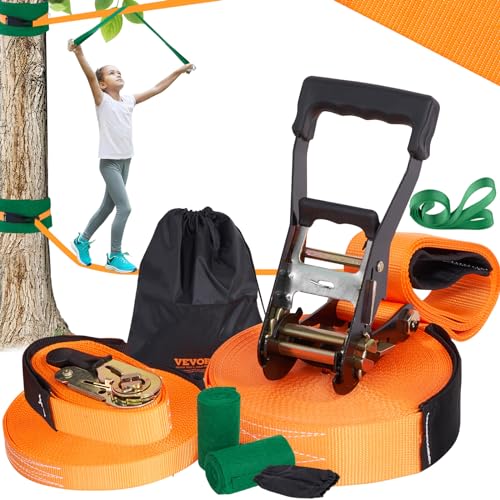
VEVOR brings the complete training format to the entry tier. The kit is a 60 ft slackline set with a training line, tree protectors, an arm trainer, a carry bag, and an instruction manual in the box, which is the full component list of the mid-range training kits above it, offered by a generalist outdoor brand whose catalogue runs from tools to playground equipment. That completeness is this pick’s real specification. The usual budget compromise in this category is a bare line and a ratchet with everything else sold separately, and this kit does not make it: a first-time buyer gets the handrail line, the bark protection, and the bag in the same box, and can rig a correct, tree-safe setup on the first afternoon without a second order.
The format is the standard two-piece ratchet system the rest of this guide uses, so everything in the How to Choose section applies unchanged: the training line rigs overhead as a handrail, the protectors wrap the trunks before the webbing goes on, and the ratchet tensions the main line. For a family that is not yet sure slacklining will stick, or a camp, school, or rental property buying a line for guests, that standard format at the entry tier is the rational shape of the purchase. The line will teach the same first steps as any pick here, because the first steps are about width, height, and tension, not about brand.
The honest limits are about published data, and they are worth stating exactly. The listing data reviewed for this kit does not publish a webbing width, a breaking load, or a working capacity figure, where the picks above it print at least some of those numbers, so a buyer who needs a stated capacity for a heavier walker should choose a kit that prints one, the Trailblaze with its 300 lb figure or the Gibbon with its certification trail. The specialist paper trail is absent here as well. What the kit offers instead is the complete format at the category’s entry point, from a brand with a broad service network behind it, and for the buyer testing the water that trade is the right one.
Specs
- Brand: VEVOR
- Type: Slackline kit with training line
- Line: 60 ft, per the listing title
- Training line: Included, per the listing title
- Included components: Tree protectors, arm trainer, carry bag, instruction manual, per the listing title
- Tensioning: Ratchet, per maker data
- Webbing width: Not stated in the listing data reviewed
- UPC: 197988345930, per published listing data
- Tier: Budget
Where it fits best: First-time buyers, camps, schools, and guest properties that want the complete training format, handrail line and tree protection included, at the entry end of the category.
Watch-outs: The listing publishes no width, breaking load, or capacity figure, so buyers who need a stated rating should step up to a kit that prints one. As a generalist brand’s kit, it carries none of the specialist certification data the premium pick publishes.
Care, Storage, and Safety Checks
Care for a slackline kit is webbing discipline and little else. The line is the wear part: inspect it along its full length at the start of each season and after any setup on rough bark, looking for frayed edges, cut fibers, and flat spots where the webbing has been crushed in the ratchet. Webbing that has been cut, sun-rotted to stiffness, or abraded through its surface weave is retired, not nursed, because the line’s strength lives in those fibers. Keep webbing out of prolonged sunlight when it is not rigged, since ultraviolet light is the material’s slow enemy, and never let a line run over a sharp edge, a metal corner, or rough masonry without padding. The ratchet wants the other half of the routine: check that its safety lock engages, that the spindle and gears are free of grit, and that the handle closes fully. A ratchet that slips a tooth under tension is replaced, not trusted.
Storage discipline is about keeping the system dry, loose, and complete. Take the line down between sessions rather than leaving it tensioned outdoors for weeks; constant tension and weather age webbing faster than use does, and a line left up is a line exposed to every storm and every lawn mower. Coil the webbing loosely rather than winding it tight, store it dry in its carry bag, and keep the full component list together, line, ratchet strap, training line, arm trainer, ratchet cover, and both tree pads, because a kit missing its pads will scar the first tree it meets and a kit missing its ratchet strap is a rope. Tree pads that live outdoors want a rinse and a dry before storage, since felt pads stored damp will mildew against the webbing they protect.
A note on safety and recalls, for completeness: no United States recall covers slackline kits as a product class, and none covers any of the five picks here. The nearest record in the federal file is a different product: the CPSC recall of TT Trsmima zipline kits, announced in July 2026 under recall number 26-632, in which the steel cable, turnbuckle, or seat of a backyard riding zipline could detach or break in use. A zipline is a steel cable you ride, not a webbing line you walk, and no pick here is affected; the lesson underneath it is the one that transfers, which is that hardware strung between trees under tension earns a close inspection before every season of use. The slackline-specific checks are setup checks. Anchor only to healthy, living trees of solid girth or to posts built for the load, never to dead trunks, fence panels, or saplings. Rig the line low, knee height for beginners, over grass or another forgiving surface, and keep the fall zone on both sides clear of rocks, roots, furniture, and spectators. Release ratchet tension slowly and with a firm grip, standing to the side of the handle rather than over it, and never let a child work the ratchet. Walked with those checks observed, a slackline is among the gentlest pieces of equipment in the yard: the falls are short, the landing is grass, and the line itself is the softest thing in the setup.
FAQ
What is a slackline kit, and how is it different from a tightrope?
A slackline kit is a two-piece system, a flat webbing line with a sewn loop and a shorter ratchet strap, that stretches between two trees or posts and tensions with a ratchet. The difference from a tightrope is the tension itself. A tightrope is pulled rigid and stays still underfoot, while a slackline is tensioned firmly but keeps its give, so the line bounces and sways and the walker balances actively with every step. That movement is the activity: it trains balance, leg strength, and focus at walking height over grass, which is why the same equipment shows up in backyards, climbing gyms, and physical therapy settings. Most backyard kits use two-inch webbing and include tree protectors, and the complete ones add an overhead training line to hold while learning.
How long a slackline kit do I need for my backyard?
Shorter than the boxes suggest. Kit lengths are system totals that include the ratchet strap and the webbing wrapped around both trunks, so a 49 ft kit offers a 41 ft main line and a 60 ft kit somewhat less span than its name. Most backyard setups use ten to twenty feet of span between two trees, and every kit in this guide covers that with webbing to spare. Choose by your anchors, not by the largest number: measure the distance between the two trees you will actually use, add the wraps around both trunks, and buy the kit whose main line clears that total. Longer kits earn their length in parks and large properties, and a longer span is also a bouncier, harder line, so extra length is not a beginner advantage.
What is a training line, and do beginners need one?
A training line is a second length of webbing rigged above the main line at about arm height, tensioned with its own small ratchet, and held like a handrail while walking. An arm trainer is a shorter handhold that does the same job. Beginners do not strictly need either, since people learned on bare lines for decades, but both shorten the frustrating first sessions dramatically, especially for children and for anyone learning alone without a spotter to walk beside them. Three of the five kits in this guide include an overhead training line and four include an arm trainer. A confident returning walker can skip the feature, and a first-time or family buyer should treat it as close to required.
How high should a slackline be set up, and how tight?
Low, especially at first. The standard beginner setup puts the middle of the line at about knee height when the walker stands on it, which usually means rigging the anchors a little higher, since a loaded line sags toward its center. Falls from knee height onto grass are trivial, and a low line is also a steadier line, because a shorter span of webbing between the walker and the ground moves less. Tension is a feel with a floor under it: the line should be firm enough that a walker in the middle does not bottom out and touch the ground, and no tighter than the ratchet can achieve with firm, controlled handle strokes. If the ratchet needs your full body weight to move, the setup is too ambitious for the span; shorten the span or accept a livelier line. Raise height and length gradually as balance improves, not before.
Conclusion
Slackline kits divide by width, hardware, and how much training help is in the box, not by the activity, because the activity, one flat line, two honest anchors, and one wobbling walker, is identical in every set here. The Gibbon ClassicLine with TreeWear is the classic answer, the original low-stretch two-inch line with a certified safety-lock ratchet and felt tree pads from the maker that defined the category. The ZenMonkey kit is the complete training answer, a 60 ft system with an overhead line, an arm trainer, and the longest tree protectors in the guide. The Trailblaze Complete Kit is the family answer, two full-length lines with wide pads for households learning together. The flybold kit is the hardware answer, a twin gear ratchet and a five-ton break load for buyers rigging longer spans. And the VEVOR kit is the entry answer, the complete training format at the budget tier. Match the identifier, protect the trees, rig it low, and any of the five will be teaching balance for seasons.