Key takeaways
- Compare the best desk fans for bedrooms, from a whisper-quiet Dreo circulator to a clip-on Lasko for bunks, with speeds, reach and noise levels checked.
A desk fan in a bedroom has to do two jobs that pull in opposite directions. It needs enough airflow reach to keep a sleeper cool through the night, but it also has to stay quiet on its lowest setting, fit on a nightstand or dorm desk, and aim its breeze at the bed rather than at a wall. A fan that is too tall blocks a lamp or alarm clock, and one that cannot tilt wastes its airflow on the ceiling.
This roundup compares five corded tabletop models built for exactly that job. The Dreo DR-HAF002 leads on published quietness, the Woozoo SC15T adds multi-directional oscillation and a remote, and the Honeywell HT-900 covers the budget end of the range. The Vornado 660 is the larger whole-room option, while the Lasko 2004W clips onto a headboard or bunk where no flat surface is free. Every figure below comes from published listing and manufacturer data.
As an Amazon Associate, we earn from qualifying purchases.
Quick Answer
For most bedrooms, the Dreo DR-HAF002 is the strongest pick, pairing a 25-decibel low setting with a 70-foot airflow reach and a tilting head. The Woozoo SC15T adds multi-directional oscillation and a remote, the Honeywell HT-900 is the simple budget workhorse, the Vornado 660 covers larger rooms, and the Lasko 2004W clips onto a headboard or bunk.
Table of Contents
- How We Compared These Desk Fans
- 1. Dreo DR-HAF002 Air Circulator Fan
- 2. IRIS USA Woozoo PCF-SC15T Globe Fan
- 3. Honeywell TurboForce HT-900 Air Circulator
- 4. Vornado 660 Large Air Circulator
- 5. Lasko 2004W Clip Fan
- How to Choose a Desk Fan for a Bedroom
- Who Should Skip a Desk Fan
- FAQ
- Final Verdict
- Product and ASIN Reference
How We Compared These Desk Fans
Published noise came first, because a bedroom fan runs for hours at close range and the lowest setting is the one most people sleep with. Airflow reach came next: a longer rated reach lets a fan sit across the room instead of beside the pillow. Footprint and tilt followed, since a nightstand fan has to fit beside a lamp and still angle toward the bed. Finally, controls mattered: a remote or an off timer is worth more in a bedroom than in an office, because nobody wants to get out of bed to change a speed.
1. Dreo DR-HAF002 Air Circulator Fan
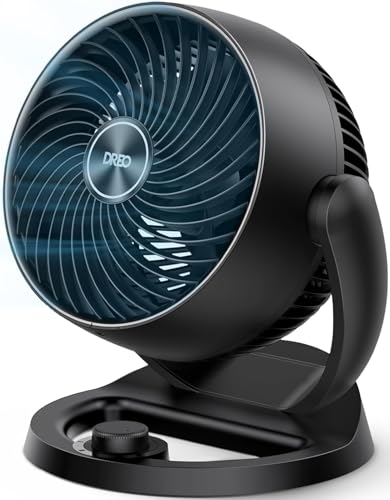
The Dreo DR-HAF002 is the quietest pick here on published figures, with a low setting rated at 25 decibels, and it pairs that with the longest reach of the compact models: its WingBoost blade system is rated to move air up to 70 feet. The head tilts through 120 degrees, so the fan can sit on a low dresser and angle up toward the bed, or sit on a desk and aim level. Three speeds keep the controls simple, and the housing is sized for a nightstand at just under a foot tall. The trade-offs are no oscillation and no remote: the head is aimed by hand, and speed changes happen on the unit. Wall-mount anchors and screws are included for anyone who would rather keep the nightstand clear.
Specs
- Model: DR-HAF002
- Size: 12-inch class table fan
- Airflow reach: up to 70 ft
- Tilt: 120 degrees adjustable
- Speeds: 3
- Noise: as low as 25 dB on the lowest setting
- Dimensions: 10.8 x 9.5 x 11.8 in (D x W x H)
- Power: corded electric
- Included: fan, wall-mount anchors and screws, user manual
2. IRIS USA Woozoo PCF-SC15T Globe Fan

The Woozoo SC15T is the convenience pick. Its globe head oscillates horizontally and vertically at the same time, spreading air around a room instead of holding one fixed line, and every function is available from the included remote: five speeds, oscillation in each direction, a natural breeze pattern, and an off timer of up to four hours. The lowest setting is rated under 28 decibels, the breeze is rated to carry up to 82 feet, and coverage is rated at up to 353 square feet, generous for a fan this small. At just over eight inches wide it fits a crowded dorm desk. The compromises are the fixed globe shape, which cannot be aimed by hand the way a tilting head can, and a remote that needs a clear line of sight.
Specs
- Model: PCF-SC15T (White)
- Speeds: 5, plus a natural breeze pattern
- Oscillation: horizontal and vertical, multi-directional
- Controls: remote control and base panel
- Timer: off timer, up to 4 hours
- Noise: under 28 dB on the lowest setting
- Airflow reach: up to 82 ft; coverage up to 353 sq ft
- Cord length: 70 in
- Dimensions: 8.27 x 8.27 x 11.42 in (W x L x H)
- Weight: 4.62 lb
3. Honeywell TurboForce HT-900 Air Circulator

The HT-900 is the long-running budget workhorse of this group. It keeps things mechanical and simple: three speeds on a dial, a head that pivots through 90 degrees from horizontal to vertical, and a housing that can also be wall mounted if the nightstand is full. Honeywell rates the breeze to be felt up to 27 feet away, plenty for a fan that will usually sit a few feet from the bed. It is a small 11-inch circulator that is easy to move between a desk and a nightstand. What it gives up against the Dreo and Woozoo is refinement: no remote, no timer and no oscillation, and Honeywell publishes no decibel figure for it, so light sleepers should use the lowest speed and place it farther from the bed.
Specs
- Model: HT-900 (Black)
- Size: 11 in
- Speeds: 3
- Pivot: head pivots 90 degrees
- Airflow reach: breeze felt up to 27 ft
- Mounting: tabletop or wall mount
- Dimensions: 6.3 x 8.94 x 10.9 in (D x W x H)
- Power: corded electric
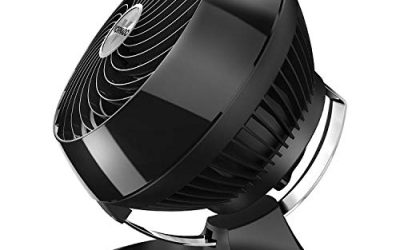
4. Vornado 660 Large Air Circulator

The Vornado 660 is the pick for larger bedrooms where a compact fan runs out of reach. Its Vortex system circulates the air of a whole room rather than blowing a narrow stream, and Vornado rates it to move air up to 100 feet. Four speeds are selected with push-button controls, and the head tilts through 90 degrees on a chrome glide bar, so it can sit on the floor or a low stand and aim up across the bed. The front grill removes for cleaning, which matters for a fan that runs nightly. It is noticeably bigger than the other fans here, so it suits a dresser top or floor corner better than a small nightstand, and it has no remote or timer. Buyers pay for airflow and build rather than features: the 660 sits in the premium tier here.
Specs
- Model: 660 (CR1-0121-06, Black)
- Speeds: 4
- Tilt: 90 degrees adjustable, chrome glide bar
- Airflow reach: up to 100 ft, whole-room circulation
- Grill: removable for cleaning
- Controls: push-button
- Power: corded electric
- Warranty: 5-year manufacturer guarantee
5. Lasko 2004W Clip Fan

The Lasko 2004W solves a different problem: bedrooms and dorms where there is no flat surface to spare. Its spring clip grips a headboard, a bunk rail, a shelf edge or a desk lip, and the head pivots through 360 degrees, so the breeze can be aimed from almost any mounting point. At six inches it is a personal fan rather than a room circulator, with two speeds for quiet close-range use. That makes it a sensible pick for a top bunk, a reading chair or a vanity, and a poor one for cooling a whole double bed. There are no extras: no remote, no timer, no oscillation. What it offers is placement freedom the other four cannot match, in the budget tier of this roundup.
Specs
- Model: 2004W (White)
- Size: 6 in
- Speeds: 2
- Pivot: 360 degrees
- Mounting: clip-on
- Power: corded electric
How to Choose a Desk Fan for a Bedroom
Start with noise. If the fan will run while you sleep, compare the published low-setting decibel figures first: ratings in the mid-20s, like the Dreo and the Woozoo on low, are the quietest class here, while fans without a published figure should sit farther from the bed. Next, match reach to placement: a nightstand fan only needs a short rated reach, while a fan across the room needs a circulator rated for tens of feet, like the Vornado 660. Then check the footprint against the fan dimensions, remembering that a tilting head needs clearance above as well.
Controls decide how the fan fits your routine. A remote and an off timer, both on the Woozoo, suit sleepers who cool the room down and then let the fan stop. A simple dial, like the Honeywell, suits set-and-forget use. Oscillation spreads air for two sleepers sharing a bed; a fixed tilting head suits one sleeper who wants the breeze aimed and steady. Finally, consider mounting: wall-mount options and the Lasko clip exist for rooms where surface space is the limit.
Who Should Skip a Desk Fan
Skip a desk fan if your bedroom is large and the bed sits far from any surface a fan can occupy; a tower or pedestal fan will move more air for that layout. Skip one for cooling a whole open-plan studio, where a floor circulator or a ceiling fan does the job better. Light sleepers disturbed by any mechanical hum may prefer to cool the room before bed and switch the fan off, in which case an off timer matters more than fan type. And for a baby’s nursery, choose a fan placed well out of reach and aimed indirectly rather than a clip fan within grabbing distance.
FAQ
How quiet should a bedroom desk fan be?
Look at the published figure for the lowest speed, since that is the setting used overnight. The quietest models here rate it in the mid-20-decibel range. Fans without a published figure can still suit sleep, but place them farther from the bed.
Is an air circulator better than a regular desk fan for a bedroom?
A circulator throws a focused stream farther, so it can sit across the room and still reach the bed, and it mixes the room air more evenly. A regular desk fan gives a wider, softer breeze at close range. For a nightstand a few feet away, either works; for across-the-room placement, a circulator is the better fit.
Can a desk fan cool two people in a double bed?
Yes, if it oscillates or has whole-room circulation. The Woozoo SC15T sweeps horizontally and vertically, and the Vornado 660 circulates air around the room, so both cover a double bed better than a fixed head aimed at one side. A small personal fan like the Lasko is a one-person solution.
Where is the best place to put a desk fan in a bedroom?
Aim it so the breeze crosses the bed rather than blowing at a face all night. A nightstand beside the bed, a dresser angled toward the foot of the bed, or a headboard clip mount all work. Keep the rear intake clear of curtains and walls so airflow is not choked.
Final Verdict
For most bedrooms, the Dreo DR-HAF002 is the buy: the quietest published low setting in this group, a long 70-foot reach, and a tilting head in a nightstand-friendly size. Choose the Woozoo SC15T for oscillation and a remote with an off timer, especially in a dorm. The Honeywell HT-900 is the budget workhorse, the Vornado 660 is the premium step up for larger rooms, and the Lasko 2004W is the specialist for bunks and headboards where no surface is free.
Product and ASIN Reference
| Product | ASIN |
|---|---|
| Dreo DR-HAF002 Air Circulator Fan | B0BSH75KZ3 |
| IRIS USA Woozoo PCF-SC15T Globe Fan | B08GDDF56H |
| Honeywell TurboForce HT-900 Air Circulator | B001R1RXUG |
| Vornado 660 Large Air Circulator | B0025QKUE8 |
| Lasko 2004W Clip Fan | B00FXOFO7W |