Key takeaways
- Compare the best sunrise alarm clocks for shift workers, with dimmable displays, sunset wind-downs, backup alarms and gradual light for daytime sleepers.
The best sunrise alarm clock for shift workers is the Lumie Bodyclock Shine 300, because it pairs a fully adjustable sunrise with a display that dims itself down, so it works as well for a 2 p.m. wake-up as a dawn one. Shift workers ask different things of a wake-up light than nine-to-five sleepers. The alarm has to fire at any hour, not just in the morning. The display must not glow into a blacked-out bedroom during daytime sleep. The wind-down at the start of a sleep block matters as much as the wake-up at the end of it, because falling asleep at 8 a.m. is its own problem. And because rosters change weekly, the alarm needs to be quick to reset. The five clocks below were chosen against those criteria: gradual light at any hour, displays that dim or switch off, sunset programs, and backup sounds assertive enough to close the deal.
As an Amazon Associate, we earn from qualifying purchases.
Quick Answer
For shift workers, the Lumie Bodyclock Shine 300 is the strongest all-round pick because its display dims automatically and its sunrise can run from 15 to 90 minutes at any hour. The Dreamegg Sunrise 1 adds sleep sounds for daytime rest, while the Philips HF3500/60 keeps things simple with a bright 200-lux wake light.
Table of Contents
- Quick Answer
-
- Lumie Bodyclock Shine 300
-
- Philips SmartSleep Wake-Up Light HF3500/60
-
- Dreamegg Sunrise 1
-
- Amazon Echo Spot (2024 Release)
-
- Casper Glow Light (Single Pack)
- How to Choose
- Who Should Skip
- FAQ
- Final Verdict
- Product and ASIN Reference
1. Lumie Bodyclock Shine 300

The Shine 300 is the most shift-aware clock in this roundup. Its sunrise and sunset durations are adjustable from 15 to 90 minutes, so a worker coming off nights can set a long, slow sunset to ease into daytime sleep and an equally gradual sunrise before an evening shift. The display is light-sensitive and auto-dimming, dropping to low or off in a dark room, exactly what a blackout-curtained bedroom needs at midday.
Fifteen wake-up sounds plus an FM radio give the audio side real range, and a tap snoozes the alarm without hunting for a button. The light uses warm white LEDs rather than a harsh blue-white panel, and the sunset can pair with sleep sounds that fade out with the light. There is no app and no Wi-Fi, which many shift workers will count as a plus: every setting lives on the device, and nothing about your wake time depends on a network or a subscription.
Specs
- Model: NBCSA-1000
- Sunrise/sunset duration: Adjustable, 15 to 90 minutes
- Wake-up sounds: 15, plus FM radio
- Display: Auto-dimming, can be set low or off
- Light: Warm white LED
- Snooze: Tap control
- Warranty: 3 years
- Tier: Premium
2. Philips SmartSleep Wake-Up Light HF3500/60
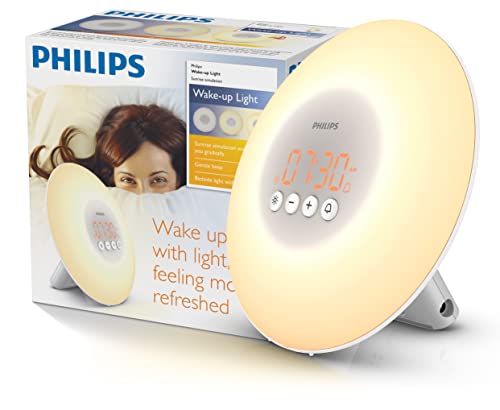
The HF3500/60 is the straightforward option: a sunrise simulation, a gentle beep, and very little else to configure. For shift workers whose roster changes constantly, that simplicity has real value, because the alarm is set with physical controls in seconds, with no app account between you and sleep. The light reaches 200 lux across 10 brightness settings, enough to register through closed eyelids in a darkened room even when the wake-up falls mid-afternoon.
Philips builds this model around a single wake-up sound, a gentle beep that follows the light, so it suits lighter sleepers and anyone whose partner keeps a different schedule. The housing doubles as a bedside lamp for reading before a sleep block. There is no sunset program and no sound library, so workers who need help falling asleep after a night shift should look at the Lumie or Dreamegg instead. As a pure, dependable wake-up light at any hour, though, it covers the brief.
Specs
- Model: HF3500/60
- Light intensity: 200 lux
- Brightness settings: 10
- Wake-up sounds: 1 (gentle beep)
- Dimensions: 7.87 x 7.87 in
- Weight: 1.19 lb
- Power: Corded electric
- Warranty: 2 years
- Tier: Budget
3. Dreamegg Sunrise 1

The Sunrise 1 is built as much for falling asleep as for waking, the right emphasis for daytime sleepers. Its library of 29 soothing sounds includes white, pink and brown noise plus seven fan sounds, the kind of steady masking audio that covers household noise and traffic while you sleep. A sleep timer runs from 5 to 180 minutes or stays on, covering a full sleep block or just the first fragile hour.
On the waking side, a simulated sunrise pairs with nature sounds, and the physical controls sit on the back of the unit, keeping the front clean. The display is dimmable, a detail that matters when the clock faces your pillow at noon, and the night light is controlled independently of the alarm. A CR2032 backup battery is included to protect the time and alarm settings through a power cut, removing one classic failure mode: the alarm lost to a tripped breaker. The fabric-covered body is compact at just under 6 inches across, and 12/24-hour switching matches the 24-hour clock most rosters use.
Specs
- Model: HFD-W26 (Classic White)
- Sleep sounds: 29 (nature, white/pink/brown noise, fan, meditation)
- Sleep timer: 5 to 180 minutes, or always on
- Display: Dimmable
- Night light: Yes, independently controlled
- Backup: CR2032 battery included for settings
- Dimensions: 5.91 x 5.91 x 2.87 in
- Weight: 12.8 oz
- Tier: Mid-range
4. Amazon Echo Spot (2024 Release)
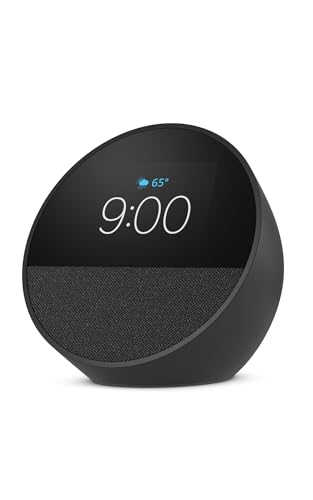
The Echo Spot takes the scheduling problem seriously. Because it runs Alexa, alarms can be set, moved and cancelled by voice from bed, genuinely useful when a roster changes at short notice. Recurring alarms can follow custom day patterns, and the gradual-volume option lets the alarm tone or a radio station build rather than jolt. Paired with compatible smart lights through an Alexa routine, it can also ramp the whole room’s lighting up before a shift, not just its own screen.
The 2.83-inch display has a night mode that dims the clock face and shifts it to softer red tones, so it will not light up a darkened room during a daytime sleep block. Music, podcasts and radio stream from its 1.73-inch front-firing speaker for wind-down listening, and a microphone-off button gives privacy control. The trade-offs are obvious: it needs Wi-Fi and an Amazon account, it has no battery backup, and its screen is a clock face rather than a true sunrise lamp, so the light effect depends on routines and bulbs you own.
Specs
- Display: 2.83 in touchscreen with night mode
- Speaker: 1.73 in front-firing
- Voice control: Alexa built in
- Alarms: Multiple, recurring, custom day patterns, gradual volume
- Smart home: Alexa routines for compatible lights
- Dimensions: 4.5 x 4.1 x 4.4 in
- Weight: 14.3 oz
- Power: Corded, Wi-Fi required
- Tier: Mid-range
5. Casper Glow Light (Single Pack)

The Glow is the outlier here: no clock face, no speaker, no alarm tone at all. It is a portable warm-white lamp that brightens and dims on a schedule set in the Casper app, waking you with light alone. For shift workers who sleep lightly, share a room with a partner on an opposite roster, or cannot face an audible alarm after nights, a silent wake-up is a legitimate strategy, and the absence of a display makes it the most blackout-friendly device here.
It lifts off its wireless charging base and can be carried, so it doubles as a low, warm light for getting ready without switching on overheads and waking the household. Flip it over and it starts a sleep session, gradually dimming so you can doze off; twist it to adjust brightness by hand. Wake-up brightening runs 30 minutes by default and is adjustable in the app. The limitations follow from the concept: scheduling needs the app, and there is no audible backup if you sleep through the light.
Specs
- Model: 953-000009-001 (Single Pack)
- Light: Warm white LED, dimmable
- Wake-up: App-scheduled gradual brightening, 30 minutes by default
- Sleep session: Flip to start gradual dimming
- Display: None
- Audio: None (silent wake-up)
- Base: Wireless charging base included
- Dimensions: 5.5 x 3.7 x 5.5 in
- Weight: 1.74 lb
- Tier: Premium
How to Choose
Start with the display, because it is the feature shift workers feel most. A clock that cannot dim fully will fight your blackout curtains all day; the Lumie’s auto-dimming display and the Dreamegg’s dimmable readout protect daytime sleep, the Echo Spot answers with a red-toned night mode, and the Casper Glow removes the display entirely. Next, look at the wind-down: a sunset program or sleep sounds with a long timer, as on the Lumie and Dreamegg, help you fall asleep at unfamiliar hours.
Then check the alarm itself. Rotating rosters reward clocks that are quick to reset: physical controls on the Lumie and Philips, voice control on the Echo Spot. Think about backup, too. A settings battery, like the Dreamegg’s included cell, guards against power cuts, while light-only devices carry an oversleep risk for deep sleepers. Finally, match the sound to your household: a gentle beep or a silent lamp respects a partner on the opposite shift.
Who Should Skip
Skip this category if you sleep through light reliably and only a loud, conventional alarm moves you; a sunrise clock will not fix that on its own, and a vibrating or high-volume alarm is the safer primary device. Skip the app-dependent models, the Echo Spot and the Casper Glow, if your bedroom Wi-Fi is unreliable or you do not want an account attached to your alarm. And skip wake-up lights altogether if your problem is really light leakage: blackout curtains and a sleep mask will do more for daytime sleep than any bedside lamp.
FAQ
Can a sunrise alarm clock work for a 3 p.m. wake-up?
Yes. None of these clocks care what the actual sun is doing; the simulated sunrise runs whenever the alarm is set, whether that is 5 a.m. before an early shift or mid-afternoon before a night shift. Check the display, since a bright clock face works against you while you sleep.
How do I stop the clock display ruining my daytime sleep?
Choose a model with a dimmable or auto-dimming display, such as the Lumie Shine 300 or the Dreamegg Sunrise 1, set it to its lowest level or off, and angle it away from the pillow. The Echo Spot’s night mode shifts to dim red tones, and the Casper Glow has no display at all.
Is a light-only alarm safe for heavy sleepers on shifts?
It is a risk. Light-only waking, like the Casper Glow, works well for light sleepers and shared rooms, but if missing a shift start is costly, pair any sunrise clock with an audible backup. Models with radio or multiple sounds, such as the Lumie, build that backup in.
Do these clocks handle rotating rosters?
Mostly, yes, but the effort differs. The Echo Spot lets you move alarms by voice and set custom day patterns, which suits rosters that change weekly. Button-controlled clocks like the Philips and Lumie are quick to reset by hand, though they lack weekday and weekend profiles.
Final Verdict
For most shift workers, the Lumie Bodyclock Shine 300 is the buy: its adjustable sunrise and sunset, auto-dimming display and radio backup cover both ends of an irregular sleep block. The Dreamegg Sunrise 1 is the pick when daytime noise is the enemy, thanks to its sound library and long timer. Choose the Philips HF3500/60 for simple, bright, no-fuss waking, the Echo Spot for voice control and routines, and the Casper Glow when the wake-up has to be silent and the room has to stay dark.
Product and ASIN Reference
| Product | ASIN |
|---|---|
| Lumie Bodyclock Shine 300 | B082VB97H9 |
| Philips SmartSleep Wake-Up Light (HF3500/60) | B00F0W1RIW |
| Dreamegg Sunrise 1 | B0D5MG7K8R |
| Amazon Echo Spot (2024 Release, Black) | B0BFC7WQ6R |
| Casper Glow Light (Single Pack) | B0BB4PRNF3 |