Key takeaways
- Compare five camping lanterns by lumens, runtime, charging and weight, from a crank-ready 600-lumen hub to a pocket AAA pick, and choose the right one.
- Top Pick: BioLite AlpenGlow 500
- Runner-up: Goal Zero Lighthouse 600
- Also consider: Final Verdict
The best camping lantern for most car campers is a rechargeable mid-range model in the 500 to 800 lumen range with a dimmable warm-white mode, because it lights a whole picnic table without blinding anyone and runs for nights at low settings. The five lanterns below cover the main ways campers use area light: the BioLite AlpenGlow 500 for color-accurate light and ambiance modes, the Goal Zero Lighthouse 600 for crank and solar backup charging, the Coleman Classic Rechargeable 800L for the brightest output here, the Black Diamond Moji+ for a pocket-size tent light that also runs on AAA cells, and the Etekcity Collapsible 4-Pack for a budget set you can spread around camp. Each pick is compared on published specifications only.
As an Amazon Associate, we earn from qualifying purchases.
Quick Answer
For most campers, the BioLite AlpenGlow 500 is the safest single buy: 500 lumens, a 6,400 mAh battery, warm and cool white modes, and a USB output for a phone. Choose the Goal Zero Lighthouse 600 if you want hand-crank and solar charging, the Coleman Classic Rechargeable 800L for maximum brightness, the Black Diamond Moji+ for ultralight tent use, and the Etekcity 4-Pack for budget multi-lantern coverage.
Table of Contents
- BioLite AlpenGlow 500
- Goal Zero Lighthouse 600
- Coleman Classic Rechargeable 800L
- Black Diamond Moji+
- Etekcity Collapsible LED Lantern 4-Pack
- How to Choose
- Who Should Skip
- FAQ
- Final Verdict
BioLite AlpenGlow 500

The AlpenGlow 500 is the ambiance pick of this group. Its ChromaReal LEDs carry a CRI of 90, so food and skin tones look natural instead of washed out, and output runs from a 5-lumen glow up to 500 lumens. Nine light settings cover 2,700 K warm white, 5,700 K cool white, multicolor cycling, and a shake-activated candle flicker mode. The sealed 6,400 mAh battery is the largest here, and the USB-A output can pass charge to a phone. Charging in is over micro-USB, which is dated next to USB-C rivals, and at about 380 grams it is a car-camping weight rather than a backpacking one. It sits in the mid-range tier.
Specs:
- Max output: 500 lumens (dimmable down to 5 lumens)
- Battery: 6,400 mAh rechargeable lithium-ion, sealed
- Runtime: 5 hours on high, up to 200 hours on low (manufacturer figures)
- Charging: micro-USB input; USB-A output for charging devices
- Light modes: warm white (2,700 K), cool white (5,700 K), multicolor, candle flicker
- Color rendering: CRI 90 ChromaReal LEDs
- Water resistance: IPX4
- Weight: about 380 g (13.4 oz)
Goal Zero Lighthouse 600

The Lighthouse 600 is built around one idea the others skip: never being stuck with a dead lantern. It recharges three ways, over USB, from a compatible Goal Zero solar panel, or with the hand crank folded into the top, where a minute of cranking returns roughly ten minutes of low light. Output reaches 600 lumens of warm 3,500 K light, and a dial lets you light both sides for 360-degree coverage or one side only to stretch runtime. The 5,200 mAh battery also works as a USB power hub for a phone. Collapsible legs lift it off the table and fold away for packing. Goal Zero publishes no water-resistance rating, so it is a fair-weather, sheltered-camp pick. It sits in the premium tier.
Specs:
- Max output: 600 lumens, warm white at 3,500 K
- Battery: 5,200 mAh (18.98 Wh) rechargeable lithium-ion
- Runtime: 2.5 hours both sides on high, 5 hours one side on high, up to 320 hours one side on low (manufacturer figures)
- Charging: USB input, solar panel input, built-in hand crank
- USB output: 5 V, up to 1.5 A for charging devices
- Direction: one side or both sides
- Dimensions: 4.5 x 5 x 6.5 inches
- Weight: 1.1 lb (498 g)
- Water resistance: not stated by the manufacturer
Coleman Classic Rechargeable 800L
The Coleman Classic Rechargeable 800L is the brightness pick. Its 800-lumen high setting is the strongest output in this roundup, with medium and low steps at 300 and 100 lumens and a beam distance rated up to 18 meters. The built-in 4,800 mAh lithium-ion battery recharges over the included USB to USB-C cord, and a separate USB port tops up a phone. Battery level indicators show how much charge is left, and the cord stores in the base. Coleman rates it IPX4 water resistant and impact resistant to one meter, and the carabiner handle clips to a pack or tent loop. The trade-off is weight: at 2.2 pounds it is the heaviest lantern here and belongs in a car-camping kit. It sits in the mid-range tier.
Specs:
- Max output: 800 lumens (high), 300 lumens (medium), 100 lumens (low), plus flashing mode
- Battery: 4,800 mAh built-in rechargeable lithium-ion
- Runtime: up to 5 hours on high, 15 hours on medium, 45 hours on low (manufacturer figures)
- Charging: USB-C cord included; USB output for devices
- Beam distance: up to 18 meters
- Water resistance: IPX4; impact resistant to 1 meter
- Handle: carabiner handle
- Weight: 2.2 lb
- Warranty: 3-year limited warranty
Black Diamond Moji+
The Moji+ is the tent-and-pack pick. It is a small frosted-globe puck that puts out 200 lumens, enough to light a tent interior or small cooking area without the glare of a big lantern. Its Dual Fuel design runs on three AAA batteries or on Black Diamond’s BD 1500 rechargeable lithium-ion battery, sold separately, so a flat rechargeable pack is never a dead end: any store-bought AAA cells bring it back. It dims smoothly, and the modes include full-spectrum color settings, a campfire mode, and a strobe. There is no USB output, and 200 lumens will not light a group campsite on its own. For backpackers who count grams, though, it is the easiest lantern here to justify carrying. It sits in the budget tier.
Specs:
- Max output: 200 lumens
- Power source: 3 AAA batteries (not included) or BD 1500 rechargeable Li-ion battery (sold separately)
- Light modes: dimmable white, full-spectrum color, campfire, strobe
- Globe: frosted lens for diffused light
- Model number: BD620684
- USB output: none
Etekcity Collapsible LED Lantern 4-Pack
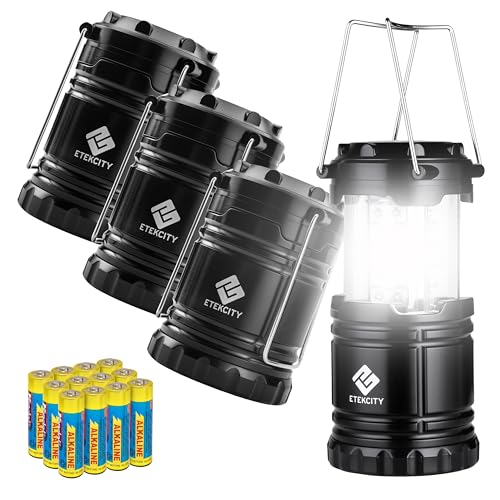
The Etekcity 4-Pack is the budget coverage pick: four collapsible lanterns in one box, so one can hang in the tent, one at the kitchen, with spares for the car and house. Each lantern uses 30 LEDs for up to 154 lumens of 360-degree light, and the collapsible body is the switch: pull it up to turn it on and open it further for more light, push it down to turn it off and pack flat. Each lantern runs on three AA batteries, and the box includes twelve AA cells, so the set works straight out of the packaging. Etekcity rates runtime at up to 50 hours per set of batteries. There is no rechargeable cell or USB output, and output per lantern is modest next to the rechargeable picks. As a multi-tent solution, though, nothing else here spreads light around as cheaply. It sits in the budget tier.
Specs:
- Pack contents: 4 lanterns, 12 AA batteries, 1 manual
- Max output: 154 lumens per lantern, 360-degree illumination
- Light source: 30 LEDs per lantern
- Power source: 3 AA batteries per lantern (included)
- Runtime: up to 50 hours (manufacturer figure)
- Design: collapsible, folds flat for storage
- Dimensions: 3.46 x 3.46 x 4.86 inches per lantern (expanded)
- Weight: 0.67 lb (302 g) per lantern
- Model number: CL10
How to Choose
Start with brightness. A tent interior needs only 100 to 200 lumens, a camp kitchen table is comfortable at 300 to 500, and lighting a group site takes 600 or more, which is why this roundup spans the Moji+ at 200 lumens up to the Coleman at 800. Next, decide how you will feed it. Rechargeable lanterns with USB output, like the AlpenGlow 500, Lighthouse 600, and Coleman 800L, double as small power banks but are dead weight once the charge is gone. The Lighthouse 600 answers that with its crank and solar input, while the Moji+ answers it with AAA compatibility. Battery lanterns like the Etekcity set are simplest to keep ready in an emergency kit, since spare AA cells store for years. Then check runtime at the setting you will actually use, not the headline low-mode figure: most campers live on medium. Finally, match the build to the trip. IPX4 covers splashes for the BioLite and Coleman, the Goal Zero lists no water rating, and weight decides the rest: under 400 grams for a pack, anything goes for a car trunk.
Who Should Skip
Skip this whole category if a headlamp already covers your trips and you camp solo, since a lantern mostly duplicates light you already carry. Skip the rechargeable picks if you cannot reliably recharge between trips or you are stocking a long-term emergency kit, where the AA-powered Etekcity set or AAA-powered Moji+ stays ready on the shelf. Skip the Coleman 800L and Lighthouse 600 for backpacking, since both weigh around a pound or more. Skip the Moji+ and Etekcity lanterns as your only light for group cooking, since 154 to 200 lumens will not carry a full camp kitchen. And skip the Lighthouse 600 if your camps are regularly wet, because Goal Zero publishes no water-resistance rating.
FAQ
How many lumens do you need for a camping lantern?
For a tent, 100 to 200 lumens is plenty. For cooking and games at a table, 300 to 500 lumens is comfortable, and 600 or more lights a shared group site. Dimmability matters as much as peak output, since most evenings are spent well below maximum.
Is a rechargeable lantern better than a battery lantern?
Rechargeable lanterns cost less to run and often add a USB output for a phone, but they are useless once discharged unless they have a backup input like the Lighthouse 600’s crank. Battery lanterns such as the Etekcity 4-Pack and AAA-fed Moji+ are simpler to store and revive, which suits emergency kits.
Can a camping lantern charge a phone?
Some can. The BioLite AlpenGlow 500, Goal Zero Lighthouse 600, and Coleman Classic Rechargeable 800L all have USB output ports fed by their internal batteries. Expect a partial to full phone charge rather than power-bank capacity, and remember every phone charge is light you no longer have.
What does an IPX4 rating mean on a lantern?
IPX4 means the lantern resists water splashing from any direction, which covers light rain and camp splashes but not submersion. The BioLite AlpenGlow 500 and Coleman Classic Rechargeable 800L carry IPX4 ratings; the Goal Zero Lighthouse 600 has no published rating.
Final Verdict
Buy the BioLite AlpenGlow 500 if you want one lantern that does the most jobs well: strong output, long low-mode runtime, natural-looking light, and a phone charge in reserve. Buy the Goal Zero Lighthouse 600 if your trips or outage kit demand a lantern that can recover from empty with a crank or solar panel. Buy the Coleman Classic Rechargeable 800L if raw brightness and a rugged, warrantied build matter more than weight. Buy the Black Diamond Moji+ if the lantern lives in a backpack or tent and AAA backup matters. Buy the Etekcity 4-Pack if the goal is light in several places at once on a budget. Every pick here is a standard lantern, so the choice comes down to brightness, power source, and weight.