Key takeaways
- Compare the best camping water filters by pore size, flow rate and filter life, from an ultralight straw filter to a press-style purifier bottle.
- Top Pick: Quick Comparison
- Runner-up: Quick Comparison
- Also consider: Quick Comparison
The best camping water filter for most people is the Sawyer Squeeze, a 0.1 micron hollow fiber filter that screws onto standard bottles and pouches, is rated by Sawyer for up to 100,000 gallons, and can be restored with a backflush instead of a replacement cartridge. Campers who want the fastest drink at the creek should look at the Katadyn BeFree, anyone traveling where viruses are a concern needs the GRAYL GeoPress purifier, and the Sawyer MINI and the LifeStraw Personal cover the ultralight and emergency-kit ends of the category.
Those five picks span the main ways people actually treat water outdoors: squeezing a pouch at a stream, drinking straight through a straw, or pressing a bottle that purifies as well as filters. Each pick below is described from its published specifications, with pore size, rated filter life, flow rate, and weight laid out so you can match a filter to your trip rather than to a marketing label. One boundary applies to four of the five: a filter removes bacteria and parasites, but only a purifier also addresses viruses, and none of these products makes salt water drinkable.
As an Amazon Associate, we earn from qualifying purchases.
Table of Contents
- How to Choose a Camping Water Filter
- Quick Comparison
- 1. Sawyer Squeeze
- 2. Katadyn BeFree 1.0L
- 3. GRAYL GeoPress
- 4. Sawyer MINI
- 5. LifeStraw Personal
- Care and Storage Tips
- Frequently Asked Questions
- Conclusion
How to Choose a Camping Water Filter
Start with pore size, because it decides what the filter can physically block. Every squeeze and straw filter in this guide uses a hollow fiber membrane rated at 0.1 or 0.2 micron absolute, small enough to stop bacteria such as E. coli and salmonella and parasites such as giardia and cryptosporidium, which are the standard risks in North American backcountry water. Viruses are far smaller than either rating, so no hollow fiber filter in this guide claims virus removal; the GRAYL GeoPress is the one pick here built as a purifier, using electroadsorption and activated carbon to address viruses, bacteria, and parasites, plus many chemicals and heavy metals, per GRAYL’s published figures.
Next, weigh rated filter life against maintenance. The two Sawyer filters are rated for up to 100,000 gallons and are cleaned by backflushing with the included syringe, so there is no cartridge to replace. The Katadyn BeFree and the LifeStraw are rated for 1,000 liters and 4,000 liters respectively, and the GeoPress cartridge is rated for 250 liters before it needs a fresh cartridge. A long rated life only holds if you backflush on schedule and keep silty water from clogging the membrane, so campers who draw from muddy sources should pre-filter through a bandana or let sediment settle first.
Finally, match the format to the trip. Squeeze filters fill bottles and cook pots and can run as gravity setups at camp. The BeFree’s soft flask is the fastest solo drink but fits only its own 42 mm flask. A straw filter is the lightest option and works only while you are at the water’s edge. The GeoPress treats a full 24 ounces with each press and needs no separate bottle, at the cost of the heaviest carry in this guide.
Quick Comparison
| Product | Style | Pore Size | Rated Life | Weight | Tier |
|---|---|---|---|---|---|
| Sawyer Squeeze | Squeeze / gravity | 0.1 micron | Up to 100,000 gallons | 3 oz | Mid-range |
| Katadyn BeFree 1.0L | Soft flask squeeze | 0.1 micron | Up to 1,000 liters | 2.2 oz | Mid-range |
| GRAYL GeoPress | Press purifier bottle | Electroadsorption | 250 liters per cartridge | 15.9 oz | Premium |
| Sawyer MINI | Squeeze / straw | 0.1 micron | Up to 100,000 gallons | 2 oz | Budget |
| LifeStraw Personal | Straw | 0.2 micron | Up to 4,000 liters | 1.6 oz | Budget |



1. Sawyer Squeeze
The Sawyer Squeeze is the default recommendation in this category because it pairs the joint-longest rated life here with the most flexible plumbing. The filter threads onto standard 28 mm bottles and the two included 32-ounce pouches, works as an inline filter on a hydration pack with the included adapter, and can hang as a gravity filter at camp. Sawyer publishes a flow rate of up to 1.7 liters per minute on a fresh filter, and when flow slows, the included cleaning syringe backflushes the membrane and restores it, which is why the Squeeze is sold as a maintain-it-forever filter rather than a disposable one.
Sawyer’s current published weight for the filter is about 3 ounces; some older listing copy still says 2 ounces, so check the listing if an exact figure matters to your pack list. The kit is the most complete in this guide, and the filter carries Sawyer’s lifetime limited warranty. Like every hollow fiber filter here, it does not remove viruses, chemicals, or salt, and Sawyer states that dissolved substances pass through.
Specs
- Model: SP129
- Filter type: Hollow fiber squeeze filter
- Pore size: 0.1 micron absolute
- Rated life: Up to 100,000 gallons
- Flow rate: Up to 1.7 liters per minute
- Weight: 3 oz (filter only)
- Threads: Standard 28 mm
- Includes: Filter, two 32 oz squeeze pouches, drinking straw, hydration pack adapter, backflushing syringe
- Warranty: Lifetime limited warranty
- Tier: Mid-range
2. Katadyn BeFree 1.0L
The Katadyn BeFree is the speed pick. Its EZ-Clean membrane is published at up to 2 liters per minute, the fastest flow of any filter in this guide, and the whole system is just a filter cap on a 1.0 liter HydraPak soft flask: fill the flask, screw the cap on, and drink or squeeze. Cleaning needs no syringe or tools, because shaking or swishing the membrane in water clears it, which suits runners, fastpackers, and anyone filtering many small fills a day.
The trade-offs are published just as clearly. The membrane is rated for up to 1,000 liters, the shortest life among the squeeze filters here, and the filter fits only Katadyn’s own 42 mm flask, so standard bottles and pouches from other brands do not attach. Published weights for the filter and flask together range from about 2.2 to 2.3 ounces depending on the source; the figure in the specs below follows the listing data. Katadyn covers the BeFree with a 2-year warranty.
Specs
- Model: 8018006
- Filter type: Hollow fiber squeeze filter on a soft flask
- Pore size: 0.1 micron
- Rated life: Up to 1,000 liters
- Flow rate: Up to 2 liters per minute
- Weight: 2.2 oz (filter and 1.0L flask)
- Flask: 1.0 liter HydraPak soft flask, 42 mm thread
- Cleaning: Shake or swish to clean, no backflush syringe
- Warranty: 2-year warranty
- Tier: Mid-range
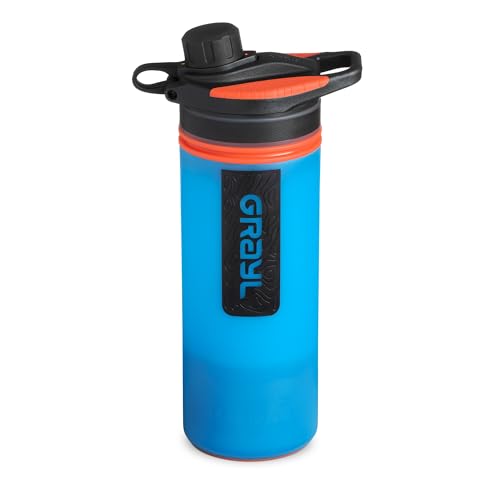
3. GRAYL GeoPress
The GRAYL GeoPress is the only purifier in this guide, and it earns its place wherever viruses, not just bacteria and parasites, are part of the risk picture. Fill the outer cup from any freshwater source, press the inner cartridge down, and the electroadsorption and activated carbon cartridge treats 24 ounces in a single press. GRAYL publishes a flow rate of 5 liters per minute, the removal of viruses, bacteria, and protozoa, and reduction of many chemicals, pesticides, and heavy metals, a broader claim set than any membrane filter here can make.
That breadth costs weight and cartridge life. At 15.9 ounces the GeoPress is several times heavier than the squeeze filters, and each cartridge is rated for 250 liters, so frequent users will replace cartridges on a schedule the Sawyer owners never face. The ASIN below is the Bali Blue colorway of the 24-ounce GeoPress; other colors of the same bottle sell under their own listings. For international travel, questionable taps, and group basecamps, it is the most capable single bottle in this roundup.
Specs
- Model: 411-BAL (Bali Blue)
- Filter type: Press-style purifier bottle
- Technology: Electroadsorption and activated carbon
- Capacity: 24 fl oz per press
- Rated life: 250 liters per cartridge
- Flow rate: 5 liters per minute
- Weight: 15.9 oz
- Dimensions: 10.4 x 3.4 in
- Removes: Viruses, bacteria, protozoa, and particulates, plus many chemicals and heavy metals, per GRAYL
- Tier: Premium
4. Sawyer MINI
The Sawyer MINI shrinks the Squeeze formula into a 2-ounce filter that disappears into a hip belt pocket, a first aid kit, or a daypack’s repair pouch. It uses the same 0.1 micron absolute hollow fiber membrane and the same up-to-100,000-gallon rating as its bigger sibling, threads onto standard 28 mm bottles, and ships with a 16-ounce squeeze pouch, a drinking straw for drinking straight from a source, and a cleaning syringe for backflushing. In practice it is the filter most campers carry as a backup even when a larger system does the daily work.
What you give up against the Squeeze is flow and kit. The MINI moves water more slowly, and Sawyer does not publish a liters-per-minute figure for it, so the specs below mark the flow rate as not stated rather than borrowing the Squeeze’s number. The pouch is smaller, and there is no hydration adapter in the box. For short trips, group kits, and emergency bags, those are easy trades for the weight and the rated life.
Specs
- Model: SP128
- Filter type: Hollow fiber squeeze and straw filter
- Pore size: 0.1 micron absolute
- Rated life: Up to 100,000 gallons
- Flow rate: Not stated
- Weight: 2 oz
- Threads: Standard 28 mm
- Includes: Filter, 16 oz squeeze pouch, drinking straw, cleaning syringe
- Warranty: Lifetime limited warranty
- Tier: Budget
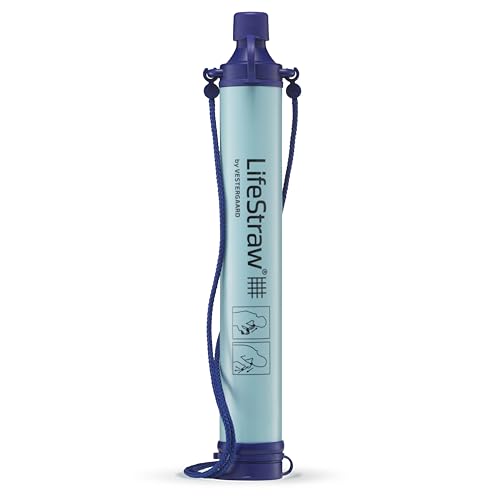
5. LifeStraw Personal
The LifeStraw Personal is the simplest water treatment in this guide: a sealed straw with a 0.2 micron membrane inside and nothing to assemble, squeeze, or pump. You drink through it directly from a stream, a lake, or a container, and LifeStraw rates the membrane for up to 4,000 liters, after which it stops allowing water through so there is no guessing about when it is done. At 1.6 ounces and 9 inches long, it is the classic glovebox, emergency-kit, and just-in-case filter.
Its limits are structural. A straw cannot fill a bottle or a cook pot, so it serves one drinker at the water’s edge and nobody else’s camp chores. LifeStraw is explicit that the Personal filter does not remove viruses, and its 0.2 micron membrane is a coarser rating than the 0.1 micron membranes in the other four picks, though it still covers the bacteria and parasites the maker publishes. Campers who want a LifeStraw that fills bottles should look at the brand’s bottle and squeeze models instead; this original straw remains the lightest way to have any treatment at all.
Specs
- Model: LSPHF038
- Filter type: Straw filter
- Pore size: 0.2 micron
- Rated life: Up to 4,000 liters (1,000 gallons)
- Flow rate: Not stated
- Weight: 1.6 oz (46 g)
- Dimensions: 9 x 1.2 in
- Includes: One LifeStraw Personal filter with lanyard
- Shelf life: Not stated
- Tier: Budget
Care and Storage Tips
Hollow fiber filters live or die on two habits. Backflush on the maker’s schedule: Sawyer supplies a syringe for exactly this, and pushing clean water backward through the membrane after trips keeps flow near its published rate. The BeFree asks for a shake or swish instead, and the GeoPress cartridge is replaced rather than cleaned. Second, never let a wet hollow fiber filter freeze. Water trapped in the fibers expands as it turns to ice and can crack the membrane invisibly, and the makers advise keeping the filter in a pocket or sleeping bag on sub-freezing nights and retiring a filter you suspect has frozen.
Before a long trip, run a liter of clean water through the filter at home to confirm flow, and pack a backup treatment method, even if it is only a small bottle of purification tablets, so a lost or damaged filter never ends the trip.
Frequently Asked Questions
What is the difference between a camping water filter and a purifier?
A filter physically blocks bacteria and parasites with a membrane, which covers the standard risks in backcountry freshwater. A purifier also addresses viruses, which are too small for the 0.1 and 0.2 micron membranes in this guide. The GRAYL GeoPress is the purifier here; the other four picks are filters, and their makers do not claim virus removal.
How long does a camping water filter last?
It depends on the model and on your water. Published ratings in this guide run from 250 liters for a GeoPress cartridge and 1,000 liters for the BeFree, up to 4,000 liters for the LifeStraw and up to 100,000 gallons for the two backflushable Sawyer filters. Silty water shortens any rating, so pre-filtering cloudy water and backflushing on schedule matter as much as the headline number.
Can a camping water filter make salt water or polluted water safe to drink?
No. None of the five products here desalinates water, and the hollow fiber filters do not remove dissolved chemicals. The GeoPress publishes reduction of many chemicals and heavy metals, but that is not the same as treating industrial or agricultural runoff, and no portable filter in this category replaces checking local water advisories.
How do I protect a water filter in freezing weather?
Keep the filter warm and dry-ish: sleep with it in your bag, carry it in an inside pocket, and drain and shake out loose water after each use. If a hollow fiber filter freezes with water inside, the membrane can crack without any visible sign, so a filter you know froze should be replaced rather than trusted.
Conclusion
Match the format to the trip and any of these five will treat backcountry water well within its published claims. Take the Sawyer Squeeze as the all-around filter for bottles, pots, and gravity setups, the Katadyn BeFree when fast solo fills matter more than filter life, and the GRAYL GeoPress when the destination calls for a true purifier. Add the Sawyer MINI as the ultralight workhorse or backup, and keep a LifeStraw Personal wherever a just-in-case filter belongs. Check pore size, rated life, and what each maker does and does not claim to remove before you buy, and the filter you pack will be the one your water sources actually require.