Our Short List of 3

- Best for: Owners of 36 volt EZGO TXT carts who want a direct D-style replacement with set-and-forget maintenance charging.
- Output voltage: 36 volts
- Output current: 18 amps
- Input voltage: 120 volts AC
- Plug type: PowerWise D-style plug

- Best for: Owners of 48 volt Club Car carts with the round three-pin receptacle who want a fast, sealed, OBC-friendly replacement.
- Output voltage: 48 volts
- Output current: 15 amps
- Output power: 800 watts
- Input voltage: 100 to 240 volts AC

- Best for: Households with two carts on different voltages, or owners who want one charger that covers lead-acid and lithium packs alike.
- Output voltage: 36 volts or 48 volts, manually selectable
- Output current: 18 amps at 36 volts, 13 amps at 48 volts
- Input voltage: 100 to 240 volts AC
- Plug type: D-style plug
All 5 Picks at a Glance
| Product | Specs | Action |
|---|---|---|
| 1. FORM 36 Volt 18 Amp Charger for EZGO TXT |
| Check price on Amazon |
| 2. EPOWREY 48 Volt 15 Amp Charger for Club Car |
| Check price on Amazon |
| 3. Huiaipaic Dual-Voltage 36 Volt and 48 Volt Charger |
| Check price on Amazon |
 4. Delta-Q SC-48 EZGO 48 Volt Charger |
| Check price on Amazon |
 5. Lztsuply 48 Volt 15 Amp Charger for Club Car |
| Check price on Amazon |
Key takeaways
- Compare the best golf cart chargers for 36V and 48V carts, with plug types, amp ratings, and battery chemistry fit explained so you buy the right one.
A dead cart on a Saturday morning usually traces back to one of two things: a tired battery pack or a charger that never matched the cart in the first place. The best golf cart battery chargers remove the second problem entirely. They match your pack voltage, fit your charging receptacle without an adapter, suit your battery chemistry, and shut themselves down when the pack is full instead of cooking it overnight.
The short answer is simple. If you run a 36 volt EZGO TXT with a D-style receptacle, the FORM 36 volt 18 amp charger is the most direct replacement. If you run a 48 volt Club Car with the round three-pin receptacle, the EPOWREY 48 volt 15 amp charger is the strongest all-around pick, with the Lztsuply 48 volt 15 amp charger close behind for owners who want a longer warranty and a depleted-battery rescue mode. If one charger must serve two carts, or you are not sure which voltage your next cart will use, the dual-voltage Huiaipaic unit covers 36 volt and 48 volt packs with a manual switch. And if you want the original-equipment charger built for EZGO fleet carts, the Delta-Q SC-48 is the premium choice, with temperature-compensated charging and a sealed die-cast housing.
As an Amazon Associate, we earn from qualifying purchases.
Table of Contents
- How to Choose a Golf Cart Battery Charger
- Quick Comparison
- 1. FORM 36 Volt 18 Amp Charger for EZGO TXT
- 2. EPOWREY 48 Volt 15 Amp Charger for Club Car
- 3. Huiaipaic Dual-Voltage 36 Volt and 48 Volt Charger
- 4. Delta-Q SC-48 EZGO 48 Volt Charger
- 5. Lztsuply 48 Volt 15 Amp Charger for Club Car
- Mistakes That Shorten Battery Life
- Frequently Asked Questions
- Conclusion
- Product and ASIN Reference
How to Choose a Golf Cart Battery Charger
Match the pack voltage first
Voltage is the one specification that cannot be fudged. A 36 volt charger on a 48 volt pack will run for hours and never finish the job, leaving the cart sluggish and the batteries sulfated from chronic undercharging. A 48 volt charger on a 36 volt pack is worse: it pushes the pack far past its safe ceiling and can boil off electrolyte, warp plates, and create a genuine safety hazard. Count your batteries and check their labels before you shop. Six 6 volt batteries make a 36 volt pack. Six 8 volt batteries, four 12 volt batteries, or eight 6 volt batteries make a 48 volt pack. A single 48 volt lithium pack is also a 48 volt system, but it needs a charger with a lithium profile, not a flooded lead-acid profile. When in doubt, read the label on your existing charger or the cart data plate, and buy the same voltage.
Match the plug second
Golf carts do not share one universal charging plug, and this is where most wrong orders happen. EZGO TXT carts from 1996 onward commonly use the PowerWise D-style plug, a rectangular connector with a distinctive D-shaped profile. Club Car DS and Precedent carts commonly use a round three-pin plug. EZGO RXV and later TXT carts often use a triangular three-pin plug. Yamaha carts use their own two-pin and three-pin designs depending on the model year. A charger with the wrong plug is useless without rewiring, and rewiring a charger voids the clean plug-and-play fit the manufacturer intended. Check the shape of your cart receptacle, count its pins, and compare it with the listing photos before ordering. Every charger in this guide names its plug plainly, so start there and work outward.
Match the battery chemistry third
Flooded lead-acid batteries remain the most common golf cart power source, and every charger here handles them. The differences appear with other chemistries. Absorbed glass mat and gel batteries want gentler finishing voltages than flooded batteries. Lithium iron phosphate packs want a higher finishing voltage and a charger that stops cleanly at full charge rather than holding a float voltage meant for lead-acid. A charger built only for lead-acid can undercharge a lithium pack, leaving range on the table, while a lithium-only charger can overcharge a lead-acid pack. If your cart already runs lithium, or you plan to convert, pick a charger that names lithium support in its specifications. If you run flooded lead-acid and plan to keep it that way, a lead-acid charger with a maintenance mode is the right tool.
Understand amp ratings and charge time
Amps set how fast the pack fills. A 15 amp charger on a 48 volt pack and an 18 amp charger on a 36 volt pack both land in the same practical band: a full charge in roughly four to seven hours from a well-used state, depending on pack capacity and depth of discharge. Lower-amp chargers in the 5 amp to 6 amp range exist, and they suit small packs and overnight top-ups, but they can take ten hours or more on a full-size cart pack. Higher-amp chargers finish sooner but generate more heat and demand more from the wall circuit. For most owners, 13 amps to 18 amps is the sweet spot: fast enough to recharge overnight after a full round, gentle enough to treat the pack well. Trickle and maintenance modes matter just as much as the headline amp number, because a charger that drops to a gentle maintenance current after the bulk charge finishes protects the pack during storage.
Weatherproofing and build quality
Many carts live in garages, carports, sheds, or under covers, and chargers get knocked around, rained on, and left in damp corners. An IP67 rating means the housing is sealed against dust and can survive brief immersion, which is a meaningful advantage for a device that sits near the ground in wet weather. An IP66 rating means strong protection against powerful water jets and dust, which is nearly as useful in practice. Die-cast aluminum housings shed heat better than plastic shells and survive drops that would crack a plastic case. A cooling fan helps during long summer charges, and a rubber cord resists abrasion better than a stiff PVC cord. None of these details change whether the charger fits your cart, but they decide whether it still works three seasons from now.
Onboard computer compatibility on Club Car carts
Club Car carts built with an onboard computer, often called an OBC, use that computer to manage the charge cycle, and the charger must work with it. Some replacement chargers are built to work with a functioning OBC and with non-OBC carts alike. Others assume the OBC has been bypassed, which is a modification some owners make when the original computer fails. Before ordering a Club Car charger, find out whether your cart still has a working OBC. If it does, choose a charger that states OBC compatibility. If the OBC has been bypassed, choose a charger that says so, or confirm with the seller. Getting this wrong can mean a charger that never starts or never stops.
Quick Comparison
| Charger | Voltage and current | Plug | Battery types | Standout feature |
|---|---|---|---|---|
| FORM 36 Volt 18 Amp | 36 volt, 18 amp | D-style | Lead-acid | Maintenance mode for storage |
| EPOWREY 48 Volt 15 Amp | 48 volt, 15 amp | 3-pin round | Lead-acid | OBC and non-OBC Club Car fit |
| Huiaipaic Dual-Voltage | 36 volt 18 amp, 48 volt 13 amp | D-style | Lead-acid, lithium, AGM, gel | One charger for two voltages |
| Delta-Q SC-48 | 48 volt, 13 amp | 3-pin paddle | Flooded lead-acid | Temperature-compensated OEM charging |
| Lztsuply 48 Volt 15 Amp | 48 volt, 15 amp | 3-pin round | Lead-acid | Depleted-battery rescue mode |
1. FORM 36 Volt 18 Amp Charger for EZGO TXT
- Best for: Owners of 36 volt EZGO TXT carts who want a direct D-style replacement with set-and-forget maintenance charging.
- Output voltage: 36 volts
- Output current: 18 amps
- Input voltage: 120 volts AC
- Plug type: PowerWise D-style plug
Owners of 36 volt EZGO TXT carts who want a direct D-style replacement with set-and-forget maintenance charging.
The FORM 36 volt charger is the straightforward pick for the most common 36 volt cart in the field. It delivers 18 amps through the PowerWise D-style plug, which fits EZGO TXT carts from 1996 onward, including Freedom TXT, Shuttle, and TXT PDS models. The listing names compatibility across the 1996 through 2009 model years in detail, and the D-style connector is the same shape as the original PowerWise plug, so it seats the way the factory charger did. There is no adapter to buy, no receptacle to change, and no wiring to modify.
What sets this charger apart from cheaper 36 volt units is the maintenance mode. Once the bulk charge finishes, the charger drops into a gentle maintenance state that keeps the pack topped up without overcharging it. That matters for carts that sit for a week or a month between rounds, because a flooded lead-acid pack self-discharges steadily in storage, and a pack left flat for a season can lose capacity permanently. A charger that can stay connected safely during storage removes the chore of remembering to top the pack up before every outing. The charger also carries an IP67 waterproof rating and a weather-resistant internal coating, plus a cooling fan, so it holds up in a damp garage or a cart barn that sees rain blowing in under the door.
The build is compact and light for its output. At five and a half pounds, it is easy to carry from the garage to the course storage shed, and its footprint is small enough to sit on a shelf beside the cart without crowding out clubs and bags. Input is standard household alternating current at 120 volts, so it plugs into any normal garage outlet. The listing describes a full charge in about five hours from a typical used state, which lines up with what an 18 amp charger should deliver on a 36 volt pack of six 6 volt batteries.
The limits are honest ones. This is a 36 volt charger, so it has no role on a 48 volt cart, and it is built around lead-acid chemistry, so lithium pack owners should look at a dual-chemistry unit instead. The D-style plug is its strength and its boundary at once: perfect for EZGO TXT carts, irrelevant for Club Car or Yamaha owners. Within that boundary, though, it is the cleanest replacement available, and the combination of 18 amp output, maintenance mode, and sealed housing is why it leads this guide.
2. EPOWREY 48 Volt 15 Amp Charger for Club Car
- Best for: Owners of 48 volt Club Car carts with the round three-pin receptacle who want a fast, sealed, OBC-friendly replacement.
- Output voltage: 48 volts
- Output current: 15 amps
- Output power: 800 watts
- Input voltage: 100 to 240 volts AC
Owners of 48 volt Club Car carts with the round three-pin receptacle who want a fast, sealed, OBC-friendly replacement.
The EPOWREY 48 volt charger is the best all-around pick for Club Car owners because it answers the three questions that decide a Club Car purchase: the plug, the onboard computer, and the weather. The round three-pin plug matches the standard Club Car receptacle on DS, Precedent, and Tempo carts, and the charger is built to work with both functioning OBC systems and non-OBC carts, so it fits whether your cart still runs its original computer or has had it bypassed. That dual compatibility removes the most common source of Club Car charger returns.
Performance is strong for the class. Fifteen amps at 48 volts, with 800 watts of output power, fills a 48 volt lead-acid pack in roughly four to six hours from a well-used state. Smart trickle charging takes over when the pack reaches full charge, topping it off gently and cutting power automatically when charging is complete, which protects the pack during storage and avoids the slow overcharge damage that shortens battery life. The one-piece rubber cord is described as more abrasion-resistant and heat-resistant than a standard PVC cord, a small detail that matters when a charger gets dragged across concrete and coiled up after every round.
Weather sealing is the other headline. The IP67 rating covers dust and brief immersion, and the die-cast aluminum case sheds heat and survives knocks that would crack a plastic shell. A heat-dissipation fan keeps the internals cool during long summer charges. At five and a half pounds with a 16 foot cable, the charger is light enough to carry and long enough to reach the cart from a wall outlet across a typical garage bay, which sounds trivial until you have tried to charge a cart with a short cord and an outlet on the wrong wall.
The boundary is chemistry. This charger is built for lead-acid batteries, and lithium pack owners need a different unit. It is also specific to the round three-pin Club Car plug, so EZGO and Yamaha owners should look elsewhere in this guide. For its intended cart, though, the combination of 15 amp output, OBC flexibility, sealed construction, and a 16 foot cable is hard to beat, and the one-year warranty backs the build.
3. Huiaipaic Dual-Voltage 36 Volt and 48 Volt Charger
- Best for: Households with two carts on different voltages, or owners who want one charger that covers lead-acid and lithium packs alike.
- Output voltage: 36 volts or 48 volts, manually selectable
- Output current: 18 amps at 36 volts, 13 amps at 48 volts
- Input voltage: 100 to 240 volts AC
- Plug type: D-style plug
Households with two carts on different voltages, or owners who want one charger that covers lead-acid and lithium packs alike.
The Huiaipaic charger is the versatile pick in this guide, and its case is simple: one unit, two voltages, many chemistries. A manual switch selects 36 volt output at 18 amps or 48 volt output at 13 amps, so the same charger can serve a 36 volt EZGO TXT today and a 48 volt cart tomorrow, or two carts in the same household on different voltages. That flexibility is genuinely useful for families with more than one cart, for course volunteers, and for anyone shopping before a planned cart upgrade, because the charger does not become obsolete when the voltage changes.
Chemistry support is the second half of the story. The charger lists compatibility with lithium, lithium iron phosphate, lead-acid, absorbed glass mat, gel, and several other sealed and flooded types, which makes it the broadest chemistry coverage in this guide. A trickle function and a pulse repair function round out the feature set: the trickle mode maintains the pack gently after the main charge, and the pulse function is designed to help recover packs that have sat unused and built up sulfate on their plates. A spark-proof design and reverse polarity protection guard against the two most common connection mistakes, which is reassuring on a charger that may be handled by different family members.
The connection setup is practical. The D-style plug fits EZGO TXT carts from 1998 onward, including Medalist, PDS, DCS, and Workhorse models, and the kit includes a two-meter power cord, a charging cable with the D-style plug, a cable clip set, and a user manual. Input spans 100 to 240 volts, so the charger tolerates a wide range of household power. The manual voltage switch is the one detail that demands attention: the owner must select the right voltage before charging, because the charger cannot detect the pack voltage on its own. Check the switch every time, and the flexibility is all upside.
The trade-off is that a dual-voltage generalist cannot match the tailored fit of a dedicated charger. It lacks the Club Car round plug and the EZGO triangular plug, so its home is firmly the D-style world. And its broad chemistry support means reading the instructions carefully rather than assuming any setting works for any battery. For owners who need that breadth, though, no other charger here does as much.
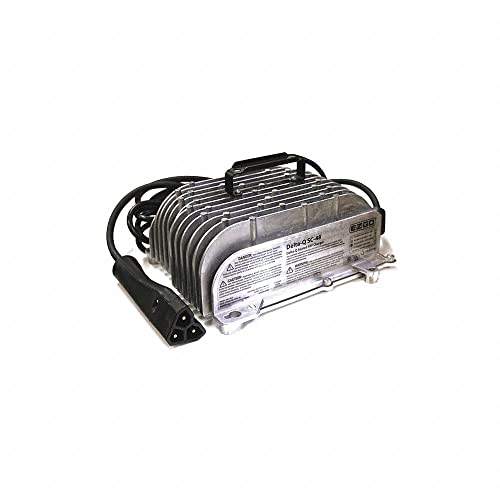
4. Delta-Q SC-48 EZGO 48 Volt Charger
- Best for: EZGO RXV and TXT fleet cart owners who want the original-equipment charger with temperature-compensated charging and a four-year warranty.
- Output voltage: 48 volts
- Output current: 13 amps
- Output power: 650 watts maximum
- Input voltage: 110 volts AC
EZGO RXV and TXT fleet cart owners who want the original-equipment charger with temperature-compensated charging and a four-year warranty.
The Delta-Q SC-48 is the premium pick, and its premium status comes from its origin: it was designed exclusively for EZGO for use on North American RXV and TXT electric fleet golf cars. This is not a generic replacement shaped to fit; it is the charger the carts were built around, with a custom three-pin direct-current paddle connector that includes a third pin for temperature-compensated charging. That third pin lets the charger read the pack temperature and adjust its charge profile accordingly, which protects the pack on hot summer afternoons and cold mornings alike, when a fixed charge profile would either undercharge or overcharge.
The electrical numbers are modest on paper and strong in practice. Thirteen amps at 48 volts, with 650 watts of maximum output power and efficiency above ninety percent, fills a pack in about six to seven hours from a deep discharge. The charger carries energy-efficiency certification, which reflects that high conversion efficiency, and its sealed die-cast housing carries an IP66 rating against dust and powerful water jets. LED indicators on the charger and a visual indicator on the cart receptacle show charging progress, completion, and faults at a glance, so there is no guessing about whether the cart is ready.
Serviceability is the feature that separates the SC-48 from every sealed disposable charger on the market. It is field-serviceable by an authorized EZGO service technician, with internal boards and the direct-current cable available as service parts, and the alternating-current and direct-current cords are designed to release under excessive stress rather than damaging the charger. The four-year warranty is the longest in this guide by a wide margin, and it reflects the fleet-grade build: this charger was designed to survive years of daily use on a working golf course, not a season in a home garage.
The limits follow from its origin. It fits EZGO TXT and RXV carts with the matching paddle receptacle, and it is built around a single temperature-compensated profile for the flooded lead-acid batteries used in EZGO fleet cars, so lithium conversions and other brands are outside its brief. At seven and three-tenths pounds it is also the heaviest charger here, though that weight is the die-cast housing doing its job. For an EZGO owner who wants the charger the factory chose, nothing else in this guide matches it.
5. Lztsuply 48 Volt 15 Amp Charger for Club Car
- Best for: Club Car DS, Precedent, and Tempo owners who want a 48 volt charger with a depleted-battery rescue mode and a two-year warranty.
- Output voltage: 48 volts
- Output current: 15 amps
- Input voltage: 120 volts AC
- Plug type: 3-pin round plug
Club Car DS, Precedent, and Tempo owners who want a 48 volt charger with a depleted-battery rescue mode and a two-year warranty.
The Lztsuply charger covers the same ground as the EPOWREY Club Car pick, then adds two features that earn it a separate place in this guide. The first is a depleted-battery rescue function: when a pack has sat unused long enough to drop to zero volts, this charger supports zero-volt charging to revive it, which can save a pack that a standard charger would refuse to start on. The second is the warranty: two years of cover, double the EPOWREY unit, which signals confidence in the sealed aluminum die-cast shell and the glue-filled interior that protects the electronics from moisture, dust, and shock.
The core numbers match the class standard. Fifteen amps at 48 volts through the round three-pin plug, with a 16 foot cable and a cooling fan, fills a 48 volt lead-acid pack in a normal overnight window. Eight protection functions cover overvoltage, overcurrent, overheating, no-load operation, short circuits, reverse connection, and overcharging, with automatic shutdown when the pack is full. The charger meets CE, FCC, and RoHS standards, and it ships with a cover plate and two standard onboard-computer lines, which gives flexibility across Club Car DS models from 1995 through 2010 and Precedent models from 2004 onward, including carts where an OBC bypass modification is part of the setup.
Build quality is a genuine strength. The sealed heat-dissipation aluminum shell, the fan, and the glue-filled interior are designed for harsh environments, and the charger is rated IP67 for dust and water protection. Noise is rated at or below 35 decibels, which is quiet enough to run in an attached garage without becoming a nuisance. At five and eighty-six hundredths pounds, with dimensions of 7.36 x 4.17 x 4.33 inches, it is compact enough to live on a shelf and light enough to carry to the cart.
The boundary is the same as its sibling: lead-acid only, round three-pin Club Car plug only. Lithium owners and EZGO or Yamaha owners need a different charger. But for a Club Car owner choosing between two strong 48 volt options, the Lztsuply earns its place on the rescue mode, the longer warranty, and the eight protection functions, and it is the pick for carts that sit unused for long stretches between outings.
Mistakes That Shorten Battery Life
The charger is only half of the battery-life equation; how it gets used is the other half. The most damaging habit is leaving a flooded lead-acid pack in a discharged state. Lead-acid batteries sulfate as they sit discharged, and sulfate hardens over days and weeks until capacity is lost for good. Recharge after every round, even a short one, and do not leave the cart sitting flat between weekends. A charger with a maintenance mode, like the FORM unit in this guide, makes this easy, because it can stay connected safely while the cart waits.
The second mistake is charging with the wrong plug forced to fit, or with a charger that does not match the pack voltage. Adapters and rewired plugs hide a mismatch instead of fixing it, and a voltage mismatch damages the pack faster than almost any other error. Check the voltage and the plug shape before every purchase, and again before the first charge if the charger has a manual voltage switch, as the dual-voltage unit here does.
The third mistake is ignoring water levels in flooded batteries. Charging warms the electrolyte and uses water, so check the levels monthly during heavy use and top up with distilled water after charging, never before, and never above the fill line. A charger cannot compensate for plates left exposed to air.
The fourth mistake is storing the cart for winter with a flat pack and a charger unplugged. Cold slows self-discharge but does not stop it, and a pack that freezes while discharged can crack its case. Charge the pack fully before storage, connect a charger with a maintenance mode, and check on it monthly. If the storage spot has no power, charge fully and disconnect, then recharge at least once a month.
Finally, keep the charger itself dry and ventilated. Sealed housings help, but a charger buried under damp towels or sitting in a puddle will fail sooner than one kept on a shelf with air around it. Let the fan breathe, keep the cords uncoiled enough to avoid kinks, and inspect the plug pins for corrosion each season. A little care here protects a purchase that should last for years.
Frequently Asked Questions
Can I use a 48 volt charger on a 36 volt golf cart?
No. A 48 volt charger pushes a 36 volt pack far past its safe ceiling, which can boil off electrolyte, warp plates, and create a safety hazard. Always match the charger voltage to the pack voltage, and count the batteries if you are unsure: six 6 volt batteries make a 36 volt pack, while six 8 volt batteries or four 12 volt batteries make a 48 volt pack.
How do I know which plug my golf cart needs?
Look at the charging receptacle on the cart and compare its shape and pin count with the charger listing. EZGO TXT carts commonly use a D-style plug, Club Car DS and Precedent carts commonly use a round three-pin plug, and EZGO RXV and later TXT carts often use a triangular three-pin plug. When the shape is unclear, check the model and year against the charger compatibility list, or ask the seller to confirm fitment before ordering.
How long does it take to charge a golf cart battery pack?
Most 13 amp to 18 amp chargers fill a well-used pack in about four to seven hours. A 15 amp charger on a 48 volt pack typically finishes in four to six hours, while a 13 amp charger takes closer to seven hours from a deep discharge. Lower-amp chargers take longer, and packs left flat for weeks take longer still, because the charger must work through the sulfation that builds up during storage.
Do I need a different charger if I switch my cart to lithium batteries?
Yes, in most cases. Lithium iron phosphate packs need a higher finishing voltage and a charger that stops cleanly at full charge, while lead-acid chargers hold a float voltage meant for a different chemistry. Choose a charger that names lithium or lithium iron phosphate support in its specifications, like the dual-voltage charger in this guide, and confirm the plug still matches your cart before ordering.
Conclusion
The right golf cart battery charger is the one that matches your cart on all three counts: voltage, plug, and chemistry. For most 36 volt EZGO TXT owners, that is the FORM 18 amp charger, with its D-style plug and maintenance mode. For most 48 volt Club Car owners, it is the EPOWREY 15 amp charger, with OBC flexibility and a sealed build, or the Lztsuply 15 amp charger if a depleted-battery rescue mode and a longer warranty matter more. For households juggling two voltages or a future lithium conversion, the dual-voltage Huiaipaic charger covers the most ground in one box. And for EZGO fleet cart owners who want the factory charger, the Delta-Q SC-48 remains the benchmark, with temperature-compensated charging and a four-year warranty. Pick the match first, then the features, and your pack will repay the care with seasons of reliable rounds.
Product and ASIN Reference
| Product | ASIN |
|---|---|
| FORM 36 Volt 18 Amp Charger for EZGO TXT | B07Q2FQB33 |
| EPOWREY 48 Volt 15 Amp Charger for Club Car | B0CYPVLQRX |
| Huiaipaic Dual-Voltage 36 Volt and 48 Volt Charger | B0BXG6YBJ5 |
| Delta-Q SC-48 EZGO 48 Volt Charger | B074R9P95J |
| Lztsuply 48 Volt 15 Amp Charger for Club Car | B0F9YBMGGT |