Our Short List of 3
All 3 Picks at a Glance
| Product | Specs | Action |
|---|---|---|
| 1. Panasonic eneloop pro AA High-Capacity NiMH Batteries, 4-Battery Pack (BK-3HCCA4BA) | Check price on Amazon | |
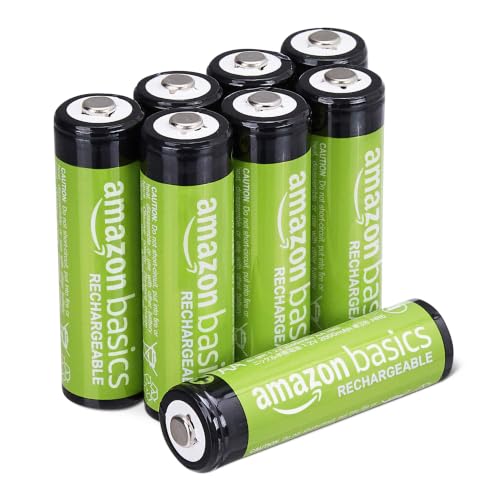 2. Amazon Basics 8-Pack Rechargeable AA NiMH Batteries, 2000 mAh | Check price on Amazon | |
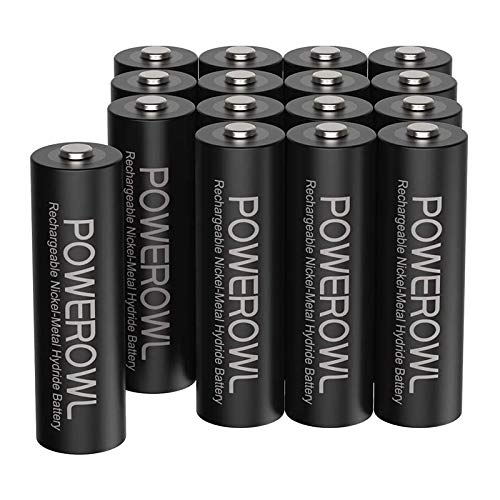
| 3. POWEROWL AA Rechargeable Batteries, 2800 mAh High Capacity, Pack of 16 | Check price on Amazon |
Key takeaways
- The best batteries for wireless lavalier microphone bodypacks: rechargeable AA cells with stable voltage and long cycle life, plus how proprietary packs differ.
As an Amazon Associate we earn from qualifying purchases.
Affiliate Disclosure: This article contains affiliate links. If you buy through a link on this page, we may earn a commission at no extra cost to you. That commission helps us keep researching battery guides like this one.
A quick note on the keyword behind this guide: “lavelier” is a common misspelling of “lavalier,” the small clip-on microphone used for presentations, interviews, worship, theatre, teaching, and video work. This article is about batteries for wireless lavalier systems — the bodypack transmitter worn by the speaker, and in some systems the receiver as well. It is not about batteries for unrelated audio gear, and every product listed below is a battery or rechargeable cell of the type that lavalier bodypacks actually use.
That focus matters, because a lavalier transmitter is an unforgiving device to power. It is small, it is worn on the body, it transmits continuously for the whole session, and it usually gives its warning late. When its batteries fade, the result is not a dim torch or a slow remote: it is crackle, dropouts, reduced range, distortion, and then silence, often in the middle of a talk, a ceremony, a lesson, or a take that cannot be repeated. Battery choice for a lavalier system is therefore less about squeezing out the last minutes of runtime and more about predictable, stable power from the moment the pack is switched on until the moment it is switched off.
Wireless lavalier systems power their bodypacks in three main ways. Many professional and semi-professional bodypacks — including widely used Sennheiser, Shure, AKG, Audio-Technica, and Line 6 designs — run on standard AA cells, typically two at a time, and some smaller or older designs use AAA cells. A second group uses a proprietary rechargeable pack made only for that system, such as Shure’s SB900 family for its digital bodypacks or Sennheiser’s BA 61 pack for the SK 6000 bodypack; those packs are system-specific and are discussed in the buying guide below rather than listed as general picks, because buying the wrong proprietary pack is an expensive mistake. A third, growing group of compact video lavalier systems has a sealed built-in rechargeable battery charged over USB; there is no replaceable cell to buy for those, and the buying advice for them is about charging routine, not about spare cells.
This guide lists the replaceable-cell options that serve the largest group of lavalier users: rechargeable AA cells for AA-powered bodypacks. Rechargeables dominate serious lavalier work for a simple reason — a team can start every session with a freshly charged, matched set of known capacity, instead of guessing how much life is left in a disposable cell that was already used at the last event. Specifications below are taken from the manufacturers’ and listings’ stated information; we have not tested these cells ourselves in any transmitter.
What a lavalier bodypack needs from a battery
Stable voltage comes first. A transmitter’s radio performance depends on its supply holding up under a continuous, steady load. NiMH rechargeable cells are rated at a nominal 1.2 volts, lower than a fresh alkaline cell at 1.5 volts, but they hold that voltage in a comparatively flat curve through most of the discharge. In practice, many bodypacks are designed with NiMH use in mind — check your transmitter manual, because some manufacturers specify approved cell types — and a good NiMH set delivers consistent transmission for a full session and then falls off relatively quickly at the end, which is why disciplined users swap cells on a schedule rather than waiting for a warning light.
Capacity comes second, and it should be read honestly. AA NiMH capacity is stated in milliamp hours, and higher figures generally mean longer runtime in the same transmitter. Very high stated capacities from unfamiliar brands should be treated with caution, and the established makers’ figures are the safer basis for planning. Whatever cells you choose, plan your swap interval from the transmitter maker’s stated runtime for that cell type, then leave a generous margin for rehearsals, delays, and the talk that runs long.
Cycle life and storage behaviour come third, and they decide whether a rechargeable system stays reliable over a season of use. Cells that can be recharged hundreds of times, and low self-discharge designs that retain a large share of their charge while stored, let a church, school, theatre, or video team keep a labelled rotation of sets that are always ready. A rechargeable that has sat forgotten and empty for months helps no one; a low self-discharge cell charged after the last event and stored properly is a genuinely dependable spare.
Finally, fit and discipline matter as much as chemistry. Use matched pairs from the same pack and the same charge cycle in a two-cell bodypack, never mix a fresh cell with a used one, label sets so pairs stay together, and carry at least one full spare set per transmitter at every event. No battery in this list can compensate for skipping those habits.
The picks at a glance
- Panasonic eneloop pro AA, 4-Battery Pack (BK-3HCCA4BA) — the high-capacity professional choice for long sessions.
- Amazon Basics 8-Pack Rechargeable AA NiMH (2000 mAh) — the straightforward rotation stock for teams running several bodypacks.
- POWEROWL AA Rechargeable Batteries, 2800 mAh, Pack of 16 — the large-count option for venues that power many transmitters.
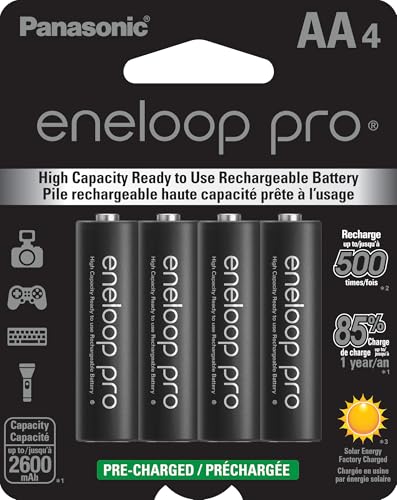
1. Panasonic eneloop pro AA High-Capacity NiMH Batteries, 4-Battery Pack (BK-3HCCA4BA)
The eneloop pro AA is the cell many location sound and live event users reach for first, and the listing information shows why. Panasonic describes the BK-3HCCA4BA pack as four AA NiMH cells delivering up to 2,500 milliamp hours typical capacity, rechargeable up to 500 times, pre-charged at the factory using solar power, and able to maintain a large share of their charge — stated as up to 85 percent — after one year when unused and properly stored. For a lavalier bodypack, that profile translates directly into the two things that matter most: a long, steady run from a fresh set, and spares that are still ready months after they were charged.
The high capacity is the headline for transmitter use. A bodypack draws continuously, and the pro version of eneloop was designed for high-drain devices, trading some cycle count and storage life compared with the standard eneloop in exchange for more capacity per charge. For a presenter wearing a transmitter through a long conference day, or a theatre bodypack that must survive a full act without a swap window, that extra capacity per set is the practical advantage. The trade is equally practical: a team that swaps and recharges after every short session may not need the pro’s capacity and could value the standard eneloop’s longer cycle life instead, which is why the next pick exists in this guide.
Two cautions belong with this pick. First, one indexed crawl of this listing reported no featured offers, while another indexed copy of the same Amazon listing reported the item in stock and sold by Amazon.com; availability for this pack should therefore be confirmed on the live listing before ordering, and buyers should make sure the pack they receive is the genuine BK-3HCCA4BA four-pack described here. Second, these are 1.2 volt NiMH cells: confirm your bodypack’s manual accepts NiMH cells, and do not be alarmed if a simple battery gauge reads lower than it does on alkaline, since the gauge may be calibrated for 1.5 volt cells while the NiMH set is still delivering its flat, usable voltage.
Choose this pack if your lavalier sessions are long, your swap windows are few, and you want the highest-capacity established NiMH AA cells for your transmitters, in matched sets of four that map neatly onto two-cell bodypacks.
2. Amazon Basics 8-Pack Rechargeable AA NiMH Batteries, 2000 mAh
The Amazon Basics rechargeable AA is the workhorse rotation stock in this guide. The listing information describes an eight-pack of AA NiMH cells rated at 2,000 milliamp hours, at a nominal 1.2 volts, with low self-discharge behaviour, pre-charged and ready to use, and rated to be recharged up to 1,000 times. An indexed copy of the listing reported this pack in stock and sold by Amazon.com. For a lavalier team, the eight-pack format is the quiet advantage: it is exactly four matched pairs for two-cell bodypacks, enough to run two transmitters with a full spare set each, or one transmitter through a long day of scheduled swaps.
The capacity is lower than the eneloop pro above, and that should be planned for rather than discovered. In a bodypack, expect a shorter safe swap interval per set, and build your event routine around it: fresh set at soundcheck, swap at the interval, recharge everything afterwards. What the Amazon Basics cell returns for that discipline is cycle life and simplicity. A stated recharge count of up to 1,000 cycles suits cells that will be charged after every event, week after week, and the low self-discharge design means charged spares kept in the kit bag remain useful between events rather than arriving flat.
This is also a sensible pick for mixed fleets. Many venues run lavalier bodypacks alongside handheld transmitters, presentation remotes, and other AA gear. A single standardised rechargeable AA stock, labelled and rotated, simplifies the whole kit. Keep lavalier sets labelled as pairs and do not let cells wander between pairs; a matched pair ages together and behaves predictably, while a mixed pair is only as strong as its weaker cell, and a transmitter will find that weakness at the worst moment.
As with every NiMH pick here, confirm your transmitter accepts 1.2 volt rechargeable cells, use a charger intended for NiMH AA cells, and retire any cell that becomes hot, damaged, or noticeably shorter-running than its pair. Choose this pack if you run several bodypacks, swap on a schedule, and want dependable, high-cycle rechargeable stock in a format that organises itself into transmitter sets.
3. POWEROWL AA Rechargeable Batteries, 2800 mAh High Capacity, Pack of 16
The POWEROWL pack serves the venue end of lavalier work: the school hall, house of worship, community theatre, or rental kit where many bodypacks are powered at once and battery logistics, not ultimate performance, is the daily problem. The Amazon listing information describes sixteen AA NiMH cells, model SC2800, rated at 2,800 milliamp hours and 1.2 volts, with low self-discharge behaviour, and the brand states a recharge life of over 1,200 cycles and retention of a large share of capacity after extended storage in its product information. Sixteen cells are eight matched pairs: a full cast, a panel of speakers, or a weekend of events from one purchase, with pairs left over as spares.
The stated capacity is the highest in this guide, and it should be handled with the honesty this guide has applied throughout. Capacity claims vary in how they are measured, and buyers should judge this pack by the routine it enables rather than by the headline number alone: charge every pair the night before, label pairs, swap on schedule, and recharge after the event. Run that routine and a large-count pack like this removes the two failures that actually ruin lavalier audio in busy venues — the transmitter fitted with half-used disposables because the fresh stock ran out, and the spare set that turns out to be flat.
Because this is a value-focused brand rather than a heritage battery maker, a sensible first step is to buy one pack, run it through several full event cycles in your own transmitters, and confirm the runtime fits your swap schedule before standardising a whole fleet on it. That is not a criticism unique to this brand; it is good practice for any cell a venue will depend on. Also note the listing’s own application list is broad household language, so the lavalier case here rests on the cell type itself — standard AA NiMH, the format AA-powered bodypacks are built for — rather than on any microphone-specific claim by the maker.
Choose this pack if you power many lavalier bodypacks, need a large matched stock in one purchase, and will run a charge, label, and swap routine that turns a big pack into reliable event audio.
Proprietary packs and built-in batteries: know your system first
Before ordering any cell in this guide, open your transmitter’s battery door — or its manual — and confirm which world your system lives in. If it takes standard AA cells, the picks above apply, subject to the manual’s guidance on NiMH use. If it takes a proprietary pack, only that system’s pack will do. Shure’s SB900 family, for example, is a lithium-ion rechargeable pack designed for Shure Axient Digital, ULX-D, QLX-D, and PSM wireless systems according to Shure, with its own chargers; it does not fit AA bodypacks and AA cells do not fit those systems. Sennheiser’s BA 61 is likewise a lithium-ion pack made for the SK 6000 bodypack transmitter, charged only in Sennheiser’s chargers for that range, while the same system’s alternative battery compartment accepts AA cells — a useful reminder that even within one system, the correct answer depends on which fitting your transmitter actually has. We have not attached any marketplace code to those proprietary packs in this guide, because the safe way to buy them is by exact system and pack name from an authorised source, after confirming compatibility.
If your lavalier system is one of the compact video kits with a sealed built-in battery, there is no spare cell to buy at all. For those systems, value means charging discipline: charge transmitters and receiver after every shoot, store them partly charged rather than flat if the maker advises it, carry a USB power source for long days, and treat a kit that cannot hold a charge as a service issue rather than a battery-shopping problem.
A swap routine that prevents dropouts
Whatever cells you choose, this routine is what makes lavalier power boring, in the best sense. Charge all sets the night before the event and keep pairs together in labelled cases. Fit a fresh set at soundcheck, even if the previous set seemed to have life left, and note the time. Set your swap interval well inside the transmitter maker’s stated runtime for your cell type, and swap at the interval whether or not a warning has appeared. After the event, recharge every used set before storing the kit, and rotate sets so the same pair is not always the one worked hardest. Retire pairs that run noticeably short, rather than letting them drift back into the bag. Teams that follow this routine rarely think about batteries during a show, which is exactly the point.
Verdict
For long sessions and few swap windows, the Panasonic eneloop pro AA four-pack is the strongest lavalier pick in this guide, with the availability caution noted above. For teams running several bodypacks on a disciplined swap schedule, the Amazon Basics 2000 mAh eight-pack is the practical rotation stock. For venues powering many transmitters at once, the POWEROWL sixteen-pack supplies the matched pairs that good logistics need. Confirm your bodypack takes AA NiMH cells, keep pairs matched and labelled, and any of these three will give a wireless lavalier system the stable, predictable power it needs.