Key takeaways
- Compare outdoor rated beverage refrigerators for home bars, including the weatherproof NewAir 160-can outdoor fridge and the EdgeStar 142-can built-in outdoor cooler.
A home bar that lives on a patio, deck, or outdoor kitchen destroys ordinary beverage fridges. Indoor units are built for stable room temperatures, and their compressors, seals, and electronics give up quickly against summer heat, humidity, and cold snaps. An outdoor rated model is engineered for that exposure, with weatherproof construction, a wider ambient temperature tolerance, and finishes that shrug off moisture. The two picks here are both 24-inch undercounter-class units built specifically for outdoor use.
They divide the decision cleanly. The NewAir is a weatherproof stainless design holding up to 160 cans, with an auto-closing door and casters that let it roll as a freestanding unit or slide in as a built-in. The EdgeStar counters with 142 cans, a lower temperature floor, a carbon filter, and a locking glass door. Both were verified as outdoor models on their listings; indoor beverage centers that merely look similar were deliberately excluded from this guide.
Quick Picks
As an Amazon Associate we earn from qualifying purchases.
| Product | Best for | Key spec from title |
|---|---|---|
| NewAir 24 Inch Outdoor Beverage Fridge, NOF160SS00 | Flexible placement, built-in or freestanding | 160-can capacity, weatherproof stainless steel |
| EdgeStar CBR1501SSOD Outdoor Beverage Cooler | Coldest settings and a locking door | 142-can capacity, temperatures down to 38°F |
How to Choose
Insist on a genuine outdoor rating
The phrase to find on the listing is an outdoor or weatherproof designation, not a stainless finish that merely looks rugged. Outdoor rated units are tested for operation in high ambient heat and built with sealed electronics and corrosion-resistant exteriors, often 304-grade stainless steel. An indoor beverage fridge placed outside typically loses cooling performance on hot afternoons, sweats condensation, and voids its warranty. Both picks here are sold explicitly as outdoor models, which is the first filter any buyer should apply before comparing capacities or prices. A useful cross-check is the certification line: electrical listings such as ETL, named on the NewAir’s specification sheet, indicate the unit was evaluated as a complete appliance for its intended environment rather than assembled from indoor parts.
Size the cabinet to your counter and your crowd
Twenty-four inches is the standard undercounter width, and both picks fit that bay while offering freestanding use as an alternative. Capacity then separates them: 160 cans against 142 cans, a difference that matters for party-heavy households and disappears for couples. Measure the installation bay’s height and depth as carefully as its width, confirm the door swing clears adjacent cabinetry, and remember that built-in units vent from the front, which is what allows the cabinet to be enclosed on the sides and top. Shelving layout deserves the same forethought: can-focused storage wastes space on bottles, so check that shelves adjust or remove before assuming a mixed bar will fit.
Compare temperature range and door design
A beverage fridge that bottoms out at 38°F serves beer and soda properly cold, while wider ranges reaching into the 70s, like the NewAir’s stated 32°F to 72°F span on its specification sheet, add flexibility for mixed storage. Door construction affects both efficiency and convenience: glass doors show contents and suit grab-and-go bars, solid doors insulate better, and an auto-closing door, as fitted to the NewAir, quietly fixes the most common cause of warm drinks and wasted energy at a busy home bar.
Plan power, leveling, and security
Outdoor placement raises practical questions indoor buyers skip. The unit needs a suitable outdoor outlet, a level surface so the door seals and the compressor sits correctly, and shelter from direct standing water even when weatherproofed. If the bar is in an open patio rather than a fenced yard, a locking door moves from luxury to necessity; the EdgeStar includes an integrated lock with two keys. Casters, included with the NewAir, make seasonal repositioning and cleaning behind the unit far easier. Also think about where meltwater and spills go: an outdoor fridge on decking needs a surface that tolerates drips, and a door opened fifty times on a party afternoon will drip, whatever the badge on the cabinet says.
The 2 Best Options
1. NewAir 24 Inch Outdoor Beverage Fridge, NOF160SS00
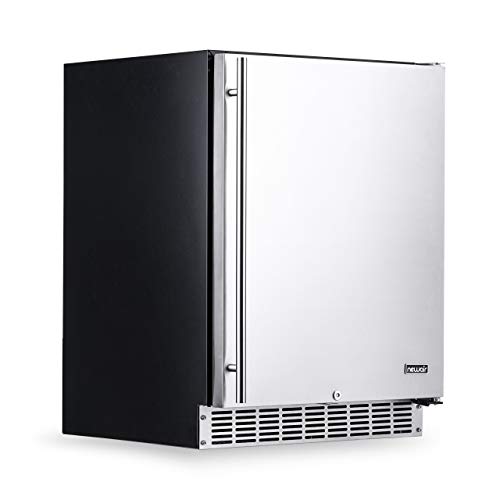
NewAir’s outdoor fridge is the flexible-placement pick: it installs built-in under a counter or stands free, and easy-glide casters let it move when the party layout changes. The weatherproof 304 stainless steel construction is the core credential, and the stated capacity is up to 160 cans across its shelving. An auto-closing door addresses the constant half-latched door problem of outdoor entertaining, and the specification sheet lists a wide 32°F to 72°F temperature range, ETL certification, and a noise level of 42 dB, which is quiet enough for seating areas nearby.
Specs
- Brand: NewAir
- Model: NOF160SS00
- Capacity: Up to 160 cans
- Construction: Weatherproof 304 stainless steel
- Installation: Built-in or freestanding, with easy-glide casters
- Temperature range: 32°F to 72°F, per specification sheet
- Noise level: 42 dB
- Certifications: ETL/cETL
- Door: Auto-closing
Best for: Home bars that may rearrange the patio, since it rolls as a freestanding unit yet still fits a standard 24-inch built-in bay.
Watch out for: The door does not lock, so in an open, unsecured yard the EdgeStar’s keyed door is the safer specification.
2. EdgeStar CBR1501SSOD 24 Inch Outdoor Beverage Cooler

The EdgeStar is the traditional built-in outdoor cooler of the pair, sized at 5.49 cubic feet and rated for up to 142 cans. Its temperature range runs from 38°F to 50°F, the coldest floor in this guide, which suits drinkers who want beer and soda served genuinely cold rather than cellar-cool. Three removable tempered-glass shelves, an integrated door lock with two keys, a carbon filter, auto defrost, and a reversible door give it the most complete feature list here for a permanent outdoor kitchen installation.
Specs
- Brand: EdgeStar
- Model: CBR1501SSOD
- Capacity: 5.49 cu. ft., up to 142 cans
- Temperature range: 38°F to 50°F
- Shelves: 3 removable tempered-glass shelves
- Door: Locking, reversible, with blue LED lighting
- Features: Carbon filter, auto defrost, digital controls
- Exterior: 304-grade stainless steel
Best for: Permanent outdoor kitchens that need a locking door, the coldest settings here, and a reversible door for layout freedom.
Watch out for: It is happiest as a fixed installation; without casters, repositioning it seasonally is a two-person lift rather than a roll.
Which One Fits Your Situation
Your bar layout changes with the season
Choose the NewAir. Casters plus genuine freestanding-or-built-in flexibility mean the fridge can live under the counter in summer, roll beside the grill for a party, and move to a sheltered wall for winter. The auto-closing door earns its keep whenever guests help themselves, and the 160-can capacity absorbs a crowd without a mid-evening restock run to the house.
You are building a fixed outdoor kitchen
Choose the EdgeStar. In a permanent installation its locking door, carbon filter, auto defrost, and reversible hinge are worth more than mobility, and its 38°F floor serves drinks colder than the NewAir’s typical beverage settings. The glass shelves present bottles and cans neatly behind the door, which suits a finished bar run where the fridge is part of the design.
Your patio is hot and your drinks must stay cold
Both units are outdoor rated, which is the main defense against ambient heat, but the EdgeStar’s narrower, colder 38°F to 50°F band is purpose-built for beverage service, while the NewAir’s wider range trades a little specialization for storage flexibility. In extreme climates, give either unit shade and airflow clearance; no compressor wins against direct afternoon sun on a sealed cabinet.
The bar lives in a garage, pool house, or covered porch
Either unit works, and the deciding factor becomes traffic rather than weather. Covered spaces still swing widely in temperature, so the outdoor rating remains valuable, but the daily question is how the fridge is used: frequent guest access favors the NewAir’s auto-closing door and rolling flexibility, while a set-and-forget drinks station favors the EdgeStar’s lock and colder floor. Measure the doorway the unit must pass through before choosing, since covered spaces often have narrower doors than the patio itself.
Common Mistakes
- Putting an indoor beverage fridge outside because it was cheaper, then losing it to heat, moisture, or a voided warranty.
- Ordering a 24-inch unit without measuring the bay height and door swing, especially under stone countertops.
- Blocking the front vent of a built-in installation with trim or toe-kick panels, starving the compressor of airflow.
- Ignoring the lock question in an open yard where the bar sits beyond a fence line.
- Leaving the door unlatched during parties; an auto-closing door or a quick check keeps temperatures and energy use sane, especially on the hottest afternoons of the year.
Frequently Asked Questions
What makes a beverage refrigerator outdoor rated?
Outdoor models are built and tested for operation in wide ambient temperature swings, with weather-resistant exteriors such as 304 stainless steel, sealed controls, and compressors sized for hot environments. The designation appears explicitly in the product name or specifications, as it does for both picks here. A standard indoor beverage center may look identical, but it is not designed or warranted for patio exposure.
Can these fridges stay outside all year?
They are designed for outdoor installation, and features like frost-free or auto-defrost operation help in shoulder seasons. In regions with hard winters, many owners keep the unit in place but empty and unplug it during the coldest weeks, following the manual’s ambient limits. Shade, a level surface, and keeping the cabinet out of standing water matter more to longevity than the badge alone, so placement still deserves thought. A simple cover during the harshest weeks adds cheap protection without undoing the installation.
Built-in or freestanding: which should a home bar choose?
Built-in suits a finished outdoor kitchen with a standard 24-inch bay, giving a flush, permanent look with front venting. Freestanding suits evolving patios and renters. The NewAir covers both paths and adds casters, while the EdgeStar is oriented to the built-in role. Decide based on whether the fridge must move within the next few years; that answer usually settles the question faster than capacity does.
How cold do drinks actually get in these units?
The EdgeStar’s range reaches 38°F, which is properly cold for beer and soda service. The NewAir’s specification sheet lists a wider 32°F to 72°F range, giving flexibility for mixed loads. Real cabinet temperatures depend on ambient heat, door openings, and how full the fridge is, so in hot climates expect performance near the warmer end of any stated range during peak afternoon load.