Key takeaways
- Compare three commercial centrifugal juicers with safety locking systems on motor power, speeds, feed chute and pulp handling, from listing specs only.
Choosing a commercial centrifugal juicer with a safety locking system is a decision about how much produce you will push through the machine each day, and how much you trust a listing’s commercial claim. True foodservice machines are built for continuous runs, but many listings aimed at commercial buyers are high-end home juicers with stronger motors. The safety lock matters either way: it keeps a high-speed basket from spinning unless the cover is secured. This guide separates genuine commercial positioning from soft claims, using only what each Amazon listing itself states about locks, motors and capacity.


The three machines below serve three buyers: juice bars that need a true commercial unit, small cafés and serious home juicers who want commercial-style performance, and budget-led cafés or food trucks equipping a juice station. Every pick was chosen from the product names and specifications on its Amazon page, including the safety-lock wording, so you can compare like with like before ordering.
Quick Picks
As an Amazon Associate we earn from qualifying purchases
| Product | Best for | Key spec from title |
|---|---|---|
| Breville 800JEXL Juice Fountain Elite | Small cafés wanting commercial-style performance | 1000-watt motor |
| Robot Coupe J80 Ultra | Juice bars running produce all day | 3000 RPM with pulp ejection |
| VEVOR Juicer Machine 850W JB-70D | First juice stations on a tight budget | 850W motor, 3-inch feed chute |
How to Choose
Locking Arm Versus Magnetic Switch
A safety locking system stops the motor unless the juicer is assembled correctly, and the three listings here use two different designs. The Breville and the VEVOR rely on a locking arm or safety lock that holds the cover in place before the machine can run. The Robot Coupe instead uses a magnetic safety switch, which senses correct assembly electronically. Both approaches answer the same risk: a centrifugal basket spinning at thousands of RPM with an unsecured lid. When comparing listings, look for the lock described in the product’s bullets, not implied by the product name, and treat any listing that never mentions a lock as a machine without one.
Motor Power and Speed Settings
The three listings span 850 to 1000 watts, but wattage alone does not set working pace. Speed control matters just as much: the Breville offers two speeds, 13,000 RPM for hard produce and 6,500 RPM for softer fruit, while the VEVOR spreads five speeds across the same jobs. The Robot Coupe takes the opposite approach, running a single 3000 RPM working speed with an automatic feed, because a commercial line values steady throughput over adjustment. Match the setup to your menu: varied produce rewards speed settings, while a fixed, high-volume menu rewards a machine that simply keeps running.
Feed Chute Size and Pulp Handling
All three listings use a 3-inch feed opening, which limits how much produce must be cut down before juicing and keeps prep moving during service. The bigger split is what happens after extraction. The Breville collects pulp in a 3.2 qt container and juice in a 1.1 qt jug, a tidy batch setup that still needs emptying between runs. The Robot Coupe ejects pulp automatically, so the machine can keep working through a crate of produce without stopping. The VEVOR listing states no jug or pulp capacity at all, so buyers should confirm container sizes on the listing before assuming it matches their batch size.
What Commercial Means on the Listing
Commercial is the most abused word in this category, so grade each listing by its own wording. The Robot Coupe is positioned as a genuine commercial machine. The Breville claims commercial performance with home kitchen convenience, which describes output, not a duty rating. The VEVOR’s Amazon title never says commercial at all; the claim comes from the maker’s own category filing. None of that makes the softer claims worthless, but it should set expectations for daily volume, spare parts and service life. Buy the wording you can point to on the page, not the wording you hoped to find there.
The 3 Best Options
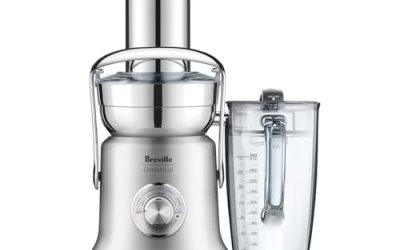
Breville 800JEXL Juice Fountain Elite
The 800JEXL suits buyers who want commercial-style output without moving to a true foodservice machine. Its listing claims commercial performance with home kitchen convenience, and the numbers are strong: a 1000-watt motor, two speeds for soft and hard produce, a 3-inch feed tube and a Safety Locking Arm that prevents operation unless the cover is locked into place. The 3.2 qt pulp container and 1.1 qt juice jug keep it self-contained on a counter. It fits cafés adding a juice line, juice trucks, and home users who juice often and want the lock, capacity and speed range of a heavier machine.
Specs
- Motor: 1000 watts
- Speeds: 2 speeds, 13,000 RPM high and 6,500 RPM low
- Feed chute: 3-inch feed tube
- Safety: Safety Locking Arm prevents operation without the cover locked into place; overload protection
- Juice jug: 1.1 qt
- Pulp container: 3.2 qt
- Listing positioning: commercial performance with home kitchen convenience
Best for: Small cafés, juice trucks and serious home juicers who want commercial-style performance with a self-contained pulp container.
Watch out for: Check availability before ordering, because recent listing signals conflict, with no featured offers shown alongside strong recent sales. Also note the listing claims commercial performance, not a commercial-duty rating, so confirm it suits your daily volume.
ASIN: B0002VAFVG
Robot Coupe J80 Ultra
The J80 Ultra is the only true commercial machine in this roundup, built for counters that juice continuously rather than in short home batches. Its Amazon title lists an automatic juicer with pulp ejection running at 3000 RPM, and the listing bullet describes a 1000 watt, 1.25 hp motor with a magnetic safety switch and a ventilation system for continued high performance. The auto feed system keeps produce moving without constant pressing, and ejected pulp means staff are not stopping to empty a container mid-service. It fits juice bars, cafés and delis where juicing is a core, all-day task.
Specs
- Motor: 1000 watt, 1.25 hp, as stated in the listing bullet
- Speed: 3000 RPM, as stated in the listing title; separate speed settings not stated
- Feed: automatic feed system
- Pulp handling: automatic pulp ejection
- Safety: magnetic safety switch; motor ventilation system
- Voltage: 120V
- Waste container capacity: not stated in the listing
Best for: Juice bars and cafés running produce continuously through the day.
Watch out for: Check availability first, since current offers are third-party only and the price record is stale. Also go by the listing figures (1000 watt, 1.25 hp, 3000 RPM), because the brand spec sheet prints different horsepower and speed numbers.
ASIN: B009Z1XWD2
VEVOR Juicer Machine 850W JB-70D
The VEVOR JB-70D is the entry point of the three, aimed at cafés, food trucks and market stalls setting up juicing without a foodservice budget. The listing gives it an 850W motor, five speeds, a large 3-inch feed chute and stainless steel, BPA-free construction, with a safety lock the listing says ensures no juice leakage during high-speed operation. Its commercial claim is the weakest here: VEVOR files the model under its commercial juicers, but the Amazon title never says commercial. It fits lower-volume service, seasonal stalls and buyers who want the widest speed range of the three.
Specs
- Motor: 850W
- Speeds: 5 speeds
- Feed chute: 3-inch large mouth feed chute
- Safety: safety lock; the listing states the lock ensures no juice leakage during high-speed operation
- Materials: stainless steel; BPA-free parts
- Variant: this ASIN is the listing’s 4-in-1 variant, model JB-70D
- Capacity: not stated in the listing
Best for: New cafés, food trucks and market stalls setting up a first juice station on a limited equipment budget.
Watch out for: Confirm you are ordering the 4-in-1 variant this ASIN covers and check live availability before paying. The Amazon title never uses the word commercial, so treat this as the lightest-duty pick of the three.
ASIN: B0CGLZHXM6
Which One Fits Your Situation
You Run a Busy Juice Bar
Pick the Robot Coupe J80 Ultra. Its automatic feed, pulp ejection and magnetic safety switch are built for continuous service, and the listing describes a ventilation system for continued high performance. Staff can keep produce moving all day without stopping to empty a pulp bin, which is exactly where the other two machines, both designed around batch juicing, start to slow a service line down.
You Want Commercial Performance in a Smaller Kitchen
Choose the Breville 800JEXL. Its listing promises commercial performance with home kitchen convenience, and the 3.2 qt pulp container plus 1.1 qt jug keep everything self-contained on one counter. The Safety Locking Arm, two speeds and 3-inch feed tube give you the working features of a bigger machine without dedicating floor space or a service contract to a full foodservice unit.
You Are Opening a Café on a Tight Budget
Start with the VEVOR JB-70D. Its 850W motor, five speeds and 3-inch chute cover everyday café juicing, and its safety lock satisfies the locking requirement of this roundup. Accept the trade-off knowingly: the commercial claim rests on VEVOR’s own category filing rather than the Amazon title, so treat it as a first machine you may outgrow rather than a lifetime purchase.
You Need a Backup Machine for Peak Hours
Keep the VEVOR JB-70D as the second unit. A spare centrifugal juicer with its own safety lock lets staff split orders between two chutes when the line builds up, and its five speeds handle overflow produce without retraining anyone on new controls. If the backup will regularly carry full services alone, step up to the Breville instead.
Common Mistakes
- Treating the word commercial in marketing copy as a duty rating. One listing here claims only commercial performance, and another never uses the word in its title at all, so read the bullets before assuming a machine is built for continuous service.
- Assuming every centrifugal juicer has a safety lock. The lock has to be stated in the listing, as a locking arm, a safety lock or a magnetic safety switch; if the copy never mentions one, do not count on it being fitted.
- Comparing wattage alone. A 1000-watt rating means different things on a two-speed home-format machine and on a commercial unit with a ventilation system, so weigh speeds, feed design and pulp handling alongside the motor figure.
- Ignoring pulp handling until service starts. A 3.2 qt container is fine for batches, but continuous juicing needs pulp ejection, or staff will stop mid-service to empty the bin.
- Ordering the first configuration on a listing page. Variant ASINs are common in this category, and availability on these commercial listings changes often, so confirm the exact variant and a live buy option before paying.
Frequently Asked Questions
What does a safety locking system do on a centrifugal juicer?
It stops the motor from running unless the juicer is correctly assembled and the cover is secured. On the Breville it is a Safety Locking Arm, on the VEVOR a safety lock, and on the Robot Coupe a magnetic safety switch. The point is simple: a basket spinning at thousands of RPM should never start with the lid loose.
Is the Breville 800JEXL a true commercial juicer?
Not by its own listing. Breville describes the 800JEXL as providing commercial performance with home kitchen convenience, which is a performance claim rather than a commercial-duty rating. Its 1000-watt motor, two speeds and locking arm make it a strong prosumer machine, but buyers running produce all day should compare it honestly against the Robot Coupe.
Which figures should I trust for the Robot Coupe J80 Ultra?
Trust the Amazon listing figures: the title states 3000 RPM and the listing bullet states a 1000 watt, 1.25 hp motor with a magnetic safety switch. The brand spec sheet prints different numbers, 1 HP and 3,450 RPM, but buying decisions here are based on what the listing itself promises, so judge and compare using the listing data.
Does the VEVOR JB-70D count as a commercial juicer?
Only loosely. VEVOR files the JB-70D under its own commercial juicers category, but the Amazon title never uses the word commercial, making its claim the weakest of the three listings here. Treat it as a capable entry-level centrifugal juicer with a stated safety lock, best suited to lower-volume cafés rather than continuous foodservice work.