Key takeaways
- Compare the best golf speakers for cart-mounted music and spoken yardages. Five Bluetooth golf speakers with GPS, magnetic mounts, and long battery life.
The best golf speakers do two jobs at once: they play music for the group and they call out yardages without making anyone pull a phone from a pocket. The strongest cart speakers combine clear Bluetooth audio with a GPS that speaks front, center, and back distances, a magnetic mount that grips the cart bar, and a battery that lasts the whole round. If music alone is enough, a rugged magnetic speaker without GPS costs less and still mounts in seconds.
As an Amazon Associate, we earn from qualifying purchases.
Table of Contents
- Quick Answer: Which Golf Speaker Should You Buy?
- How to Choose a Golf Speaker
- GPS Speakers vs. Music-Only Speakers
- Mounting: Magnetic, Clip-On, and Cart Bar Fit
- Battery Life and Charging on the Course
- Weather Resistance and Durability
- Sound Quality and Course Etiquette
- 1. Bushnell Wingman GPS Speaker
- 2. Rokform G-ROK Wireless Golf Speaker
- 3. Bushnell Wingman View GPS Speaker
- 4. Bushnell Wingman 2 GPS Bluetooth Speaker
- 5. Blue Tees Player+ GPS Speaker
- Frequently Asked Questions
- Conclusion
- Product and ASIN Reference
Quick Answer: Which Golf Speaker Should You Buy?
For most golfers, the Bushnell Wingman View is the sweet spot: it pairs Bluetooth music with audible and on-screen yardages, hazard distances, a magnetic cart mount, and a remote, so the whole group hears the number and sees it too. Golfers who want GPS guidance at the lowest entry point should look at the original Bushnell Wingman, which speaks distances for more than 36,000 courses and skips the screen. The Rokform G-ROK is the pick for golfers who only want music, since it mounts magnetically, shrugs off rain and dust, and runs far longer than a single round. The Bushnell Wingman 2 adds a newer feature set with a longer stated runtime and pairing for a second speaker, while the Blue Tees Player+ sits at the premium end with a touchscreen, visual and audible distances, and hazard detail across more than 40,000 courses.
How to Choose a Golf Speaker
A golf speaker lives a harder life than a home speaker. It rides on a cart bar over bumpy paths, sits in sun and rain, and gets handled with sweaty or gloved hands. The right choice starts with how it mounts, because a speaker that slides off the cart on the first bumpy fairway is useless no matter how good it sounds. Magnetic mounts are the standard on golf carts: a strong magnet on the back of the speaker grips the metal cart bar or frame, and the speaker lifts off just as easily at the turn or at the end of the round. Check that the magnet is built into the speaker itself rather than relying on a separate bracket that can be forgotten at home.
Sound comes next. A cart speaker needs enough volume to be heard across a cart and down a fairway without distorting when the volume rises. Dual drivers and a tuned enclosure help, and a speaker that stays clear at higher volume is worth more than one that is loud only on paper. Direction matters too: a speaker that fires sound outward from the cart reaches both riders, while one that fires straight up can sound muffled under a cart roof. If two speakers can pair together, the group gets stereo coverage, though a single well-placed unit covers most foursomes.
Controls should work without looking. Big buttons, a remote, or voice-prompted distances all help when the speaker sits on a cart bar behind the driver. A remote that clips to a belt or bag lets any player in the group request a yardage without reaching across the cart. A display is a bonus rather than a requirement: audible distances keep eyes on the course, while a screen confirms the number for anyone who missed the callout.
Battery life should cover a full round with margin. A slow group on a busy weekend can take five hours or more, and music plus GPS drains a battery faster than music alone. Look for a stated runtime of at least ten hours, and treat that figure as a best-case number, since volume level and GPS use both shorten real-world runtime. USB-C charging is the current standard and makes topping up from a cart USB port or a portable charger simple.
GPS Speakers vs. Music-Only Speakers
GPS speakers merge a Bluetooth speaker with a golf GPS, so one device covers music and distances. They store thousands of preloaded courses, announce front, center, and back yardages at the press of a button, and many show hazard distances as well. The course library size matters: a speaker with more than 36,000 preloaded courses covers nearly every course a traveling golfer will play, while a smaller library may miss a local municipal track. GPS speakers need a companion app for setup and course updates, and they need a clear view of the sky to lock onto satellites, which is rarely a problem on an open course.
Music-only speakers skip the GPS entirely and focus on sound, battery life, and toughness. They cost less, weigh less, and run longer, since no power goes to a GPS receiver or a display. They suit golfers who already carry a rangefinder, a GPS watch, or a phone app for distances and simply want music on the cart. The trade-off is carrying two devices instead of one, and the music-only speaker never calls out a yardage when the rangefinder is in the bag.
The choice comes down to how the group plays. A casual group that likes music and quick yardages gets the most from a GPS speaker, since it answers the most common question on every hole without anyone opening an app. A serious group that already trusts a laser rangefinder may prefer a music-only speaker and keep distance measurement separate. Either way, the speaker should mount securely and survive the weather, because those two traits decide whether it gets used every round or left in the garage.
Mounting: Magnetic, Clip-On, and Cart Bar Fit
Magnetic mounting is the defining feature of a golf speaker. A strong magnet on the speaker body attaches directly to the cart frame, the cart bar, or any flat metal surface, and it holds through bumps and turns. The best implementations use a large magnet area rather than a small pad, since a wider contact patch resists sliding when the cart bounces. Some speakers add a secondary grip surface or a shaped back that sits flush against a round cart bar, which keeps the unit from rotating as the cart moves.
Clip-on and carabiner mounts suit golfers who walk or who use a push cart. A clip attaches the speaker to a golf bag, a belt loop, or a push-cart frame, keeping music close without taking up a pocket. Clip mounts are less secure than magnets on a rough cart path, so they work best for walkers and for smaller, lighter speakers. A few speakers combine both: a magnetic back for the cart and a clip or loop for the bag.
Before buying, think about where the speaker will live during the round. On a riding cart, the cart bar is the natural spot, within reach of the driver and facing the group. On a push cart, the handle or the bag strap works better. On a walking round, a bag clip keeps the weight off the shoulders. A speaker with a flexible mount fits all three setups, while one with a single fixed mount may only suit one style of play.
Battery Life and Charging on the Course
Battery life separates the speakers that finish the round from the ones that fade on the back nine. Stated runtimes range from around ten hours for GPS speakers to a full day for music-only models, and the difference comes from the GPS receiver, the display, and the amplifier all drawing power at once. A ten-hour rating covers two full rounds in theory, but high volume and frequent GPS callouts shorten it, so a speaker rated for ten hours is a one-round device with a comfortable margin rather than a two-round device in practice.
Charging habits matter as much as the headline number. USB-C charging is faster and more universal than older barrel or micro-USB connectors, and a speaker with USB-C can charge from the same cable as a modern phone. Some GPS speakers add a USB output port that charges a phone from the speaker battery, which is handy on long rounds but drains the speaker faster. A full charge before the round and a topped-up phone are the simple habits that prevent a dead speaker on the seventeenth hole.
Cold and heat both reduce battery performance, so a speaker left in a hot car trunk all summer will hold less charge than one stored indoors. Lithium-ion batteries also age: a speaker that once lasted ten hours may last eight after a few seasons of heavy use. Buying a speaker with more runtime than the round requires leaves room for that decline and for the occasional slow round behind a large group.
Weather Resistance and Durability
Golf is an outdoor game, and a cart speaker will meet rain, dew, dust, and the occasional splash from a water hazard. Water-resistance ratings use the IP scale: a rating of IPX6 handles strong water jets and heavy rain, while IPX7 means the speaker survives brief submersion in shallow water. Either rating covers a rainy round, and the higher rating adds peace of mind when the speaker sits near a drink holder or gets caught in a downpour.
Dust and shock resistance matter just as much. A speaker that rides on a cart bar collects dust from cart paths and gets knocked when clubs come in and out of the bag. A rugged housing with a rubberized bumper absorbs those knocks, and sealed buttons keep dust and moisture out of the controls. A speaker with a drop-resistant design survives the inevitable fall from the cart bar to the path, while a bare plastic shell may crack on the first drop.
Weight and size affect how the speaker rides. A heavy speaker stresses a magnetic mount and can slide on a steep path, while a compact speaker stays put. Most cart speakers weigh between one and three pounds, and the lighter end of that range suits magnetic mounting best. A speaker that is easy to carry from the car to the cart and back gets used more often than one that feels like a chore to haul.
Sound Quality and Course Etiquette
Sound quality on a golf speaker is about clarity at moderate volume rather than bass that shakes the cart. A good cart speaker keeps voices in music clear, keeps the low end tight rather than muddy, and stays clean when the volume rises for a windy hole. Dual drivers help separate the sound, and a well-tuned enclosure keeps the audio from sounding hollow. A speaker that distorts at the volume the group actually uses is worse than a quieter speaker that stays clean.
Etiquette matters as much as audio quality. Not every group wants music, and not every course allows it, so the speaker should have a quick mute or a volume control that works without fumbling. Keeping the volume low enough that only the group hears it is the basic courtesy, and turning the music off on the tee box and the green keeps the focus where it belongs. A speaker with a remote makes this easy: one press silences the music while a playing partner putts, and another press brings it back on the next tee.
Pairing two speakers adds coverage but also adds volume, so a group that pairs speakers should keep the combined level modest. A single speaker placed between the two riders usually covers a cart, and a second speaker helps only on a large group spread across two carts. The best sound setup is the one nobody else on the course notices.
1. Bushnell Wingman GPS Speaker
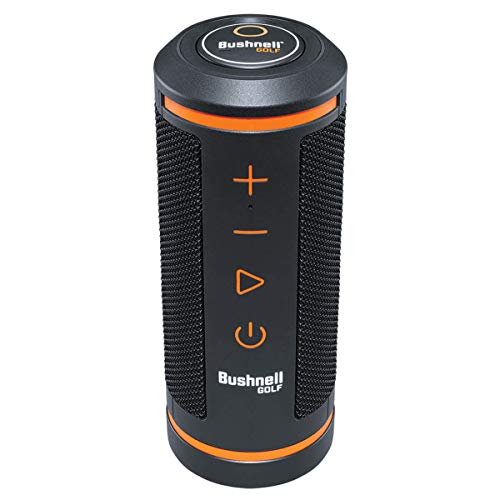
The original Bushnell Wingman set the template for the golf GPS speaker: a Bluetooth speaker with audible yardages, a magnetic mount, and a remote, all in a package that lives on the cart bar. It speaks front, center, and back distances for more than 36,000 preloaded courses at the press of a button, so the group hears the number without anyone reaching for a phone. The remote clips to a belt or bag and requests distances from anywhere near the cart, which keeps the speaker mounted and the music playing while a player walks ahead to a ball.
Sound is the Wingman first job, and it handles that job with a full, clear output that carries across a cart and down the fairway. Music streams over Bluetooth from a phone, and the speaker pauses or ducks the music to announce a yardage, then brings the music back without any extra steps. That smooth handoff is the detail that makes a GPS speaker feel like one device instead of two gadgets sharing a box, and it matters on every hole where the group wants both a song and a number.
The BITE magnetic mount is the Wingman signature feature. A strong magnet on the back of the speaker grips the metal cart bar and holds through bumps, turns, and rough cart paths, and the speaker lifts off with a firm pull at the end of the round. The mount needs no bracket, no strap, and no extra hardware, which means there is nothing to forget at home and nothing to install before the first tee. Golfers who switch between carts will appreciate that the mount works on any cart with a metal bar or frame.
Battery life runs up to ten hours per charge, which covers a full round with margin for a slow day and leaves enough for the drive home. Charging runs over USB-C, and the speaker also carries a USB output that can top up a phone during the round, though using it draws down the speaker battery faster. The Wingman pairs with the Bushnell Golf app for course updates and setup, and the app also tracks scores and stats for golfers who want a record of the round.
As the earliest model in the Wingman line, this speaker skips the display found on later models, so all yardages arrive by voice. Golfers who like a screen will prefer the Wingman View, while golfers who are happy to hear the number and keep their eyes on the course will find the original Wingman does everything they need. Its combination of spoken distances, magnetic mounting, and straightforward controls makes it a strong budget entry into GPS speakers, and its long run on the market means the course library and the app support behind it are well established.
The Wingman suits golfers who want GPS yardages and music in one cart-mounted device without paying for a touchscreen. It suits groups that share one cart, since the audible callout reaches both riders, and it suits golfers who play the same home course often, since the preloaded library covers the courses most players visit. Golfers who want visual distances or hazard detail on a screen should step up to the Wingman View, and golfers who want the longest runtime should look at the Wingman 2.
Specs
- Bluetooth speaker with audible GPS distances for more than 36,000 preloaded courses
- BITE magnetic mount grips the cart bar with no bracket or strap needed
- Removable remote requests front, center, and back yardages from anywhere near the cart
- Battery life up to ten hours per charge with USB-C charging
- USB output port charges a phone during the round
- Pairs with the Bushnell Golf app for course updates, score tracking, and stats
- Tier: Budget
- ASIN: B08D8D73PD
2. Rokform G-ROK Wireless Golf Speaker

The Rokform G-ROK takes a different approach from the GPS speakers in this roundup: it skips the GPS entirely and pours everything into music, mounting, and battery life. The result is a rugged magnetic speaker built for the cart, with a stated runtime of up to a full day at moderate volume, an IPX7 water-resistance rating, and a shockproof and dustproof housing. Golfers who already carry a rangefinder or a GPS watch and simply want great music on the cart will find the G-ROK covers that job better than any GPS speaker at a similar size.
The magnetic mount is built into the body of the speaker, so it attaches to a cart bar, a cart frame, or any flat metal surface the moment it touches one. There is no separate mount to install and no strap to thread, and the magnet holds through bumps and turns on rough cart paths. The speaker is compact enough to ride on the cart bar without blocking the view ahead, and it lifts off easily for the walk from the cart to the clubhouse.
Sound quality is the G-ROK calling card. It plays loud and clear, with a clean output that stays intelligible at the volume a group actually uses on a windy hole. The speaker is tuned for outdoor listening, so voices in music stay clear and the low end stays tight rather than muddy. Bluetooth pairing is quick, and the speaker reconnects to a familiar phone without fuss, which matters when the group is already on the first tee and nobody wants to troubleshoot a connection.
Durability is where the G-ROK earns its keep. The IPX7 rating means it survives rain, splashes, and brief submersion, while the shockproof and dustproof build handles drops from the cart bar and dust from dry cart paths. The housing is rugged without being bulky, and the buttons are large enough to work with a gloved hand. A speaker that lives on a golf cart takes more abuse in a season than a home speaker takes in years, and the G-ROK is built for that reality.
Battery life is the other headline: up to a full day of play per charge at moderate volume, powered by a high-capacity rechargeable cell. That runtime covers several rounds between charges, which means the speaker is ready whenever the group is, without a nightly charging routine. Golfers who play twice a week will charge it far less often than owners of GPS speakers, and the long runtime leaves a wide margin for slow rounds and high-volume holes.
The G-ROK suits golfers who want music only and already have distances covered by a rangefinder, a watch, or a phone app. It suits walkers and push-cart users too, since its compact size and magnetic back adapt to a bag or a metal frame, and it suits golfers who play in all weather, since the water and dust protection covers the worst a course can offer. Golfers who want spoken yardages should choose a GPS speaker instead, since the G-ROK never calls out a distance.
Specs
- Portable Bluetooth speaker built for golf carts with a built-in magnetic mount
- IPX7 water resistance plus shockproof and dustproof rugged housing
- Battery life up to a full day per charge at moderate volume
- Loud, clear outdoor-tuned sound that stays clean at group-listening volume
- Compact size rides on the cart bar without blocking the view ahead
- Quick Bluetooth pairing with automatic reconnection to a familiar phone
- Tier: Budget
- ASIN: B08336KZCL
3. Bushnell Wingman View GPS Speaker

The Bushnell Wingman View takes the original Wingman formula and adds the one thing the original lacks: a screen. A built-in LCD shows front, center, and back distances, hole and par information, and up to six hazard distances per hole, so the group can see the number as well as hear it. The display rotates to stay upright, and the speaker still announces distances aloud through the remote, which means the group gets both a spoken callout and a visual confirmation on every hole.
Hazard information is the View real advantage over the original Wingman. Knowing the distance to a bunker, a water hazard, or a layup point changes club selection in a way a single green distance cannot, and the View shows those numbers without anyone opening an app. The course library covers more than 36,000 preloaded courses, and the speaker pairs with the Bushnell Golf app for updates and score tracking. The display also shows music information, so the group can see what is playing without pulling out a phone.
The BITE magnetic mount carries over from the original Wingman, gripping the cart bar with a strong magnet and no extra bracket. The removable remote requests audible distances and controls the music from a belt clip or a pocket, and the speaker keeps playing while the remote does its work. The View adds a USB charging port that can top up a phone during the round, which helps on long days when the phone is also running a scorecard app.
Battery life runs up to ten hours per charge, covering a full round with margin, and the speaker charges over USB-C. Water resistance is rated IPX6, so heavy rain and splashes from a water hazard are no threat, though the speaker should not be submerged. The unit weighs just under a pound and a half, which keeps it stable on the magnetic mount even on bumpy cart paths, and its size fits the cart bar without crowding the driver.
The View suits golfers who want distances they can see and hear, and it suits groups where different players prefer different formats: one hears the callout, another glances at the screen. It suits golfers who play unfamiliar courses, since the hazard distances help with layups and carries on holes they have never seen. Golfers who only want music and already own a rangefinder will find the screen unnecessary, and golfers who want the longest runtime should look at the Wingman 2 instead.
Specs
- LCD screen shows front, center, and back distances plus hole, par, and battery information
- Displays up to six hazard distances per hole for layups and carries
- Audible GPS distances for more than 36,000 preloaded courses via the removable remote
- BITE magnetic mount grips the cart bar with no bracket or strap needed
- Battery life up to ten hours per charge with USB-C charging and a phone-charging USB port
- Water resistance rated IPX6 for heavy rain and splashes
- Tier: Mid-range
- ASIN: B0C4TP5FN2
4. Bushnell Wingman 2 GPS Bluetooth Speaker

The Bushnell Wingman 2 is the newest generation of the Wingman line, and it refines the original in the areas golfers notice most: runtime, sound, and connectivity. Battery life stretches to up to fourteen hours per charge, which covers two unhurried rounds in theory and a long tournament day in practice, and USB-C charging keeps the turnaround quick between rounds. The speaker announces audible distances for more than 38,000 preloaded courses, a larger library than the original Wingman, and it pairs with the Bushnell Golf app for course updates and scoring.
A small LCD on the Wingman 2 shows distance information at a glance, bridging the gap between the screen-free original and the larger display on the View. The removable remote still handles audible callouts and music control, so the group can request a yardage without touching the speaker. Custom sound bites let golfers personalize the audio cues, a small touch that makes the speaker feel like their own rather than a generic gadget.
Sound quality steps up with an improved driver setup that plays louder and clearer than the original, and the speaker supports pairing with a second Wingman 2 for a wider soundstage across two carts or a larger group. That pairing feature suits outings and scrambles where the group spreads out, though a single unit covers a standard foursome on one cart. The magnetic cart mount carries over from the rest of the Wingman line, gripping the cart bar without a bracket and releasing with a firm pull.
The Wingman 2 build is made for outdoor use, with a rugged housing and controls that work with wet or gloved hands. The speaker sits securely on the cart bar through bumps and turns, and its weight stays in the range that a magnetic mount handles comfortably. Setup runs through the Bushnell Golf app, which handles course downloads, firmware updates, and score tracking in one place.
The Wingman 2 suits golfers who want the latest Wingman with the longest runtime and the largest course library in the line. It suits golfers who play long tournament days or back-to-back rounds, since the fourteen-hour rating leaves the widest margin in this roundup, and it suits groups that might pair two speakers for bigger outings. Golfers who want a large touchscreen should look at the Blue Tees Player+, and golfers who want the lowest entry cost should look at the original Wingman or the Rokform G-ROK.
Specs
- Audible GPS distances for more than 38,000 preloaded courses with a compact LCD readout
- Battery life up to fourteen hours per charge with USB-C charging
- Improved driver setup for louder, clearer sound plus pairing with a second speaker
- Custom sound bites personalize the audible distance cues
- Magnetic cart mount grips the bar with no bracket or strap needed
- Removable remote requests distances and controls music from anywhere near the cart
- Tier: Mid-range
- ASIN: B0CZ7M97D5
5. Blue Tees Player+ GPS Speaker

The Blue Tees Player+ sits at the premium end of this roundup, and it earns that spot with a touchscreen, the largest course library here, and a speaker system tuned for big outdoor sound. A full-color touchscreen shows distances, hazards, and music controls, and the speaker announces yardages aloud as well, so the group gets visual and audible distances on every hole. The course library covers more than 40,000 courses, and the touchscreen makes it easy to check a hazard distance or switch songs without reaching for a phone.
Hazard detection is a headline feature: the Player+ shows hazard distances and helps with club selection on unfamiliar holes, while the visual display lays out the hole in a way a voice callout cannot. The touchscreen responds to taps and swipes even outdoors, and the display stays readable in bright sun, which matters on a cloudless afternoon. The speaker pairs with the Blue Tees app for course updates and round tracking, and the app adds features like shot tracking for golfers who want a record of the round.
Sound is where the Player+ separates itself from the rest of the field. Its speaker system plays with a full, rich output that carries across a cart and down the fairway, and it stays clean at the volume a group uses on a windy hole. The larger cabinet holds bigger drivers than the compact magnetic speakers, and the difference shows in the low end and in the clarity of voices in music. For a group that treats music as part of the round rather than background noise, the Player+ delivers the best listening experience in this roundup.
Battery life runs more than ten hours per charge, covering a full round with margin, and the speaker charges over USB-C. Water resistance is rated IPX7, so rain, splashes, and even brief submersion are covered, and the rugged build handles dust and knocks from cart life. The Player+ is heavier than the magnetic speakers here, at close to three pounds, and it mounts to the cart with a magnetic strip and a sturdy build that holds it in place.
The Player+ suits golfers who want the most complete GPS speaker available: a touchscreen, the largest course library, hazard detail, and premium sound in one device. It suits golfers who play many different courses, since the course library and hazard data help most on unfamiliar layouts, and it suits groups that value music quality as much as yardages. Golfers who want a light, compact speaker should look at the Wingman line or the Rokform G-ROK, and golfers who only need music should save money with the G-ROK.
Specs
- Full-color touchscreen with visual and audible distances for more than 40,000 courses
- Hazard distances and hole views support club selection on unfamiliar courses
- Premium speaker system with full, rich outdoor sound that stays clean at group volume
- Battery life more than ten hours per charge with USB-C charging
- Water resistance rated IPX7 plus a rugged build for dust and knocks
- Magnetic mounting strip holds the speaker on the cart bar and frame
- Tier: Premium
- ASIN: B0CF9THQDK
Frequently Asked Questions
Do golf speakers work on any golf cart?
Most golf speakers use a magnetic mount that grips any cart with a metal bar or frame, which covers nearly all riding carts. Carts with plastic or composite bars may not hold a magnet, so a clip or strap mount works better there. Walkers and push-cart users should look for a speaker with a clip or a compact magnetic back that fits a bag strap.
Are GPS golf speakers allowed on the course?
Rules vary by course and by competition, so golfers should check the local rules before a round. Many casual courses allow music and GPS speakers, while formal competitions often restrict devices that measure distance or play audio. When in doubt, ask the pro shop before teeing off, and keep the volume low enough that only the group hears it.
How long does a golf speaker battery last?
Most GPS golf speakers run around ten hours per charge, which covers a full round with margin, while music-only speakers can run up to a full day. High volume, frequent GPS callouts, and cold weather all shorten runtime, so a speaker rated above the length of a round is the safe choice. Charging over USB-C between rounds keeps the speaker ready.
Can a golf speaker get wet?
Golf speakers built for the course carry water-resistance ratings from IPX6 to IPX7, which cover heavy rain and splashes. An IPX7 rating also covers brief submersion in shallow water, while an IPX6 rating handles strong water jets and downpours. No cart speaker should be left sitting in standing water, and the charging port should be dry before plugging in a cable.
Conclusion
The best golf speaker for most golfers is one that mounts in seconds, plays clearly, and calls out yardages without a phone in hand. The Bushnell Wingman View covers that brief best, with a screen and a voice for every distance, hazard detail, a magnetic mount, and a battery that lasts the round. The original Bushnell Wingman gives the same audible GPS guidance at a lower tier for golfers who do not need a screen, and the Bushnell Wingman 2 adds the longest runtime and the largest Wingman course library for long days and back-to-back rounds. The Rokform G-ROK is the right call for golfers who only want music, with a rugged magnetic build and a battery that lasts several rounds, while the Blue Tees Player+ is the premium choice for golfers who want a touchscreen, the biggest course library, and the best sound in this roundup. Pick the speaker that matches how the group plays, mount it on the cart bar, keep the volume respectful, and let the music and the yardages carry the round.
Product and ASIN Reference
| Product | ASIN |
|---|---|
| Bushnell Wingman GPS Speaker | B08D8D73PD |
| Rokform G-ROK Wireless Golf Speaker | B08336KZCL |
| Bushnell Wingman View GPS Speaker | B0C4TP5FN2 |
| Bushnell Wingman 2 GPS Bluetooth Speaker | B0CZ7M97D5 |
| Blue Tees Player+ GPS Speaker | B0CF9THQDK |